

Which Programming Languages Are Used in Ethical Hacking?
Discover the top programming languages used in ethical hacking, their real-world applications, and how they help cybersecurity professionals strengthen defenses and perform penetration testing effectively.
Introduction
Ethical hacking has evolved into one of the most in-demand skills in today’s cybersecurity-driven world. It’s no longer limited to just using tools; ethical hackers need a solid understanding of programming languages to identify, exploit, and secure vulnerabilities effectively. Learning to code not only gives you a competitive edge but also deepens your technical understanding of systems and networks.
Whether you aim to become a penetration tester or a cybersecurity analyst, mastering the right programming languages will make you far more efficient in solving complex security challenges. If you’re planning to start your journey, training programs at institutes like Ethical Hacking Institute, Cybersecurity Training Institute, and Webasha Technologies provide structured learning paths tailored for both beginners and professionals.
Why Programming Is Important in Ethical Hacking
Programming is the foundation of ethical hacking. It helps hackers understand how software, operating systems, and networks work behind the scenes. Without coding knowledge, ethical hackers are limited to surface-level testing using automated tools.
Knowing how to code enables hackers to:
- Create and modify penetration testing scripts
- Automate repetitive security tasks
- Analyze source code for vulnerabilities
- Develop custom exploits for testing
- Write secure software that prevents attacks
According to recent cybersecurity reports, professionals with programming experience earn significantly higher salaries and are more likely to be hired by top organizations.
Top Programming Languages for Ethical Hacking
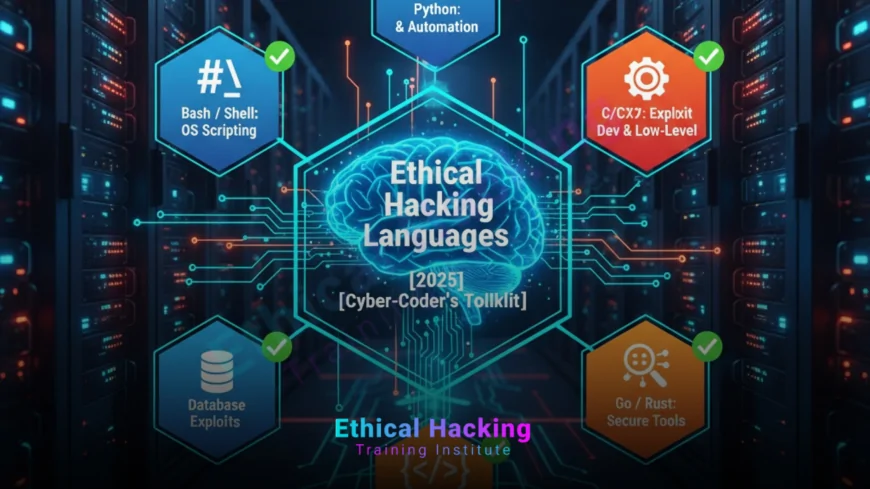
Let’s explore the most popular and effective programming languages that every ethical hacker should learn. Each language serves a specific purpose in the cybersecurity ecosystem, from web security to network penetration and malware analysis.
1. Python
Python is widely regarded as the best language for ethical hacking due to its simplicity and versatility. It is used for automation, exploit development, data analysis, and scripting penetration tests. Python’s rich library ecosystem makes it ideal for creating custom tools and malware analysis scripts. Tools like Scapy, Nmap, and Pwntools are Python-based and frequently used in the hacking community.
2. C and C++
C and C++ are essential for understanding low-level operations of operating systems, memory management, and network communications. Many security exploits and shellcodes are written in C, making it indispensable for advanced hackers. By learning C++, you can dive deeper into reverse engineering and vulnerability assessment at the system level.
To learn practical applications of these languages, you can check out courses that focus on ethical hacking and cybersecurity fundamentals.
JavaScript
JavaScript plays a crucial role in web-based ethical hacking. Since most web applications rely on JavaScript, ethical hackers use it to test and exploit vulnerabilities like cross-site scripting (XSS) and cross-site request forgery (CSRF). Understanding JavaScript helps security professionals identify insecure coding practices and design more secure web applications.
SQL
SQL (Structured Query Language) is used to communicate with databases. Knowledge of SQL is critical for identifying and preventing database-related attacks, especially SQL injection vulnerabilities. Ethical hackers use SQL to test and secure database-driven applications by performing simulated injection attacks and query manipulation.
For example, a simple SQL injection test can reveal how an attacker might bypass authentication or extract sensitive data. Many cybersecurity training platforms, including those offered by Ethical Hacking Institute and Webasha Technologies, teach real-world SQL exploitation techniques in controlled environments.
PHP
PHP is the backbone of many web servers and content management systems like WordPress. Ethical hackers who understand PHP can identify security flaws in server-side code, detect misconfigurations, and develop countermeasures. PHP knowledge also aids in securing web applications against file inclusion and session hijacking vulnerabilities.
Bash and PowerShell
When it comes to automating tasks and performing administrative operations, Bash and PowerShell are essential. Bash scripting is primarily used on Linux systems, while PowerShell is preferred in Windows environments. Ethical hackers use them to execute commands, monitor network activity, and manage system configurations.
Automation is a key part of penetration testing, and mastering these scripting languages can dramatically improve your efficiency. To explore their practical use, you might want to read about AI tools that enhance cybersecurity testing.
Ruby
Ruby is another language used in ethical hacking, particularly in the development of penetration testing frameworks. The famous Metasploit Framework is built using Ruby, making it a go-to language for creating and modifying exploit modules. Learning Ruby helps ethical hackers understand how exploits are developed and deployed.
Java
Java remains one of the most widely used languages globally, and it’s essential for understanding software vulnerabilities in enterprise-level applications. Ethical hackers use Java to analyze bytecode, detect insecure deserialization, and test Android applications for security flaws.
Comparison of Programming Languages in Ethical Hacking
| Language | Primary Use | Difficulty Level |
|---|---|---|
| Python | Automation, scripting, exploit development | Easy |
| C/C++ | System-level hacking, exploit development | Hard |
| JavaScript | Web application testing | Medium |
| SQL | Database security and injection testing | Medium |
| Ruby | Penetration testing frameworks | Medium |
How to Choose the Right Language for You
Choosing the right programming language depends on your career goals. If you want to specialize in web security, focus on JavaScript, PHP, and SQL. For network and system hacking, C, C++, and Python are more valuable. Beginners are advised to start with Python due to its simplicity and community support.
Comprehensive online courses such as those from online platforms can help you master these languages step-by-step through guided exercises and labs.
Conclusion
Programming is the key to unlocking your potential as an ethical hacker. While tools can help you get started, true mastery comes from understanding how systems and software work at their core. Learning languages like Python, C, JavaScript, and SQL gives you the ability to analyze vulnerabilities, build custom tools, and think like both a hacker and a defender.
If you’re serious about becoming an ethical hacker, consider structured learning programs offered by Ethical Hacking Institute, Cybersecurity Training Institute, and Webasha Technologies. Their hands-on courses are designed to help you transition from beginner to professional with practical knowledge and certification support.
Frequently Asked Questions (FAQs)
What is the best language for beginners in ethical hacking?
Python is the best starting point for beginners due to its readability, vast libraries, and ease of use.
Do I need to learn all programming languages to become an ethical hacker?
No, you only need to master a few based on your area of interest, such as Python, C, and JavaScript.
Can I learn ethical hacking without programming knowledge?
Basic understanding of programming is necessary to go beyond automated tools and perform deep security analysis.
Is C programming still relevant for hackers?
Yes, C remains crucial for understanding low-level exploits, memory management, and reverse engineering.
Which scripting languages are used in ethical hacking?
Bash and PowerShell are two widely used scripting languages for automating penetration testing tasks.
Why is SQL important for ethical hacking?
SQL helps identify database vulnerabilities, especially SQL injection attacks, which are among the most common threats.
Can I use Java in ethical hacking?
Yes, Java is used in analyzing enterprise applications and Android app security testing.
How long does it take to learn these languages?
It typically takes 6 months to a year to gain proficiency depending on your learning pace and practice routine.
What tools use Python in ethical hacking?
Popular tools include Nmap, Scapy, Pwntools, and custom penetration testing scripts built with Python.
Is JavaScript used for hacking websites?
Yes, JavaScript is essential for testing and exploiting web-based vulnerabilities like XSS.
Which language is best for exploit development?
C and Python are the most preferred languages for developing custom exploits.
What is Ruby used for in ethical hacking?
Ruby is mainly used for building and extending penetration testing frameworks such as Metasploit.
Can I learn ethical hacking after 12th?
Yes, many institutes offer foundational courses for students after 12th to start their cybersecurity journey.
What are some popular certifications to pursue?
CEH, OSCP, and CompTIA Security+ are among the most recognized certifications for ethical hackers.
Where can I learn ethical hacking professionally?
You can enroll in programs at Ethical Hacking Institute, Cybersecurity Training Institute, or Webasha Technologies for structured, hands-on learning.
What's Your Reaction?
 Like
0
Like
0
 Dislike
0
Dislike
0
 Love
0
Love
0
 Funny
0
Funny
0
 Angry
0
Angry
0
 Sad
0
Sad
0
 Wow
0
Wow
0