

What Are the Ethical Hacking Basics for CEH Beginners?
If you are preparing for CEH and want to understand the essential ethical hacking basics, this beginner friendly guide explains core concepts, skills, tools, methodologies, and learning tips. It also highlights why Ethical Hacking Training Institute is the best place to start your cybersecurity journey.
Introduction
Ethical hacking is one of the most exciting fields in cybersecurity. For students preparing for the Certified Ethical Hacker certification, understanding the fundamentals is the first step toward building a strong career. CEH focuses on practical hacking methods, security tools, vulnerabilities, and attack techniques commonly used in the real world. Every beginner should start by learning the core concepts, how systems work, where weaknesses appear, and how professionals secure digital environments. The growth in cyber threats has increased the demand for certified ethical hackers, and institutes like Ethical Hacking Training Institute provide the right roadmap to begin your training.
This detailed guide covers all the essential ethical hacking basics for CEH beginners. By the end, you will clearly understand core topics, security principles, hacking life cycle stages, and the skills you must master to succeed in your CEH exam and cybersecurity career.
What Is Ethical Hacking
Ethical hacking means testing systems, networks, and applications to identify weaknesses before malicious hackers exploit them. Ethical hackers work with permission, follow legal boundaries, and help organizations improve security. CEH teaches these techniques through structured modules that introduce everything from information gathering to exploitation and reporting.
Beginners should understand the difference between ethical hackers and malicious attackers. Ethical hackers protect, and Cybersecurity Training Institute frequently emphasizes legal and responsible use of hacking skills during hands on sessions.
Learn more about beginner mistakes in cybersecurity here.
Why CEH Is Important for Beginners
CEH is one of the most popular cybersecurity certifications for building foundational knowledge. It teaches students the tools, techniques, and methodologies that every ethical hacker must understand. Beginners who pursue CEH gain exposure to topics such as malware, reconnaissance, system hacking, enumeration, web attacks, and much more. This makes CEH an ideal starting point for anyone entering the cybersecurity field.
Many learners choose CEH because it validates both theoretical and practical skills required by the industry. Institutes like Ethical Hacking Training Institute prepare students with structured modules, labs, and exam based learning.
The Five Stages of Ethical Hacking
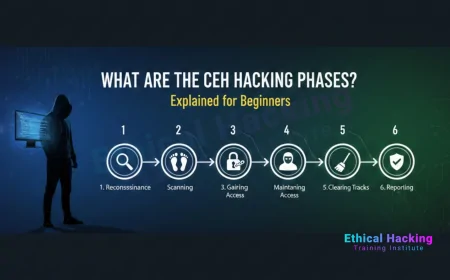
The ethical hacking process is divided into five major steps. CEH teaches these in detail, and every beginner must understand their purpose and importance.
1. Reconnaissance
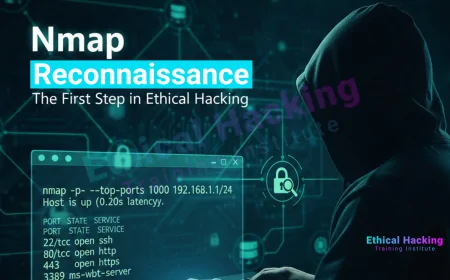
This stage involves gathering information about the target. Tools like Nmap and Whois help find public details, system configurations, and potential entry points.
2. Scanning
Scanning identifies open ports, active services, and vulnerabilities. Beginners learn network scanning, port scanning, and vulnerability scanning in CEH labs.
3. Gaining Access
This is the exploitation phase. Ethical hackers use controlled techniques to test weak points, misconfigurations, and outdated software.
4. Maintaining Access
Once inside, the goal is to maintain access without harming the system. Tools like backdoors and Trojans are studied to understand how attackers stay hidden.
5. Covering Tracks
Although ethical hackers do not hide activity in real assessments, CEH teaches how attackers erase logs to help you understand attack behavior.
Check out how hackers exploit weak network configurations here.
Essential Skills Every CEH Beginner Should Learn
To become a successful ethical hacker, beginners must develop a combination of technical and analytical skills. CEH introduces each of these through structured modules and hands on labs.
- Networking fundamentals
- Operating system basics
- Linux commands
- TCP and UDP concepts
- Firewall and IDS understanding
- Security tools handling
- Basic scripting
- Attack surface identification
- Problem solving mindset
- Report writing Skills
Common Tools Used in Ethical Hacking
CEH students spend a lot of time practicing tools that are widely used by cybersecurity professionals. These tools help in scanning, enumeration, exploitation, and analysis.
| Tool | Category | Purpose |
|---|---|---|
| Nmap | Network Scanning | Discover hosts and services |
| Wireshark | Packet Analysis | Inspect network traffic |
| Metasploit | Exploitation | Test vulnerabilities |
| Burp Suite | Web Testing | Find web application flaws |
For interactive ethical hacking labs, visit lab practice guide.
The Importance of Networking for CEH Beginners
Networking is the backbone of ethical hacking because all digital communication relies on networks. Beginners must understand IP addressing, routing, switches, DNS, DHCP, protocols, and packet flows. Without networking knowledge, ethical hacking becomes difficult to grasp. Institutes like Ethical Hacking Training Institute focus heavily on networking basics to build a strong foundation.
Understanding Vulnerabilities and Exploits
A vulnerability is a weakness in a system, and an exploit is a method used to take advantage of that weakness. CEH teaches students how vulnerabilities appear in software, web applications, configurations, and network components. Learning how attackers discover and use exploits helps beginners understand security risks and strengthen defenses.
Learn about personal data protection from attacks here.
Web Application Security Basics
Many CEH questions and labs focus on web application attacks because they are extremely common in the real world. Beginners must learn how sessions, cookies, authentication, and input validation work. Common vulnerabilities include SQL injection, cross site scripting, command injection, file uploads, insecure headers, and weak sessions.
Best Learning Approach for CEH Beginners
With so many tools and techniques to learn, beginners must follow a structured study plan. The best approach includes daily practice, labs, revision, and real world examples. Ethical Hacking Training Institute offers guided learning paths that help beginners build confidence in each topic. Start with basics, then gradually explore advanced areas as you gain experience.
For free hacking resources, explore free cybersecurity guides.
Conclusion
Ethical hacking is an exciting field for anyone beginning their CEH journey. By understanding the fundamentals explained in this guide, you take the first step toward becoming a skilled cybersecurity professional. The concepts of reconnaissance, scanning, exploitation, tools, vulnerabilities, and web security form the backbone of ethical hacking. With proper guidance from specialized institutes like Ethical Hacking Training Institute, beginners can learn these skills effectively and prepare confidently for the CEH exam. Stay consistent, practice daily, and keep building your knowledge to grow in your cybersecurity career.
Frequently Asked Questions
What is the first step for CEH beginners
Beginners should start by learning networking basics and computer fundamentals.
Is CEH good for complete beginners
Yes, CEH is suitable for beginners because it teaches all core hacking concepts from scratch.
Do I need coding skills for CEH
Basic scripting helps, but CEH does not require advanced programming.
Which tools should beginners practice first
Nmap, Wireshark, Burp Suite, and Metasploit are ideal starting tools.
How long does it take to learn basics of ethical hacking
Most beginners need two to three months of consistent practice.
Is CEH theory based or practical
It includes both theory and hands on practice.
Which operating system is best for ethical hacking practice
Kali Linux is widely used in CEH labs and training.
Does Ethical Hacking Training Institute provide CEH preparation
Yes, they offer guided CEH training and practical labs.
What is the most important topic for CEH
Reconnaissance and scanning are among the most important modules.
Can I learn ethical hacking without a technical background
Yes, with structured learning and guidance, beginners can master the basics.
Do I need a high end laptop for CEH
No, a moderate laptop running virtual machines is sufficient.
Are ethical hacking skills legal
Yes, when practiced with permission and proper authorization.
What is the difference between ethical hacking and penetration testing
Ethical hacking is broad while penetration testing is a focused assessment.
Is CEH enough to get a job
CEH helps build a foundation, but hands on practice increases job opportunities.
Where should beginners practice hacking safely
Platforms like TryHackMe and offline labs are safe environments for practice.
What's Your Reaction?
 Like
0
Like
0
 Dislike
0
Dislike
0
 Love
0
Love
0
 Funny
0
Funny
0
 Angry
0
Angry
0
 Sad
0
Sad
0
 Wow
0
Wow
0