

What Are the CEH Network Scanning Techniques?
Network scanning is a core skill for Certified Ethical Hacker candidates. This comprehensive guide explains CEH network scanning techniques from basic host discovery to advanced evasion and timing strategies. You will learn about port scanning types, TCP and UDP methods, OS detection, service and version enumeration, use of Nmap and other tools, integrating OSINT with scans, scanning workflows for penetration tests, safe lab setups, and how to interpret and report results. The guide is written so beginners can follow practical examples and best practices taught by the Ethical Hacking Training Institute to prepare for CEH theory and practical exams.
Introduction
Network scanning is the process of probing networks and hosts to discover live systems, open services, and potential vulnerabilities. In the CEH syllabus, scanning sits inside the reconnaissance and enumeration phases, and it directly feeds later exploitation steps. For aspiring ethical hackers, mastering scanning techniques helps you map targets, prioritize attack paths, and perform efficient, repeatable tests. This guide explains practical techniques used in CEH labs and real world assessments, focusing on how and when to apply each method, plus how to remain ethical and legal while testing.
Why Network Scanning Is Critical for CEH
Network scanning provides the actionable intelligence needed to plan penetration tests. Without accurate scans, you risk missing entry points or wasting time on irrelevant systems. CEH examines not only which scans exist, but also how to interpret results, avoid disruption, and document findings. Scanning teaches pattern recognition, tool usage, and the analytical mindset necessary for ethical hacking.
To avoid beginner pitfalls while practicing scans, review common errors and prevention techniques mistakes.
Core Scanning Categories
CEH covers several scanning categories. Each category serves a purpose in the reconnaissance chain. Understanding these categories helps you select the correct tool and options for any scenario.
- Host discovery, to identify live systems on a network
- Port scanning, to enumerate open ports and services
- Service and version detection, to determine what software and versions are running
- OS detection, to infer the operating system and its likely vulnerabilities
- Vulnerability scanning, to cross reference services with known CVEs
Common Port Scanning Techniques
Port scanning methods vary by stealth, speed, and reliability. CEH expects you to know several key techniques and their tradeoffs.
TCP SYN Scan (Half Open)
Also known as a SYN scan, this technique sends an initial SYN and analyzes responses. If the target replies with SYN+ACK, the port is open; if it replies with RST, the port is closed. SYN scans are fast and relatively stealthy because they do not complete the TCP handshake by default.
TCP Connect Scan
A full connect scan completes the TCP handshake using the operating system network stack. It is reliable but noisier and easier to detect by intrusion detection systems.
TCP ACK / Window / Idle Scans
ACK and other specialized scans help map firewall rules or bypass filters. For example, ACK scans can reveal whether ports are filtered by a firewall. The idle scan uses a third party "zombie" host to obscure the attacker's IP, increasing stealth.
UDP Scan
UDP scanning is inherently slower and less reliable because many UDP services do not respond. UDP scans require careful timing and often use multiple probes to infer open ports via absence of ICMP unreachable messages.
Xmas, FIN, and NULL Scans
These special TCP scans send unusual flag combinations and exploit differences in how TCP stacks respond. They can be stealthy against some systems, but modern stacks and firewalls may not react predictably.
Host Discovery Techniques
Before scanning ports, you often perform host discovery to reduce the scan surface. Common methods include:
- ICMP echo requests to check for live hosts (ping)
- ARP requests on local networks for fast discovery
- TCP SYN/ACK probes to selected ports
- DNS and SNMP queries as part of passive discovery
On switched networks, ARP discovery is generally the most accurate for local hosts, while ICMP and TCP probes are more appropriate across routed networks.
Tools for Network Scanning in CEH
CEH introduces several scanning tools. Each has strengths and specialties; choose tools based on the task and rules of engagement.
- Nmap — the foundational network scanner, supporting many scan types, OS detection, service enumeration, NSE scripts, timing options, and multiple output formats
- Masscan — very fast internet scale TCP SYN scanner suitable for wide range scans, but fewer features for service detection
- Netcat — simple read/write sockets for banner grabbing and ad hoc scanning
- Unicornscan — asynchronous scanner designed for large scale discovery
- Vulnerability scanners like OpenVAS or Nessus for correlating scan results to known vulnerabilities
- OSINT tools like DNS enumeration and Shodan to augment scanning
Practical Scanning Workflows
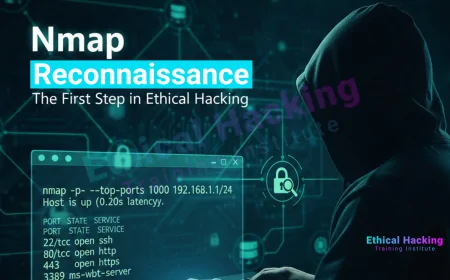
CEH emphasizes structured workflows that minimize noise and maximize useful output. A typical scanning workflow includes passive reconnaissance, host discovery, port/service enumeration, and vulnerability correlation.
Example Workflow
- Start with passive OSINT: DNS records, public services, certificates, and web footprints
- Perform host discovery to list live targets (ARP or ICMP where appropriate)
- Run targeted port scans on discovered hosts with
-sSor-sTdepending on privileges - Use version detection
-sVto identify services - Run NSE or vulnerability scans against specific services
- Document findings, map attack paths, and plan safe exploitation steps
To practice scanning in a safe environment, consider building a lab following this guide on creating virtual labs lab.
Advanced Scanning and Evasion Techniques
Advanced techniques help when you must remain less detectable or face active defenses. Use these carefully and ethically.
- Timing templates (-T0 to -T5 in Nmap) to trade speed for stealth
- Rate limiting and randomized delays to avoid IDS thresholds
- Fragmentation of packets to bypass simple packet filters
- Decoy and spoofing to obscure the true source of scans
- NSE scripts that perform focused checks instead of broad noisy scans
Note: evasion techniques may be illegal to use on unauthorized networks. In CEH labs you practice these to understand detection and defense, not to attack without permission.
Interpreting Scan Results and Correlating Data
Raw scan data must be analyzed and correlated to be useful. CEH teaches how to convert scan outputs into priorities and reports. Key steps include:
- Validate hosts and services to avoid false positives
- Cross reference service versions with vulnerability databases like NVD
- Prioritize findings by exploitability and business impact
- Use saved outputs (XML/grepable) for automated parsing and evidence
Integrating OSINT with Active Scanning
Open source intelligence improves scanning efficiency. Use public data to tailor scans and avoid noisy, unnecessary probes. Examples:
- Public DNS and WHOIS for IP ranges and subdomains
- Certificate transparency logs to find service endpoints
- Shodan searches to identify likely exposed services before scanning
When you discover network devices and routers during scans, learn how attackers exploit router weaknesses by reading this guide routers.
Safe Lab Setup and Legal Considerations
Always test in controlled environments. CEH labs are designed to teach scanning safely. To prepare:
- Use VirtualBox/VMware to construct isolated networks
- Deploy a mix of target VMs: Windows, Linux, and intentionally vulnerable appliances
- Keep clear written permission when scanning third party networks
- Document scope, time windows, and rollback plans to minimize impact
Comparison Table: Scanning Techniques Overview
| Technique | Typical Command | Strengths | Weaknesses |
|---|---|---|---|
| TCP SYN (SYN) | nmap -sS |
Fast, stealthier than full connect | May still trigger IDS |
| TCP Connect | nmap -sT |
Reliable across systems | Louder, more detectable |
| UDP Scan | nmap -sU |
Finds UDP services | Slow, many false negatives |
| Idle/Decoy/Fragment | nmap -sI |
High stealth | Complex to setup, may be unreliable |
To protect accounts and systems you discover during scans, review practical protection tips here accounts.
Conclusion
CEH network scanning techniques range from simple host discovery to complex evasion strategies. The key to success is understanding purpose, context, and impact for each method. Learn to combine OSINT with focused scans, use tools like Nmap efficiently, and always operate within legal and ethical boundaries. Practice in well designed labs, document everything, and translate scan results into prioritized remediation steps. With disciplined practice and clear reporting, scanning becomes a dependable skill in your CEH toolkit.
Frequently Asked Questions
What is the first scan I should run in CEH?
Start with host discovery, such as ARP on local segments or nmap -sn , to list live targets before port scanning.
Why use SYN scans instead of full connect scans?
SYN scans are faster and generally quieter because they avoid completing the TCP handshake, reducing logging on many systems.
Are UDP scans necessary?
Yes, UDP services are common and sometimes overlooked; however, UDP scans are slower and require careful timing to reduce false negatives.
How do I avoid triggering intrusion detection systems?
Use conservative timing templates, rate limits, selective scanning, and ensure you have written authorization to scan.
What is NSE and why is it useful?
The Nmap Scripting Engine automates checks for discovery and vulnerabilities, making scans more efficient and informative.
Can scanning crash target systems?
Aggressive scans or improper probes can cause instability; always test on authorized and isolated lab systems first.
How do I correlate scan results to vulnerabilities?
Use version detection to identify software versions, then consult vulnerability databases like NVD or CVE listings for exploitability.
When should I use Masscan?
Use Masscan for wide internet scale discovery due to its speed, then follow up with detailed Nmap scans for identified hosts.
Is OS detection always accurate?
OS fingerprinting is not foolproof; some systems obfuscate responses or use firewalls that interfere with accurate detection.
How do I save scan outputs for reporting?
Use Nmap options like -oN and -oX to save human readable and XML outputs for documentation.
What is the idle scan used for?
Idle scans use a third party "zombie" host to scan targets without revealing your IP, providing high stealth when set up correctly.
Should I scan all ports by default?
Scanning all ports can be slow; start with common ports and extend to full port ranges only when required by the scope.
How often should I run vulnerability scans?
Run scans regularly based on risk posture, such as weekly for critical assets and monthly for general infrastructure.
Can I scan IPv6 networks?
Yes, many modern tools support IPv6 scanning; ensure your toolchain and lab support IPv6 configuration.
Where can I practice these techniques safely?
Practice in isolated VMs, dedicated lab environments, or reputable cloud labs provided by training institutes and platforms designed for ethical hacking practice.
What's Your Reaction?
 Like
0
Like
0
 Dislike
0
Dislike
0
 Love
0
Love
0
 Funny
0
Funny
0
 Angry
0
Angry
0
 Sad
0
Sad
0
 Wow
0
Wow
0