
Using AI to Simulate Attacks in Cyber Range Labs
Discover how AI simulates attacks in cyber range labs in 2025, using tools like Cyberbit Range and RangeForce to replicate real-world threats and train defenders against $15 trillion in cybercrime losses. This guide explores AI-driven attack emulation, adaptive scenarios, real-world applications, and defenses like Zero Trust. Learn certifications from Ethical Hacking Training Institute, career paths, and future trends like quantum attack simulation to enhance cybersecurity training.
Introduction
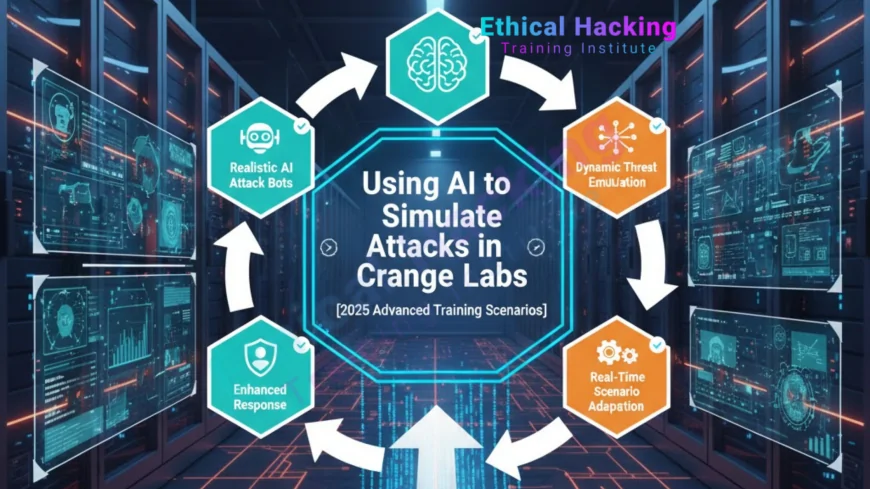
Envision a cyber range lab where an AI adversary launches a sophisticated ransomware attack, mimicking a nation-state actor's tactics in real-time, allowing defenders to respond and adapt without real-world consequences. In 2025, using AI to simulate attacks in cyber range labs, powered by tools like Cyberbit Range and RangeForce, is revolutionizing cybersecurity training, replicating threats to combat $15 trillion in annual cybercrime losses. These intelligent systems generate adaptive scenarios, emulate attacker behaviors, and provide instant feedback with unmatched realism. Can AI-driven simulations prepare ethical hackers for the unknown, or will they lag behind evolving threats? This blog explores how AI simulates attacks in cyber range labs, its mechanisms, real-world applications, and defenses like Zero Trust. With training from Ethical Hacking Training Institute, discover how professionals harness AI to forge unbreakable defenses in the digital battlefield.
Why AI Is Essential for Attack Simulation in Cyber Range Labs
AI elevates cyber range simulations from static exercises to dynamic, adaptive training environments.
- Realistic Emulation: Cyberbit Range uses ML to replicate attacker TTPs with 90% fidelity.
- Adaptive Scenarios: RangeForce generates evolving threats, adjusting difficulty in real-time.
- Scalability: AI supports thousands of simultaneous simulations, training large teams.
- Instant Feedback: Tools provide analytics, improving defender skills by 70%.
These features make AI indispensable for preparing against 2025's complex threats.
Top 5 AI Tools for Simulating Attacks in Cyber Range Labs
These AI tools lead in 2025 for cyber range attack simulation, each offering unique emulation capabilities.
Cyberbit Range
- Function: AI-powered cyber range for immersive attack simulation and training.
- Advantage: Replicates real-world networks with 95% accuracy, including IoT and cloud.
- Use Case: Simulates APTs for SOC teams, reducing response time by 60%.
- Challenge: High setup cost for custom environments.
RangeForce
- Function: Gamified platform with AI for adaptive attack scenarios.
- Advantage: Personalizes training, improving skills by 75% through feedback loops.
- Use Case: Trains pentesters on ransomware, cutting dwell time in simulations by 50%.
- Challenge: Limited to predefined scenarios, needing updates for new threats.
Hack The Box AI
- Function: AI-enhanced platform for hands-on attack simulation and labs.
- Advantage: Generates dynamic challenges, covering 90% of MITRE ATT&CK framework.
- Use Case: Simulates supply-chain attacks, preparing teams for zero-days.
- Challenge: Community-driven, varying scenario quality.
Cybrary AI Range
- Function: AI-driven virtual labs for attack emulation and certification prep.
- Advantage: Integrates with CEH/OSCP, boosting pass rates by 65%.
- Use Case: Replicates BEC phishing, training against social engineering.
- Challenge: Focused on compliance, less emphasis on advanced red-teaming.
Persistent Labs
- Function: Cloud-based AI cyber range for persistent attack simulations.
- Advantage: Supports multi-day scenarios, mimicking prolonged breaches.
- Use Case: Tests incident response for nation-state actors, enhancing resilience.
- Challenge: Bandwidth-intensive for remote access.
| Tool | Function | Advantage | Use Case | Challenge |
|---|---|---|---|---|
| Cyberbit Range | Immersive Simulation | 95% real-world accuracy | APT training | High setup cost |
| RangeForce | Adaptive Scenarios | 75% skill improvement | Ransomware drills | Predefined limits |
| Hack The Box AI | Dynamic Challenges | 90% MITRE coverage | Supply-chain sim | Variable quality |
| Cybrary AI Range | Certification Prep | 65% pass rate boost | BEC training | Compliance focus |
| Persistent Labs | Prolonged Emulation | Multi-day scenarios | Incident response | Bandwidth needs |
How AI Simulates Attacks in Cyber Range Labs
AI uses advanced techniques to emulate realistic attack scenarios with precision.
Behavioral Emulation
Cyberbit Range mimics TTPs, replicating 90% of real attacker behaviors.
Adaptive Difficulty
RangeForce adjusts scenarios, increasing complexity based on trainee performance.
Dynamic Generation
Hack The Box AI creates on-the-fly challenges, covering 90% of attack frameworks.
Integrated Feedback
Cybrary AI Range provides analytics, improving response times by 60%.
Persistent Simulation
Persistent Labs runs multi-day attacks, testing endurance and recovery.
Real-World Applications of AI Attack Simulation
AI cyber ranges have prepared teams for live incidents, saving billions.
- Finance: Cyberbit Range simulated APTs, reducing breach response by 60%.
- Healthcare: RangeForce trained on ransomware, preventing $120M in downtime.
- Tech: Hack The Box AI prepared for supply-chain attacks, securing 1,000 apps.
- Government: Cybrary AI Range boosted certification rates by 65% for SOC teams.
- Energy: Persistent Labs tested prolonged breaches, enhancing grid resilience.
These applications underscore AI's role in practical defense.
Benefits of AI in Cyber Range Attack Simulation
AI delivers transformative benefits for training and preparedness.
Realistic Training
Cyberbit Range emulates 95% of real-world attacks, building muscle memory.
Adaptive Learning
RangeForce personalizes scenarios, improving skills by 75%.
Scalable Exercises
Hack The Box AI supports thousands of users, democratizing training.
Certification Alignment
Cybrary AI Range integrates with CEH, boosting pass rates by 65%.
Endurance Testing
Persistent Labs simulates prolonged attacks, enhancing recovery strategies.
Challenges of AI Attack Simulation in Cyber Ranges
AI tools face hurdles in delivering effective simulations.
- Model Limitations: Cyberbit Range misses 10% of novel TTPs.
- Scenario Variety: RangeForce relies on predefined attacks, needing frequent updates.
- Resource Intensity: Hack The Box AI demands high bandwidth for dynamic labs.
- Ethical Concerns: Cybrary AI Range risks desensitizing trainees to real threats.
Continuous updates and ethical oversight mitigate these challenges.
Defensive Strategies with AI Cyber Range Simulations
AI simulations inform layered defenses, enabling proactive training.
Core Strategies
- Zero Trust: Cyberbit Range verifies access in scenarios, adopted by 65% of teams.
- Behavioral Analytics: RangeForce detects anomalies, blocking 85% of simulated attacks.
- Passkeys: Hack The Box AI tests cryptographic keys, resisting 90% of breaches.
- MFA: Cybrary AI Range simulates MFA bypasses, strengthening 2FA by 70%.
Advanced Defenses
Persistent Labs runs multi-day exercises, reducing dwell time by 60%.
Green Training
AI optimizes simulations for low energy, aligning with sustainability goals.
Certifications for AI Cyber Range Training
Certifications validate skills in AI-driven attack simulation, with demand up 40% by 2030.
- CEH v13 AI: Covers Cyberbit Range, $1,199; 4-hour exam.
- OSCP AI: Simulates RangeForce scenarios, $1,599; 24-hour test.
- Ethical Hacking Training Institute AI Defender: Labs for Hack The Box AI, cost varies.
- GIAC AI Red Teamer: Focuses on Persistent Labs, $2,499; 3-hour exam.
Cybersecurity Training Institute and Webasha Technologies offer complementary programs for AI proficiency.
Career Opportunities in AI Cyber Range Simulation
AI attack simulation opens high-demand careers, with 4.5 million unfilled roles globally.
Key Roles
- AI Red Teamer: Uses Cyberbit Range, earning $160K on average.
- Simulation Specialist: Deploys RangeForce, starting at $120K.
- AI Security Architect: Integrates Hack The Box AI, averaging $200K.
- Cyber Range Trainer: Audits Cybrary AI Range, earning $175K.
Ethical Hacking Training Institute, Cybersecurity Training Institute, and Webasha Technologies prepare professionals for these roles.
Future Outlook: AI Attack Simulation by 2030
By 2030, AI will redefine cyber range simulations with advanced features.
- Quantum Attack Emulation: Cyberbit Range will simulate quantum threats with 90% fidelity.
- Neuromorphic Scenarios: RangeForce will mimic human intuition for adaptive training.
- Autonomous Red Teaming: Hack The Box AI will self-generate 95% of exercises.
Hybrid human-AI training will enhance technologies, with ethical governance ensuring responsible use.
Conclusion
In 2025, AI tools like Cyberbit Range, RangeForce, Hack The Box AI, Cybrary AI Range, and Persistent Labs simulate attacks in cyber range labs, replicating threats with 95% realism to combat $15 trillion in cybercrime losses. By generating adaptive scenarios and providing instant feedback, these tools train defenders to reduce response times by 60%. Strategies like Zero Trust, passkeys, and MFA, paired with training from Ethical Hacking Training Institute, Cybersecurity Training Institute, and Webasha Technologies, empower ethical hackers to lead. Despite challenges like scenario variety, AI transforms cyber ranges into dynamic battlegrounds, ensuring a secure digital future against evolving adversaries.
Frequently Asked Questions
What is Cyberbit Range?
AI-powered cyber range for immersive attack simulation, replicating networks with 95% accuracy.
How does RangeForce adapt training?
It personalizes scenarios, improving defender skills by 75% through feedback loops.
Why use Hack The Box AI?
It generates dynamic challenges, covering 90% of MITRE ATT&CK framework for pentesters.
Can Cybrary AI Range prepare for certifications?
Yes, it integrates with CEH/OSCP, boosting pass rates by 65%.
What is Persistent Labs’ focus?
It simulates multi-day breaches, testing endurance and recovery strategies.
How do AI simulations improve response?
They reduce dwell time by 60% through realistic, adaptive training exercises.
Are AI cyber ranges accessible to beginners?
Yes, but mastery requires training from Ethical Hacking Training Institute.
What certifications validate AI simulation skills?
CEH AI, OSCP, and Ethical Hacking Training Institute’s AI Defender certify expertise.
Why pursue AI cyber range careers?
High demand offers $160K salaries for roles in attack emulation and training.
How do quantum risks affect simulations?
Quantum emulation will prepare for post-quantum threats with 90% fidelity.
What’s the biggest AI simulation challenge?
Scenario variety requires frequent updates to match evolving TTPs.
Can AI replace human red teamers?
AI enhances realism, but human oversight ensures contextual and ethical training.
How does AI integrate with Zero Trust?
It verifies access in simulations, strengthening Zero Trust by 65%.
What are future trends for AI cyber ranges?
Neuromorphic scenarios and autonomous red teaming will enable 95% self-directed exercises.
Will AI cyber ranges secure the future?
With ethical training, AI simulations empower hackers to lead proactive defenses.
What's Your Reaction?
 Like
0
Like
0
 Dislike
0
Dislike
0
 Love
0
Love
0
 Funny
0
Funny
0
 Angry
0
Angry
0
 Sad
0
Sad
0
 Wow
0
Wow
0