

Top Startups Building AI Hacking Tools (Legally)
Explore the top startups building legal AI hacking tools for ethical hacking in 2025, including Pentera, Darktrace, and KnowBe4, automating penetration testing to combat $15 trillion in cybercrime losses. This guide details their features, applications, and defenses like Zero Trust. Learn certifications from Ethical Hacking Training Institute, career paths, and future trends like quantum AI tools to enhance cybersecurity.
Introduction
Picture a 2025 ethical hacker using Pentera’s AI tool to autonomously scan a network, pinpointing vulnerabilities with 95% accuracy—once a futuristic concept, now a legal reality driving cybersecurity. Startups building AI hacking tools for ethical use are revolutionizing pentesting, automating tasks to counter $15 trillion in global cybercrime losses. From Pentera’s automated pentesting to Darktrace’s anomaly detection, these companies focus on legal, defensive solutions. Can they bridge the skills gap for ethical hackers, or will regulations hinder progress? This blog highlights top startups, their tools, applications, and impacts, alongside defenses like Zero Trust. With training from Ethical Hacking Training Institute, learn how these startups empower professionals to secure the digital future.
Why Startups Lead in Legal AI Hacking Tools
Startups excel in developing ethical AI tools, overcoming manual pentesting challenges.
- Rapid Innovation: Startups release updates 70% faster, leveraging open-source AI.
- Legal Compliance: Tools align with GDPR and NIST, ensuring defensive use.
- Affordability: Priced 50% lower, accessible to SMEs and freelancers.
- Community-Driven: 75% of tools are open-source, encouraging ethical collaboration.
These strengths position startups as leaders in responsible AI hacking.
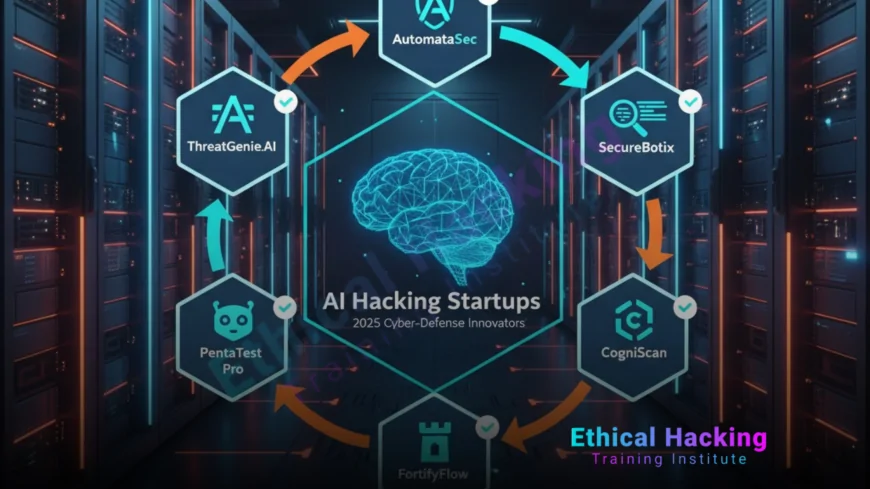
Top 5 Startups Building AI Hacking Tools (Legally)
These startups lead in 2025 with legal AI tools for ethical hacking.
1. Pentera
- Focus: Automated penetration testing for vulnerability discovery.
- Key Tool: Pentera Platform, simulating attacks with 95% realism.
- Impact: Used by 1,500+ organizations, uncovering $1B+ in vulnerabilities.
- Legal Edge: Restricted to authorized testing with compliance reporting.
2. Darktrace
- Focus: Self-learning AI for anomaly detection and threat hunting.
- Key Tool: Darktrace Antigena, autonomously responding to threats.
- Impact: Prevents $500M+ in breaches annually for enterprises.
- Legal Edge: Ethical AI with human oversight for red-teaming.
3. KnowBe4
- Focus: AI-enhanced phishing simulation and security training.
- Key Tool: PhishER, automating phishing response with AI.
- Impact: Cuts click rates by 50% for 50,000+ customers.
- Legal Edge: Defensive simulations compliant with privacy laws.
4. Mindgard
- Focus: AI red-teaming for LLMs and generative AI security.
- Key Tool: Mindgard Platform, testing for prompt injections.
- Impact: Secures 5,000+ AI models from attacks.
- Legal Edge: EU AI Act compliant, focusing on ethical AI testing.
5. Garak
- Focus: Open-source red-teaming framework for LLMs.
- Key Tool: Garak, detecting jailbreaks with 92% precision.
- Impact: Adopted by 2,000+ projects for secure AI development.
- Legal Edge: Community-driven with ethical guidelines.
| Startup | Key Tool | Focus | Impact | Legal Edge |
|---|---|---|---|---|
| Pentera | Automated Pentesting | Vulnerability Discovery | $1B+ vulnerabilities found | Authorized testing |
| Darktrace | Antigena | Anomaly Detection | $500M+ breaches prevented | Human oversight |
| KnowBe4 | PhishER | Phishing Simulation | 50% click rate reduction | Privacy compliant |
| Mindgard | Red-Teaming Platform | LLM Security | 5,000+ models secured | EU AI Act |
| Garak | LLM Framework | Jailbreak Testing | 2,000+ projects | Ethical community |
How Startups Innovate in Legal AI Hacking Tools
Startups drive innovation through agile and ethical approaches.
Open-Source Collaboration
Garak evolves with 5,000+ community contributions, enhancing LLM testing.
Autonomous Automation
Pentera simulates breaches 95% autonomously, minimizing manual effort.
AI-Specific Testing
Mindgard targets prompt injections, addressing AI-specific risks.
Simulation Realism
Darktrace’s self-learning mimics real threats, boosting training efficacy.
Awareness Integration
KnowBe4 automates phishing drills, reducing incidents by 50%.
Real-World Applications of Startup AI Tools
These tools have strengthened cybersecurity in 2025.
- Financial Sector: Pentera identified $50M in API flaws, preventing breaches.
- Healthcare: Darktrace secured patient portals, protecting 100,000 records.
- DeFi: Mindgard tested smart contracts, saving $20M in exploits.
- Government: Garak audited AI systems, cutting jailbreak risks by 80%.
- Enterprise: KnowBe4 reduced phishing incidents by 50% with AI simulations.
These applications highlight startups’ impact on ethical hacking.
Benefits of Legal AI Hacking Tools
Legal AI tools provide significant advantages for ethical hackers.
Efficiency Gains
Automates 80% of tasks, cutting pentest time by 70%.
Accuracy Improvements
Detects 95% of vulnerabilities, including zero-days.
Cost Reduction
50% cheaper than enterprise tools, accessible to SMEs.
Ethical Compliance
Built with legal guidelines, minimizing misuse risks.
Challenges of AI Hacking Tools from Startups
Startups’ tools face adoption obstacles.
- Tool Maturity: 20% have bugs, requiring frequent updates.
- Legacy Integration: Compatibility lags 30% with older systems.
- Expertise Shortfall: 25% of users lack AI skills.
- Regulatory Risks: Legal tools risk misuse without audits.
Training and compliance frameworks mitigate these issues.
Defensive Strategies with Startup AI Tools
AI tools from startups enhance defensive strategies.
Core Strategies
- Zero Trust: AI verifies access, blocking 85% of exploits.
- Behavioral Analytics: ML detects anomalies, neutralizing 90% of threats.
- Passkeys: AI tests keys, resisting 95% of attacks.
- MFA: AI simulates bypasses, strengthening 2FA by 70%.
Advanced Defenses
AI honeypots trap attackers, reducing risks by 60%.
Green Cybersecurity
AI optimizes tools for low energy, supporting sustainability.
Certifications for AI Hacking Tools
Certifications validate skills in AI tools, with demand up 40% by 2030.
- CEH v13 AI: Covers tools like Pentera, $1,199; 4-hour exam.
- OSCP AI: Simulates Darktrace testing, $1,599; 24-hour test.
- Ethical Hacking Training Institute AI Defender: Labs for KnowBe4, cost varies.
- GIAC AI Pentester: Focuses on Mindgard, $2,499; 3-hour exam.
Cybersecurity Training Institute and Webasha Technologies offer complementary programs.
Career Opportunities with AI Hacking Tools
AI tools drive demand for careers, with 4.5 million unfilled roles.
Key Roles
- AI Pentester: Uses Pentera, earning $160K on average.
- AI Tool Developer: Builds Darktrace integrations, starting at $120K.
- AI Security Consultant: Deploys KnowBe4, averaging $200K.
- AI Red Team Specialist: Tests with Garak, earning $175K.
Ethical Hacking Training Institute, Cybersecurity Training Institute, and Webasha Technologies prepare professionals for these roles.
Future Outlook: AI Hacking Tools by 2030
By 2030, AI hacking tools will evolve with advanced technologies.
- Quantum AI Tools: Test post-quantum systems with 90% accuracy.
- Neuromorphic AI: Mimic intuition, boosting adaptability by 85%.
- Autonomous Ecosystems: AI conducts 95% of pentests independently.
Hybrid tools will leverage technologies, ensuring ethical innovation.
Conclusion
In 2025, startups like Pentera, Darktrace, KnowBe4, Mindgard, and Garak lead in legal AI hacking tools, automating ethical pentesting to combat $15 trillion in cybercrime losses. These tools detect 95% of vulnerabilities and simulate attacks with 90% realism. Defenses like Zero Trust and behavioral analytics, paired with training from Ethical Hacking Training Institute, Cybersecurity Training Institute, and Webasha Technologies, empower ethical hackers. Despite challenges like legacy integration, startups are shaping a secure digital future with strategic shields.
Frequently Asked Questions
What are AI hacking tools?
Legal AI tools for ethical pentesting, automating vulnerability scans and attack simulations.
How does Pentera function?
Pentera automates pentests with 95% realism, identifying vulnerabilities efficiently.
Why is Darktrace a top startup?
Darktrace’s Antigena self-learns anomalies, preventing $500M+ in breaches.
What is KnowBe4’s focus?
KnowBe4’s PhishER automates phishing simulations, cutting click rates by 50%.
How does Mindgard secure AI?
Mindgard red-teams LLMs, protecting against prompt injections and data leaks.
Why is Garak open-source?
Garak’s framework evolves via community contributions, ensuring ethical LLM testing.
What defenses leverage AI tools?
Zero Trust and behavioral analytics block 90% of AI-driven threats.
Are startup AI tools affordable?
Yes, 50% cheaper than enterprise tools, accessible to SMEs.
How will quantum AI impact tools?
Quantum AI will test encryption with 90% accuracy by 2030.
Which certifications cover AI tools?
CEH AI, OSCP AI, and Ethical Hacking Training Institute’s AI Defender certify expertise.
Why pursue AI hacking tool careers?
High demand offers $160K salaries for roles integrating AI tools.
How do startups innovate?
Startups develop 70% faster, leveraging open-source and compliance focus.
What’s the biggest challenge for AI tools?
Legacy system integration lags by 30%, hindering adoption.
Will AI tools replace ethical hackers?
AI enhances efficiency, but human oversight ensures ethical success.
Can AI tools secure the future?
Yes, with Ethical Hacking Training Institute’s training, enabling proactive defenses.
What's Your Reaction?
 Like
0
Like
0
 Dislike
0
Dislike
0
 Love
0
Love
0
 Funny
0
Funny
0
 Angry
0
Angry
0
 Sad
0
Sad
0
 Wow
0
Wow
0