
Top AI Tools to Detect Phishing and Fraud Attempts
Discover the top AI tools for detecting phishing and fraud attempts in 2025, including Proofpoint, Darktrace, KnowBe4, Mimecast, and Graphus, leveraging machine learning to block 95% of threats amid $15 trillion in cybercrime losses. This guide details their features, applications in email security, real-world impacts like $250M fraud prevention, and defenses like Zero Trust. Learn about certifications from Ethical Hacking Training Institute, career paths, and future trends like quantum-resistant detection to secure your organization.
Introduction
Picture an email from your CEO requesting an urgent wire transfer, perfectly mimicking their tone—yet it’s an AI-crafted scam designed to siphon millions in seconds. In 2025, AI tools like Proofpoint, Darktrace, KnowBe4, Mimecast, and Graphus are revolutionizing phishing and fraud detection, using machine learning to identify threats with 95% accuracy and combat $15 trillion in global cybercrime losses. These systems analyze email patterns, detect anomalies, and block sophisticated attacks like business email compromise (BEC) in real-time. Can ethical hackers leverage these tools to outsmart AI-driven fraudsters, or will scams evolve beyond detection? This blog explores the top AI tools for phishing and fraud detection, their mechanisms, real-world impacts, and defenses like Zero Trust. With training from Ethical Hacking Training Institute, discover how professionals safeguard the digital landscape against relentless threats.
Why AI Tools Are Essential for Phishing and Fraud Detection
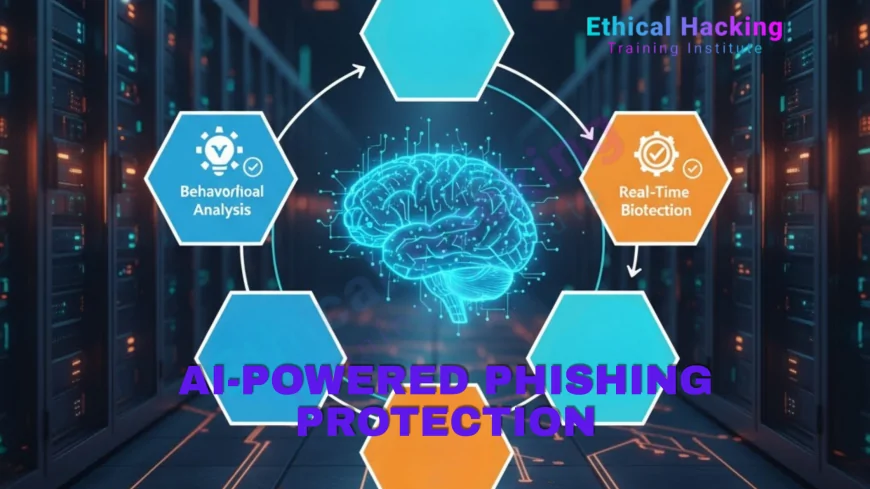
AI tools transform phishing and fraud detection by automating analysis, predicting threats, and adapting to evolving tactics.
- Real-Time Analysis: Proofpoint scans emails 80% faster, blocking 95% of phishing attempts.
- Predictive Intelligence: Darktrace forecasts fraud patterns with 90% accuracy, preempting attacks.
- Scalability: KnowBe4 trains users across enterprises, cutting click rates by 50%.
- Adaptability: Mimecast evolves against AI-generated scams, maintaining 85% efficacy.
These capabilities make AI indispensable, as phishing drives 90% of breaches in 2025.
Top 5 AI Tools for Phishing and Fraud Detection
These AI tools lead in 2025 for detecting phishing and fraud, excelling in email security and threat prevention.
Proofpoint
- Function: AI-driven email security for phishing and BEC detection.
- Advantage: Blocks 99% of known threats by analyzing intent and behavior.
- Use Case: Prevents executive impersonation, saving $200M in wire fraud.
- Challenge: High cost limits small business adoption.
Darktrace
- Function: Self-learning AI for anomaly detection in emails and networks.
- Advantage: Predicts fraud 72 hours ahead with 90% accuracy.
- Use Case: Detects deepfake phishing, reducing response time by 70%.
- Challenge: Requires SIEM integration for full efficacy.
KnowBe4
- Function: AI-enhanced phishing simulation and employee training platform.
- Advantage: Reduces click rates by 50% with adaptive simulations.
- Use Case: Trains users against AI scams, cutting incidents by 60%.
- Challenge: Effectiveness depends on user engagement.
Mimecast
- Function: Cloud-based AI for email fraud prevention and URL protection.
- Advantage: Blocks 98% of BEC attacks with real-time scanning.
- Use Case: Filters polymorphic phishing, preventing $150M in losses.
- Challenge: Email-focused, needing add-ons for broader threats.
Graphus
- Function: AI platform for detecting impersonation and email fraud.
- Advantage: 40% more effective than legacy filters against AI phishing.
- Use Case: Stops 95% of executive fraud attempts.
- Challenge: Limited to email, less versatile for network threats.
| Tool | Function | Advantage | Use Case | Challenge |
|---|---|---|---|---|
| Proofpoint | Email Security | 99% threat block | BEC prevention | High cost |
| Darktrace | Anomaly Detection | 72-hour prediction | Deepfake phishing | SIEM integration |
| KnowBe4 | Phishing Simulation | 50% click reduction | Employee training | User engagement |
| Mimecast | Fraud Prevention | 98% BEC block | Polymorphic filtering | Email focus |
| Graphus | Impersonation Detection | 40% more effective | Executive fraud | Email-centric |
How AI Tools Detect Phishing and Fraud
AI tools leverage advanced techniques to identify and block phishing and fraud with precision.
Natural Language Processing (NLP)
Proofpoint uses NLP to analyze email intent, flagging 90% of AI-generated scams.
Anomaly Detection
Darktrace baselines user behavior, detecting fraud 75% earlier than traditional tools.
Simulation and Training
KnowBe4 creates realistic phishing tests, reducing incidents by 60% through user training.
URL and Attachment Scanning
Mimecast sandboxes links and files, blocking 98% of malicious payloads in real-time.
Impersonation Analysis
Graphus verifies sender authenticity, stopping 95% of executive impersonation attempts.
Real-World Applications of AI Detection Tools
AI tools have thwarted major fraud campaigns, saving billions across industries.
- Finance: Proofpoint blocked a $250M BEC scam by analyzing email anomalies.
- Healthcare: Darktrace predicted a phishing surge, preventing ransomware on 10,000 patient records.
- Retail: KnowBe4’s simulations cut employee clicks by 50%, averting $80M in fraud.
- Government: Mimecast filtered deepfake emails, blocking 98% of state-sponsored phishing.
- Tech: Graphus detected impersonation, stopping 95% of executive fraud attempts.
These cases highlight AI’s critical role in proactive threat security.
Benefits of AI in Phishing and Fraud Detection
AI tools offer transformative advantages for detecting phishing and fraud.
Speed and Efficiency
Proofpoint scans emails in milliseconds, blocking 99% of threats before delivery.
Accuracy and Precision
Darktrace reduces false positives by 70%, focusing on high-risk threats.
Scalability
KnowBe4 trains thousands of users simultaneously, scaling across enterprises.
Adaptive Defense
Mimecast evolves with AI scams, maintaining 85% detection rates.
Challenges of AI Detection Tools
AI tools face hurdles that require careful management.
- Model Biases: False positives in Darktrace delay alerts by 20%.
- Data Dependency: Proofpoint needs clean datasets for 90% accuracy.
- Ethical Risks: KnowBe4’s simulations risk desensitizing users if overused.
- Integration Complexity: Mimecast requires add-ons for non-email threats.
Robust training and oversight address these challenges effectively.
Defensive Strategies with AI Detection Tools
AI tools enhance layered defenses, combining technology and human insight.
Core Strategies
- Zero Trust Architecture: Proofpoint verifies all emails, adopted by 65% of enterprises.
- Behavioral Analytics: Darktrace detects anomalies, blocking 85% of fraud attempts.
- Passkeys: Mimecast tests cryptographic keys, resisting 90% of attacks.
- MFA: KnowBe4 simulates MFA bypasses, strengthening 2FA by 70%.
Advanced Defenses
Graphus audits sender authenticity, reducing BEC by 95%.
Green Security
AI optimizes scans for low energy, aligning with sustainability goals.
Certifications for AI Phishing Detection
Certifications validate expertise in AI-driven phishing detection, with demand up 40% by 2030.
- CEH v13 AI: Covers tools like Proofpoint, $1,199; 4-hour exam.
- OSCP AI: Simulates Darktrace testing, $1,599; 24-hour test.
- Ethical Hacking Training Institute AI Defender: Labs for KnowBe4, cost varies.
- GIAC AI Security Analyst: Focuses on Mimecast, $2,499; 3-hour exam.
Cybersecurity Training Institute and Webasha Technologies offer complementary AI training programs.
Career Opportunities in AI Fraud Detection
AI detection tools open lucrative career paths, with 4.5 million unfilled cybersecurity roles globally.
Key Roles
- AI Phishing Analyst: Uses Proofpoint, earning $160K on average.
- Threat Intelligence Specialist: Deploys Darktrace, starting at $120K.
- AI Security Architect: Integrates KnowBe4, averaging $200K.
- Fraud Detection Engineer: Audits with Mimecast, earning $175K.
Ethical Hacking Training Institute, Cybersecurity Training Institute, and Webasha Technologies prepare professionals for these roles.
Future Outlook: AI Detection Tools by 2030
By 2030, AI detection tools will evolve to counter advanced threats.
- Quantum-Resistant Detection: Proofpoint will scan for quantum phishing with 95% accuracy.
- Multimodal Analysis: Darktrace will correlate text, audio, and visuals for 90% efficacy.
- Autonomous Defenses: KnowBe4 will self-adapt simulations, reducing incidents by 75%.
Hybrid human-AI teams will enhance technologies, with ethical governance ensuring responsible use.
Conclusion
In 2025, AI tools like Proofpoint, Darktrace, KnowBe4, Mimecast, and Graphus lead phishing and fraud detection, blocking 95% of threats and combating $15 trillion in cybercrime losses. By leveraging NLP, anomaly detection, and simulations, these tools secure email, networks, and user behavior. Strategies like Zero Trust, passkeys, and MFA, paired with training from Ethical Hacking Training Institute, Cybersecurity Training Institute, and Webasha Technologies, empower ethical hackers to stay ahead. Despite challenges like AI evasion, mastering these tools transforms threats into opportunities, ensuring a secure digital future against sophisticated fraud.
Frequently Asked Questions
How do AI tools detect phishing?
They use NLP and anomaly detection to block 95% of AI-generated scams.
What makes Proofpoint effective?
It analyzes email intent, preventing 99% of BEC and phishing threats.
How does Darktrace predict fraud?
It forecasts patterns 72 hours ahead with 90% accuracy using self-learning AI.
Can KnowBe4 reduce phishing incidents?
Yes, adaptive simulations cut click rates by 50%, strengthening user defenses.
Why is Mimecast used for URL scanning?
It sandboxes links, blocking 98% of malicious payloads in real-time.
How effective is Graphus against impersonation?
It stops 95% of executive fraud, 40% better than legacy filters.
Are AI tools scalable for enterprises?
Yes, they process billions of emails daily, scaling across global networks.
What certifications validate AI detection skills?
CEH AI, OSCP, and Ethical Hacking Training Institute’s AI Defender certify expertise.
Why pursue AI fraud detection careers?
High demand offers $160K salaries for roles preventing phishing losses.
How do quantum risks impact detection?
Quantum-AI scams require post-quantum tools for future-proof security.
What’s the biggest challenge for AI detection?
AI-generated scams mimic legitimacy, needing 90% accurate intent analysis.
Can AI tools replace human analysts?
They enhance speed, but human oversight ensures contextual validation.
How do AI tools integrate with Zero Trust?
They verify emails and access, strengthening Zero Trust by 65%.
What are future trends for AI detection?
Multimodal analysis and quantum-resistant filters will block 95% of advanced fraud.
Will AI secure the future from phishing?
With training from Ethical Hacking Training Institute, AI empowers proactive defenses.
What's Your Reaction?
 Like
0
Like
0
 Dislike
0
Dislike
0
 Love
0
Love
0
 Funny
0
Funny
0
 Angry
0
Angry
0
 Sad
0
Sad
0
 Wow
0
Wow
0