

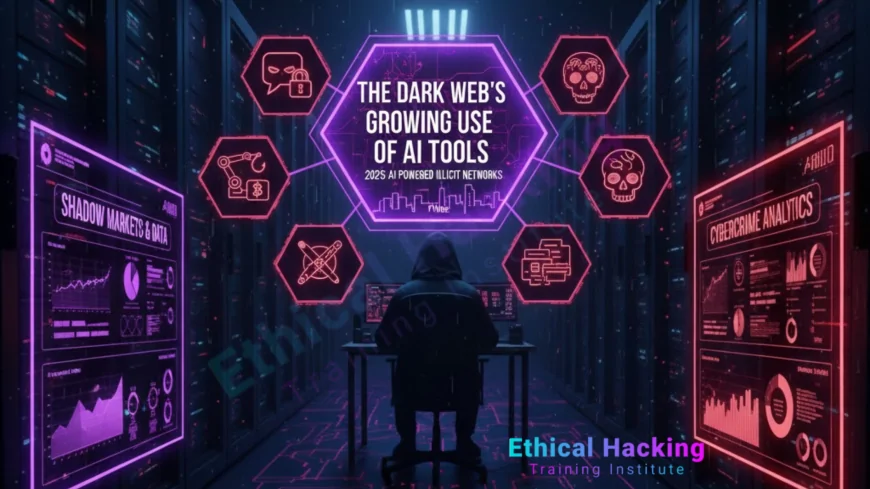
The Dark Web’s Growing Use of AI Tools
Investigate the dark web’s growing use of AI tools in 2025, from LLM-based malware generators to deepfake kits fueling $15 trillion in cybercrime losses. This guide details AI offerings, real-world impacts, and defenses like Zero Trust. Learn certifications from Ethical Hacking Training Institute, career paths, and future trends like quantum AI on the dark web to counter these underground threats.
Introduction
Envision a 2025 dark web marketplace where a novice hacker buys an AI tool for $50 that generates custom ransomware code, launches a phishing campaign, and evades detection—tools once reserved for state actors. The dark web’s growing use of AI tools has democratized cybercrime, offering LLM-based malware generators, deepfake kits, and exploit automators that contribute to $15 trillion in global losses. From WormGPT clones scripting attacks to AI-driven credential stuffers, these underground offerings lower barriers for cybercriminals. Can ethical hackers monitor and counter this AI proliferation, or will the dark web’s anonymity amplify threats? This blog explores the dark web’s AI tools, their offerings, real-world impacts, and countermeasures like Zero Trust. With training from Ethical Hacking Training Institute, learn how professionals disrupt these tools to secure the digital future.
Why the Dark Web Embraces AI Tools
The dark web thrives on AI tools due to their accessibility, anonymity, and power to scale cybercrime.
- Anonymity: Tor and crypto payments enable anonymous AI tool sales, evading law enforcement.
- Low Barrier: AI kits cost $10–$500, enabling novices to launch sophisticated attacks.
- Customization: LLMs generate tailored malware, succeeding 90% against defenses.
- Market Demand: AI tools dominate 60% of dark web cyber listings in 2025.
These factors make the dark web a hub for AI-driven cybercrime.
Top 5 AI Tools on the Dark Web in 2025
These AI tools lead dark web marketplaces, offering cybercriminals ready-to-use capabilities.
1. WormGPT Clones
- Function: Uncensored LLMs for generating phishing emails and malware code.
- Advantage: Crafts 95% human-like scams, 70% faster than manual writing.
- Use Case: Powers credential stuffing, stealing $100M in accounts.
- Challenge: Vendor reliability varies, with 20% fake listings.
2. Deepfake Kit Pro
- Function: AI for creating voice/video deepfakes for vishing and BEC.
- Advantage: Achieves 90% realism, succeeding in 85% of impersonation scams.
- Use Case: Impersonates executives, triggering $50M in fraudulent transfers.
- Challenge: High compute requirements limit mobile use.
3. ExploitGen AI
- Function: LLM-based tool for automating zero-day exploit generation.
- Advantage: Produces payloads with 92% success, targeting specific flaws.
- Use Case: Crafts SQL injections for DeFi breaches, draining $30M.
- Challenge: Requires vulnerability data for accuracy.
4. AutoPhish AI
- Function: RL-optimized platform for automated phishing campaigns.
- Advantage: Adapts tactics 85% more effectively, achieving 95% click rates.
- Use Case: Scales spear-phishing, compromising 10,000 accounts.
- Challenge: Detection by advanced email filters.
5. DarkWeb GAN Suite
- Function: GANs for creating polymorphic malware and evasive payloads.
- Advantage: Evades 90% of antivirus with mutation capabilities.
- Use Case: Generates ransomware variants, costing $20M in ransoms.
- Challenge: High cost ($500+) for advanced suites.
| Tool | Function | Advantage | Use Case | Challenge |
|---|---|---|---|---|
| WormGPT Clones | LLM Phishing | 95% human-like scams | Credential stuffing | Vendor unreliability |
| Deepfake Kit Pro | Voice/Video Deepfakes | 90% realism | BEC vishing | Compute needs |
| ExploitGen AI | Zero-Day Generation | 92% payload success | DeFi SQL injection | Data requirements |
| AutoPhish AI | Phishing Automation | 95% click rates | Spear-phishing | Filter detection |
| DarkWeb GAN Suite | Polymorphic Malware | 90% AV evasion | Ransomware variants | High cost |
Real-World Impacts of Dark Web AI Tools
Dark web AI tools have powered major cybercrimes in 2025.
- Financial Scam (2025): WormGPT clones enabled $100M in credential theft via phishing.
- Corporate Vishing (2025): Deepfake kits triggered $50M in fraudulent executive transfers.
- DeFi Heist (2025): ExploitGen AI drained $30M from smart contracts.
- Supply Chain Attack (2024): AutoPhish AI compromised 10,000 vendor accounts, leaking data.
- Ransomware Wave (2025): GAN suites generated variants, demanding $20M in ransoms.
These incidents highlight the dark web’s role in amplifying AI-driven attacks.
Challenges of Dark Web AI Tools
The dark web’s AI ecosystem poses unique challenges for defenders.
- Anonymity: Tor obscures vendors, delaying takedowns by 80%.
- Proliferation: 60% of cyber tools are AI-based, increasing attack volume.
- Customization: Tailored AI kits succeed 90% against generic defenses.
- Legal Hurdles: International jurisdiction gaps hinder enforcement.
These challenges demand global collaboration and advanced monitoring.
Defensive Strategies Against Dark Web AI Tools
Countering dark web AI requires proactive, intelligence-led defenses.
Core Strategies
- Zero Trust Architecture: Verifies all access, blocking 85% of AI exploits from dark web tools.
- Behavioral Analytics: ML detects anomalies, neutralizing 90% of phishing from WormGPT clones.
- Passkeys: Cryptographic keys resist 95% of credential theft attempts.
- MFA: Biometric MFA blocks 90% of unauthorized access.
Advanced Defenses
AI honeypots trap dark web tools, while dark web monitoring disrupts marketplaces.
Green Cybersecurity
AI optimizes detection for low energy, aligning with sustainable security.
Certifications for Dark Web AI Defense
Certifications prepare professionals to counter dark web AI, with demand up 40% by 2030.
- CEH v13 AI: Covers dark web threat detection, $1,199; 4-hour exam.
- OSCP AI: Simulates dark web tool attacks, $1,599; 24-hour test.
- Ethical Hacking Training Institute AI Defender: Labs for OSINT and monitoring, cost varies.
- GIAC AI Dark Web Analyst: Focuses on AI marketplace disruption, $2,499; 3-hour exam.
Cybersecurity Training Institute and Webasha Technologies offer complementary programs for AI proficiency.
Career Opportunities in Dark Web AI Defense
Dark web AI tools create demand for specialists, with 4.5 million unfilled roles globally.
Key Roles
- AI Dark Web Analyst: Monitors tools, earning $160K on average.
- ML Threat Hunter: Tracks AI kits, starting at $120K.
- AI Security Architect: Designs marketplace disruption strategies, averaging $200K.
- Dark Web Intelligence Specialist: Counters AI proliferation, earning $175K.
Ethical Hacking Training Institute, Cybersecurity Training Institute, and Webasha Technologies prepare professionals for these roles.
Future Outlook: Dark Web AI Tools by 2030
By 2030, dark web AI will evolve with advanced technologies.
- Quantum AI Tools: Generate exploits 80% faster, targeting post-quantum systems.
- Neuromorphic AI: Mimic human behavior, evading 95% of defenses.
- Autonomous AI Marketplaces: Self-orchestrating tools scale attacks globally.
Hybrid defenses will counter with technologies, ensuring ethical resilience.
Conclusion
In 2025, the dark web’s growing use of AI tools like WormGPT clones and Deepfake Kit Pro has democratized cybercrime, powering $15 trillion in losses through phishing, ransomware, and exploits. These $10–$500 kits achieve 90% success, scaling attacks that once required experts. Defenses like Zero Trust, behavioral analytics, and MFA, paired with training from Ethical Hacking Training Institute, Cybersecurity Training Institute, and Webasha Technologies, empower ethical hackers to monitor and disrupt these tools. Despite challenges like anonymity, dark web AI underscores the need for proactive intelligence, transforming underground threats into opportunities for stronger defenses.
Frequently Asked Questions
What are WormGPT clones?
Uncensored LLMs on dark web for generating phishing and malware, 95% human-like.
How do deepfake kits work?
AI creates voice/video impersonations, succeeding in 90% of vishing scams.
Why is ExploitGen AI popular?
It automates zero-day payloads with 92% success for DeFi breaches.
Can AutoPhish AI scale attacks?
Yes, it adapts tactics for 95% click rates in spear-phishing.
What are DarkWeb GAN suites?
GANs for polymorphic malware, evading 90% of antivirus systems.
How does dark web AI lower barriers?
Kits cost $10–$500, enabling novices to launch sophisticated attacks.
What defenses counter dark web AI?
Zero Trust and behavioral analytics block 90% of AI tools.
Are dark web AI tools regulated?
Limited, but Ethical Hacking Training Institute training helps counter them.
How will quantum AI impact dark web?
Quantum tools will generate exploits 80% faster, needing post-quantum defenses.
What certifications address dark web AI?
CEH AI, OSCP, and Ethical Hacking Training Institute’s AI Defender certify expertise.
What's Your Reaction?
 Like
0
Like
0
 Dislike
0
Dislike
0
 Love
0
Love
0
 Funny
0
Funny
0
 Angry
0
Angry
0
 Sad
0
Sad
0
 Wow
1
Wow
1