

How to Use Metasploit in CEH Labs?
Learn how to use Metasploit in CEH labs with simple steps, hands on examples, module explanations, exploitation phases, and guidance from the Ethical Hacking Training Institute. This complete guide helps beginners understand reconnaissance, scanning, exploitation, post exploitation, and reporting using Metasploit.
Introduction
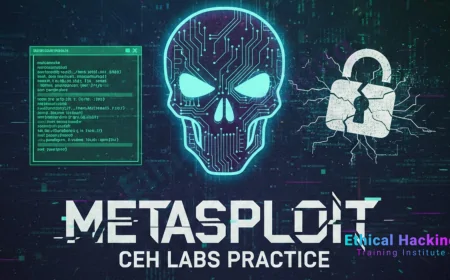
Metasploit is one of the most powerful penetration testing frameworks used by ethical hackers. In CEH labs, Metasploit is widely used for scanning, exploiting vulnerabilities, testing defenses, and validating security controls. Learning Metasploit helps you understand real world attack techniques in a safe and controlled environment.
The Ethical Hacking Training Institute teaches Metasploit in detailed step by step sessions, making it easy for beginners to practice exploitation techniques without confusion. This guide explains everything you need to know to start using Metasploit confidently in your CEH practical labs.
What Is Metasploit and Why Is It Used in CEH?
Metasploit is an open source penetration testing framework that allows ethical hackers to find and exploit security weaknesses. It includes hundreds of exploit modules, payloads, auxiliary scanners, and post exploitation tools.
CEH labs use Metasploit because it helps students practice ethical hacking in realistic environments. You learn how attackers think, how vulnerabilities work, and how to test systems safely using controlled exploit modules.
To explore different attack surfaces used by hackers, you can read more about IoT exploitation.
Understanding Metasploit Components
Before using Metasploit, you need to know how its components work. Each part has a specific purpose during exploitation. Metasploit includes modules, payloads, encoders, exploits, scanners, post modules, plugins, and sessions.
Main components include:
- Exploit modules to attack vulnerabilities
- Payloads that run after exploitation
- Auxiliary modules for scanning and information gathering
- Encoders to modify payload signatures
- Sessions created after successful exploitation
Each module plays a role in carrying out a complete penetration test. CEH labs guide you in using these modules one by one so you can understand the full lifecycle of exploitation.
Installing and Starting Metasploit for CEH Labs
Metasploit is available on Kali Linux which is used in CEH labs. You can start the framework easily from the terminal with the msfconsole command. Installation is usually preconfigured in lab environments, but you can also update the framework using msfupdate.
Once Metasploit loads, you can see the banner with the number of modules and commands. This console is the center of all Metasploit operations. You will use it to load exploits, configure targets, launch payloads, and interact with sessions.
If you want to see how professionals handle online attacks, you can check this guide on laptop protection.
Performing Reconnaissance with Metasploit
Every CEH hacking process begins with reconnaissance. Metasploit contains many auxiliary modules that help you gather information about a target. These modules do not harm the system but only collect useful data.
Common recon modules include:
- Port scanners
- Service version scanners
- SMB information gatherers
- FTP scanners
- SNMP discovery tools
CEH labs often provide vulnerable machines with specific open ports. Using recon modules helps you identify which exploit modules may work on the system.
Scanning and Identifying Vulnerabilities
Scanning helps you understand how the target is configured. Metasploit allows integration with tools like Nmap to discover open ports and running services. After scanning, you can search for common vulnerabilities associated with that service version.
Basic workflow includes:
- Scan open ports
- Identify service versions
- Search related exploit modules
- Configure exploit parameters
To learn more about weak network setups, check this guide on network exposure.
Selecting the Right Exploit Module
Once you identify a vulnerability, the next step is selecting an exploit. Metasploit contains hundreds of exploit modules for operating systems, applications, protocols, and web services. Use the search command to find an exploit related to the discovered vulnerability.
- Search for the exploit
- Load the module with use
- Check required options
- Set RHOST, RPORT, and payloads
Ethical hacking requires careful module selection. Choosing the wrong module may fail or crash the target system. CEH labs provide safe environments so you can practice module usage without causing real harm.
Configuring Payloads in Metasploit
Payloads define what happens after exploitation. These include reverse shells, command execution, Meterpreter sessions, and more. You must choose a payload that matches your target and network configuration. In most CEH scenarios, reverse TCP payloads are used.
Types of payloads include:
- Singles for simple commands
- Stagers for building connections
- Stages for advanced sessions
To explore how attackers gain access to systems, you can read about spyware threats.
Launching the Exploit
After setting all options, you can launch the exploit with the exploit or run command. If the vulnerability is present and the configuration is correct, Metasploit will create a session. Meterpreter is the most commonly used session type due to its flexibility.
During CEH labs, you will try several exploits before finding one that works. This teaches you how to troubleshoot and adjust attack parameters based on real results.
Post Exploitation in Metasploit
Post exploitation is one of the most interesting parts of Metasploit. After gaining access, you can gather information, move laterally, escalate privileges, and maintain control of the system. These steps help understand how attackers continue their operations after initial access.
Post exploitation tasks include:
- Privilege escalation
- Network pivoting
- File extraction
- System enumeration
- Clearing logs
If you want to learn more about account compromise methods, explore this article on mobile data theft.
Metasploit Commands Used in CEH Labs
CEH requires basic command usage for exploitation. These commands help you navigate Metasploit modules, configure settings, and run tasks efficiently.
| Command | Purpose |
|---|---|
| search | Find modules related to vulnerabilities |
| use | Load selected module |
| show options | List required module settings |
| set | Configure module parameters |
| exploit | Launch attack |
Reporting and Documentation
CEH places importance on reporting because ethical hackers must document every action performed during penetration testing. Metasploit allows you to collect session data, command histories, logs, and screenshots for your report. This process teaches you how to prepare professional penetration testing documentation.
Conclusion
Metasploit is one of the most important tools in CEH labs. It helps you understand vulnerabilities, exploit systems, practice post exploitation, and learn attacker techniques in a safe environment. With proper guidance from the Ethical Hacking Training Institute, you can master Metasploit even as a beginner.
To explore more learning resources, you can refer to this guide on hacking channels.
Frequently Asked Questions
Is Metasploit required for CEH?
Yes, Metasploit is an important part of CEH practical labs.
Is Metasploit difficult for beginners?
No, with guided practice from the Ethical Hacking Training Institute it becomes simple.
Can Metasploit hack any system?
Only systems with known vulnerabilities can be exploited.
Do I need programming skills for Metasploit?
No, basic command usage is enough for CEH labs.
Does CEH include Metasploit scripting?
CEH covers basic usage but not advanced scripting.
Can Metasploit cause system crashes?
Some exploits may cause instability which is why labs are used.
What is the most used payload in CEH?
The reverse TCP Meterpreter payload is most common.
Is Metasploit included in Kali?
Yes, it comes preinstalled in Kali Linux.
Can Metasploit be used for mobile testing?
Yes, but this is not fully covered in CEH.
Does CEH teach post exploitation?
Yes, CEH includes basic post exploitation tasks.
Is Metasploit free?
Yes, the community edition is free.
What is a Meterpreter session?
It is an advanced interactive shell used after exploitation.
Is Metasploit used by real hackers?
Yes, both ethical hackers and attackers use it.
Can I practice Metasploit at home?
Yes, using virtual machines and safe environments.
Where should I learn Metasploit?
The Ethical Hacking Training Institute provides complete Metasploit training.
What's Your Reaction?
 Like
0
Like
0
 Dislike
0
Dislike
0
 Love
0
Love
0
 Funny
0
Funny
0
 Angry
0
Angry
0
 Sad
0
Sad
0
 Wow
0
Wow
0