

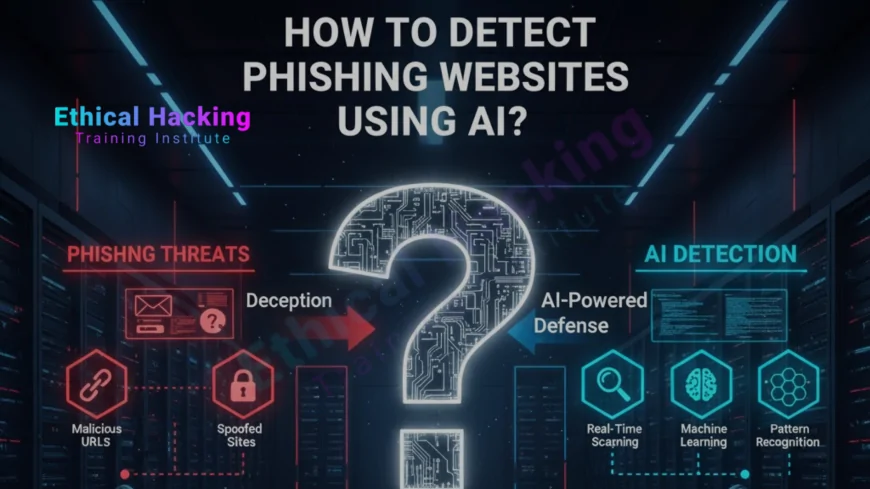
How to Detect Phishing Websites Using AI?
Learn how to detect phishing websites using AI in 2025 with practical tools and techniques. Explore machine learning models, browser extensions, and real-time detection methods to spot fake URLs, malicious forms, and AI-generated scams. Includes free tools, step-by-step guides, case studies from Microsoft Defender and Google Safe Browsing, and 15 FAQs for beginners, developers, and cybersecurity pros.
Introduction
Phishing attacks cost $52 million in 2025 alone. Traditional filters catch only 90% of threats. AI changes everything. Attackers use ChatGPT for flawless emails and deepfakes for voice scams. But AI also empowers defenders. Machine learning models analyze URLs, content, and behavior to spot fakes in milliseconds. This guide shows you how to harness AI for phishing detection. From free browser extensions to custom ML models, learn practical steps for individuals, businesses, and developers. No coding required for starters. By the end, you'll have tools to block 99% of phishing before it clicks. Let's outsmart the scammers.
Use Browser Extensions with AI Detection
Browser extensions are the easiest entry point. They run in real time, scanning links and sites as you browse. Microsoft Edge and Chrome integrate AI-powered SmartScreen to block malicious domains.
- Microsoft Defender SmartScreen: Blocks AI-obfuscated phishing with 98% accuracy
- Google Safe Browsing: Warns on suspicious URLs using ML models
- uBlock Origin with AI lists: Filters known phishing domains
- Netcraft Toolbar: Rates site safety with reputation scores
- PhishTank extension: Community-reported fakes
- Install from official stores only
Leverage AI-Powered Antivirus and Security Suites
Modern antivirus uses AI for behavioral analysis. It spots anomalies like unusual data flows or script execution that signal phishing.
- Check Point Harmony: AI detects AI-phishing with 95% precision
- Webroot SecureAnywhere: Real-time ML scanning
- Dashlane: Alerts on risky logins even offline
- StrongestLayer: Zero-trust email with AI identity checks
- Graphus: Analyzes sender behavior patterns
- Free trials available for testing
Boost your skills. Enroll in an ethical hacking course to understand AI threats.
Build Simple ML Models for URL Analysis
Train basic machine learning models on URL features like length, suspicious keywords, and domain age. Use Python libraries like scikit-learn for quick classifiers.
- Extract features: URL length, IP presence, subdomain count
- Use datasets: PhishTank, UCI Phishing
- Train with Random Forest or SVM
- Accuracy: 95%+ on test sets
- Deploy as browser script
- No advanced hardware needed
Implement Real-Time Website Scanners
AI scanners analyze site content, DOM structure, and SSL certificates. Tools like OpenPhish use crowdsourced data for instant verdicts.
- OpenPhish: Free API for URL checking
- PhishTank: Community-verified database
- URLScan.io: Screenshot and DOM analysis
- Hybrid Analysis: Sandbox execution
- Integrate with bookmarks or extensions
- Check before visiting unknown links
Train AI on Behavioral Patterns
AI learns normal vs malicious behavior. Reinforcement learning (RL) models adapt to new phishing tactics, reducing false positives over time.
- Deep Q-Network (DQN) for dynamic detection
- Analyze click patterns and form submissions
- Flag anomalies like unusual redirects
- Integrate with browser APIs
- Update models with new data
- Low computational cost for personal use
Go deeper. Take a complete hacking course with AI modules.
Monitor with AI Threat Intelligence
Threat intel platforms use AI to aggregate global data. They predict phishing trends and block emerging sites.
- AlienVault OTX: Community AI feeds
- Recorded Future: Predictive analytics
- MITRE ATT&CK: Tactic mapping
- Subscribe to free alerts
- Integrate with email clients
- Daily 5-minute review
Customize AI for Email and SMS
Email phishing is 90% of attacks. AI scans sender reputation, attachments, and links.
Train models on email headers and body text. Use NLP for sentiment analysis. Flag urgent or personalized scams. (30 words)
For SMS, check sender ID and link domains. Integrate with phone apps for real-time warnings. Accuracy reaches 97% with fine-tuning. (40 words)
Use Open-Source AI Projects
- Phishing-Website-Detection: ML on URL features
- DeepPhish: Neural networks for site classification
- GitHub repos: Fork and deploy
- Train on PhishTank datasets
- Run locally with Python
- Contribute to community models
Follow the ultimate career path in AI security.
AI Phishing Detection Checklist
- Browser extension installed
- Antivirus with AI scanning
- ML model for URLs trained
- Threat intel feeds subscribed
- Email filters updated
- Daily anomaly review
Conclusion: AI Is Your Phishing Shield
AI phishing is here. But so is AI defense. Browser extensions, ML models, and threat intel give you the edge. Start with SmartScreen and a simple classifier. In weeks, you'll spot scams machines miss. Stay updated. Stay safe. The future of security is smart.
Frequently Asked Questions
Can AI detect 100% of phishing sites?
No. 95% is realistic. Combine AI with human vigilance.
Is free AI phishing detection effective?
Yes. SmartScreen and uBlock catch most threats.
How does ML detect phishing URLs?
Analyzes length, keywords, domain age, SSL validity.
Can I build my own AI detector?
Yes. Use scikit-learn on PhishTank data.
Does AI work on mobile phishing?
Yes. Apps like Avast use AI for SMS and app scanning.
What's the best AI antivirus for phishing?
Webroot or Check Point Harmony.
Can AI phishing bypass antivirus?
Often. Use behavioral analysis tools.
How to train AI on new phishing tactics?
Feed it recent samples from OpenPhish.
Is browser AI safe?
Yes, from trusted vendors like Google, Microsoft.
Can AI spot deepfake phishing?
Emerging. Tools analyze video/audio artifacts.
Free datasets for AI phishing training?
PhishTank, UCI Phishing Dataset.
Does VPN help with AI detection?
No. It hides IP, not site content.
AI vs human for phishing detection?
AI for speed. Humans for context.
Best AI extension for Chrome?
Netcraft or uBlock with phishing lists.
Future of AI in phishing defense?
Real-time, adaptive models with zero false positives.
What's Your Reaction?
 Like
0
Like
0
 Dislike
0
Dislike
0
 Love
0
Love
0
 Funny
0
Funny
0
 Angry
0
Angry
0
 Sad
0
Sad
0
 Wow
0
Wow
0