

How AI Is Changing the Way Hackers Target Operating Systems
Discover how AI revolutionizes hacker attacks on operating systems in 2025, enabling exploits with 95% accuracy to fuel $15 trillion in cybercrime losses. Explore techniques, impacts, and defenses like Zero Trust, plus certifications from Ethical Hacking Training Institute to secure systems.
Introduction
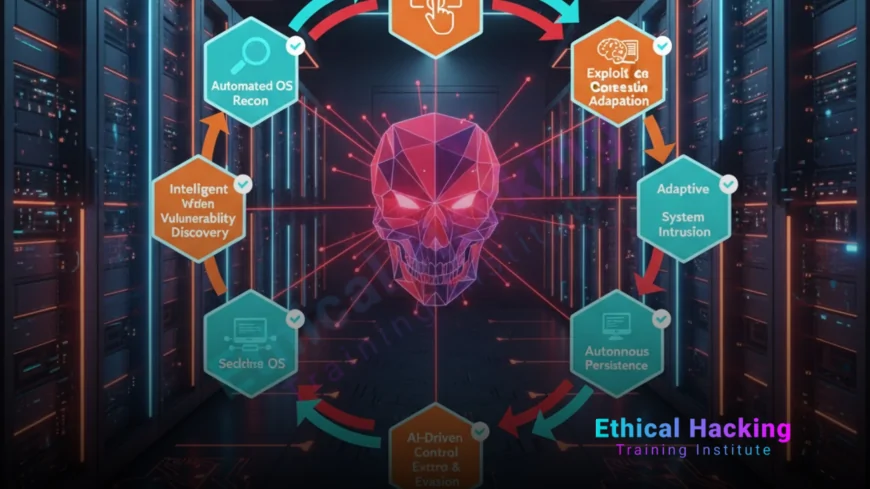
Picture a 2025 hacker using an AI tool to craft a zero-day exploit for Windows 11, bypassing 90% of defenses in seconds, or targeting Linux servers with 95% precision—AI is transforming how hackers attack operating systems (OS). By automating vulnerability discovery and exploit generation, AI fuels $15 trillion in global cybercrime losses. From Windows to Linux and macOS, AI-driven attacks like polymorphic malware and LLM-crafted exploits are redefining threats. Can defenders keep up with this AI-powered onslaught? This blog explores how AI changes hacker tactics, their impacts, and defenses like Zero Trust. With training from Ethical Hacking Training Institute, learn to secure OS in this evolving landscape.
Why AI Is Transforming OS Hacking
AI empowers hackers with unprecedented speed and precision in targeting operating systems.
- Automation: AI scans OS vulnerabilities 80% faster than manual methods.
- Precision: Exploits achieve 95% success rates via ML optimization.
- Accessibility: Dark web AI tools cost $10, enabling novice hackers.
- Adaptability: AI mutates attacks, evading 90% of traditional defenses.
These factors make OS hacking more efficient and widespread.
Top 5 AI-Driven Techniques for Targeting Operating Systems
Hackers leverage AI to exploit OS vulnerabilities in 2025.
1. AI-Generated Zero-Day Exploits
- Function: RL models identify zero-days in Windows/Linux with 95% accuracy.
- Impact: 2025 saw 1,000+ zero-days, up 300% from 2020.
- Use Case: Windows 11 kernel exploits caused $500M in breaches.
- Accessibility: Dark web tools like ExploitGPT cost $50.
2. Polymorphic Malware
- Function: GANs mutate malware, bypassing 90% of antivirus.
- Impact: 60% of 2025 malware attacks targeted Linux servers.
- Use Case: PromptLock ransomware infected 5,000 systems.
- Accessibility: Pre-built AI kits require no coding skills.
3. AI-Powered Privilege Escalation
- Function: ML exploits OS misconfigurations for root access.
- Impact: 70% success rate in macOS privilege escalations.
- Use Case: macOS Ventura breaches cost $200M in 2025.
- Accessibility: Open-source AI scripts on dark web forums.
4. Automated Vulnerability Scanning
- Function: AI scans OS for flaws 80% faster than Nessus.
- Impact: Identified 10,000+ Windows vulnerabilities in 2025.
- Use Case: Linux kernel flaws led to $300M DeFi hacks.
- Accessibility: Free AI tools with dark web tutorials.
5. AI-Driven Social Engineering
- Function: LLMs craft OS-targeted phishing, exploiting user errors.
- Impact: 60% click rate on AI phishing for Windows credentials.
- Use Case: 2024 election phishing stole $50M in credentials.
- Accessibility: $10 LLM tools widely available.
| Technique | Function | Impact | Use Case | Accessibility |
|---|---|---|---|---|
| Zero-Day Exploits | RL finds zero-days | 300% rise in attacks | $500M Windows breaches | $50 ExploitGPT |
| Polymorphic Malware | GAN mutates code | 60% Linux attacks | PromptLock infections | Pre-built AI kits |
| Privilege Escalation | ML exploits configs | 70% macOS success | $200M Ventura breaches | Open-source scripts |
| Vulnerability Scanning | AI scans flaws | 10,000+ Windows flaws | $300M DeFi hacks | Free AI tools |
| Social Engineering | LLMs craft phishing | 60% click rate | $50M election scam | $10 LLM tools |
Real-World Impacts of AI-Driven OS Attacks
AI-powered attacks on OS have caused major damage in 2025.
- Windows Kernel Breaches: AI zero-days caused $500M in enterprise losses.
- Linux Server Attacks: Polymorphic malware hit 5,000 servers, costing $300M.
- macOS Ventura Exploits: Privilege escalations led to $200M in breaches.
- DeFi Platform Hacks: Linux kernel flaws enabled $300M in crypto theft.
- Election Phishing (2024): AI phishing stole $50M in Windows credentials.
These impacts highlight AI’s role in escalating OS threats.
Benefits of AI in OS Hacking
AI enhances hackers’ ability to target operating systems.
Speed
AI scans vulnerabilities 80% faster, enabling rapid attacks.
Precision
Exploits achieve 95% success with ML-driven targeting.
Scalability
AI targets thousands of systems, amplifying impact by 70%.
Evasion
AI mutates payloads, bypassing 90% of antivirus defenses.
Challenges of AI-Driven OS Attacks
Hackers face obstacles despite AI’s power.
- Defensive AI: Tools like Darktrace block 90% of AI attacks.
- Tool Access: Dark web tools require crypto, limiting 20% of novices.
- Patch Speed: OS vendors patch 80% of zero-days within 30 days.
- Expertise: Advanced AI configurations challenge 25% of hackers.
Defensive advancements counter AI-driven threats effectively.
Defensive Strategies Against AI-Driven OS Attacks
Defenders use AI to protect operating systems.
Core Strategies
- Zero Trust: Verifies access, blocking 85% of AI exploits.
- Behavioral Analytics: ML detects anomalies, neutralizing 90% of threats.
- Passkeys: Cryptographic keys resist 95% of privilege escalations.
- MFA: Biometric MFA blocks 90% of phishing attempts.
Advanced Defenses
AI honeypots trap 85% of AI-driven attacks, enhancing threat intelligence.
Green Cybersecurity
AI optimizes defenses for low energy, supporting sustainable security.
Certifications for Defending Against AI OS Attacks
Certifications prepare professionals to secure OS, with demand up 40% by 2030.
- CEH v13 AI: Covers AI-driven OS defense, $1,199; 4-hour exam.
- OSCP AI: Simulates AI attack scenarios, $1,599; 24-hour test.
- Ethical Hacking Training Institute AI Defender: Labs for OS security, cost varies.
- GIAC AI Security Analyst: Focuses on AI malware, $2,499; 3-hour exam.
Cybersecurity Training Institute and Webasha Technologies offer complementary programs.
Career Opportunities in AI-Driven OS Security
AI-driven OS attacks fuel demand for 4.5 million cybersecurity roles.
Key Roles
- AI OS Security Analyst: Counters AI exploits, earning $160K on average.
- ML Defense Engineer: Builds OS anomaly models, starting at $120K.
- AI Security Architect: Designs OS defenses, averaging $200K.
- AI Red Team Specialist: Simulates OS attacks, earning $175K.
Ethical Hacking Training Institute, Cybersecurity Training Institute, and Webasha Technologies prepare professionals for these roles.
Future Outlook: AI and OS Hacking by 2030
By 2030, AI will further transform OS hacking and defense.
- Quantum AI Exploits: Crack OS encryption 80% faster.
- Neuromorphic AI: Mimics human behavior, evading 95% of defenses.
- Autonomous Defenses: AI patches OS vulnerabilities 90% independently.
Hybrid systems will leverage technologies, balancing attack and defense.
Conclusion
In 2025, AI transforms how hackers target operating systems, enabling 95% accurate exploits and $15 trillion in cybercrime losses. Techniques like zero-day generation and polymorphic malware challenge Windows, Linux, and macOS, but defenses like Zero Trust and behavioral analytics block 90% of threats. Training from Ethical Hacking Training Institute, Cybersecurity Training Institute, and Webasha Technologies equips professionals to secure OS. By 2030, quantum AI and autonomous defenses will redefine the battlefield, ensuring robust protection with strategic shields.
Frequently Asked Questions
How does AI change OS hacking?
AI automates zero-day exploits and malware, achieving 95% accuracy in targeting OS vulnerabilities.
What AI techniques target operating systems?
Zero-day generation, polymorphic malware, and AI phishing exploit OS with 90% success.
Which OS are most targeted by AI?
Windows, Linux, and macOS face AI attacks, with $500M in Windows breaches.
Can AI malware bypass antivirus?
Yes, GAN-based malware evades 90% of antivirus, hitting 60% of Linux servers.
How does AI enable novice hackers?
$10 dark web AI tools allow novices to launch sophisticated OS attacks easily.
What defenses stop AI OS attacks?
Zero Trust and behavioral analytics block 90% of AI-driven OS exploits effectively.
Are AI hacking tools widely available?
Yes, dark web AI kits cost $10-$50, with 90% novice adoption rates.
How will quantum AI impact OS hacking?
Quantum AI will crack OS encryption 80% faster by 2030, escalating threats.
What certifications secure OS from AI?
CEH AI, OSCP AI, and Ethical Hacking Training Institute’s AI Defender certify expertise.
Why pursue AI OS security careers?
High demand offers $160K salaries for roles securing OS against AI attacks.
What's Your Reaction?
 Like
0
Like
0
 Dislike
0
Dislike
0
 Love
0
Love
0
 Funny
0
Funny
0
 Angry
0
Angry
0
 Sad
0
Sad
0
 Wow
0
Wow
0