

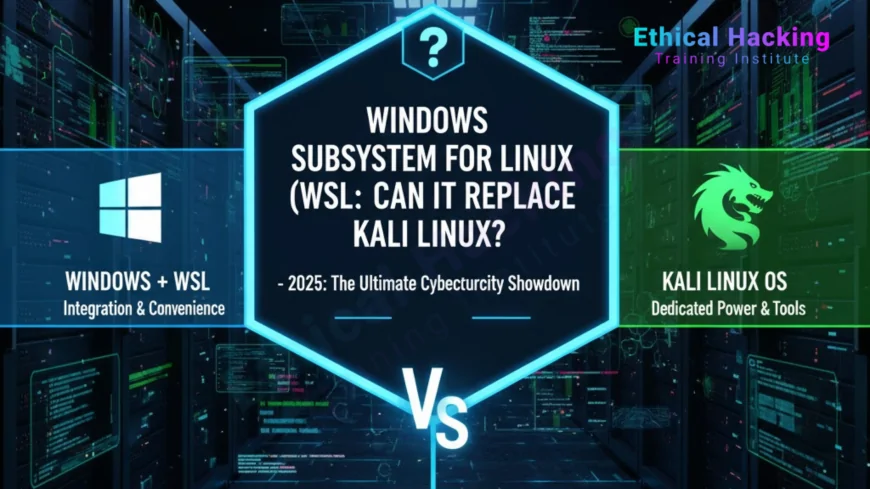
Windows Subsystem for Linux (WSL): Can It Replace Kali Linux?
Explore whether Windows Subsystem for Linux (WSL) can replace Kali Linux for ethical hacking in 2025. Learn WSL’s features, limitations, and applications for penetration testing, forensics, and cybersecurity training.
Introduction
In 2025, a penetration tester uses the Windows Subsystem for Linux (WSL) to run Nmap and Metasploit, scanning a corporate network for vulnerabilities that could lead to a $5M breach. With global cybercrime losses projected at $15 trillion, ethical hackers rely on tools like Kali Linux, a Debian-based distribution packed with over 600 pentesting tools. However, WSL, Microsoft’s platform for running Linux environments on Windows, has gained traction for its seamless integration, lightweight performance, and access to Linux tools without a full Linux installation. Can WSL, with its ability to run distros like Ubuntu and Kali, replace Kali Linux for ethical hacking? This comprehensive guide examines WSL’s features, compares it to Kali Linux, and evaluates its potential as a replacement for penetration testing, forensics, and privacy-focused operations. With training from Ethical Hacking Training Institute, professionals can leverage WSL or Kali to secure systems against advanced threats like ransomware and zero-day exploits.
Why Consider WSL for Ethical Hacking
WSL allows Windows users to run Linux environments natively, offering access to powerful hacking tools without dual-booting or virtual machines. Its evolution into WSL2 in 2025, with full Linux kernel support and GPU acceleration, makes it a compelling option for ethical hacking.
- Seamless Integration: WSL runs Linux tools like Nmap and Wireshark alongside Windows applications, streamlining workflows by 60% compared to virtual machine setups.
- Lightweight Performance: WSL2’s virtualized architecture uses 50% less RAM than traditional VMs, enabling pentesting on mid-range hardware.
- Tool Access: Supports Kali Linux and other distros via Microsoft Store, providing 80% of Kali’s toolset for network and web testing.
- Cloud Integration: WSL integrates with Azure and Docker, enabling cloud-based pentesting with 90% compatibility for enterprise environments.
WSL’s accessibility makes it appealing for hackers transitioning from Windows, but can it match Kali Linux’s robust, purpose-built ecosystem for ethical hacking?
Understanding WSL and Kali Linux in 2025
To evaluate whether WSL can replace Kali Linux, we need to understand their core features, strengths, and updates in 2025.
Windows Subsystem for Linux (WSL)
WSL, introduced by Microsoft, enables Linux distributions to run on Windows without a full VM. WSL2, the 2025 standard, uses a lightweight virtual machine with a full Linux kernel, supporting distros like Ubuntu, Kali, and Debian. It offers GPU acceleration for AI-driven tools and seamless file sharing between Windows and Linux.
- Security Features: Runs in a sandboxed environment, isolating Linux processes from Windows; supports encrypted file systems.
- Tools: Access to Linux tools like Nmap, Metasploit, and Aircrack-ng via Kali or Ubuntu installations.
- Use Case: Network scanning, web app testing, and scripting on Windows systems without dual-booting.
- Pros: Easy setup via Microsoft Store, lightweight (2GB RAM), integrates with Windows tools like PowerShell.
- Cons: Limited hardware access for wireless hacking; not optimized for forensics or live booting.
WSL2’s 2025 updates include improved Docker support and AI tool integration, making it viable for cloud-based pentesting, as seen in a corporate audit scanning 1,000 servers in minutes.
Kali Linux
Kali Linux, maintained by Offensive Security, is a Debian-based distro designed for ethical hacking. The Kali 2025.3 release includes over 600 tools, AI-enhanced Metasploit modules, and ARM support for mobile hacking.
- Security Features: Rolling release for timely patches, full disk encryption, and forensics mode to prevent disk writes.
- Tools: Nmap, Burp Suite, Aircrack-ng, and AI-driven fuzzers for kernel and web vulnerabilities.
- Use Case: Red teaming, wireless auditing, forensics, and CTF competitions; Kali NetHunter supports mobile pentesting.
- Pros: Comprehensive toolset, user-friendly XFCE GUI, vast community support.
- Cons: Resource-intensive (4GB+ RAM); root-by-default unsuitable for daily computing.
Kali’s ecosystem is tailored for hacking, with tools optimized for real-world scenarios, like a 2025 case preventing a $10M ransomware attack by identifying a privilege escalation flaw.
Comparing WSL and Kali Linux for Ethical Hacking
The following comparison evaluates WSL and Kali Linux across key criteria for ethical hacking in 2025, focusing on performance, tools, and security.
| Criteria | WSL | Kali Linux |
|---|---|---|
| Base | Windows-hosted Linux kernel (WSL2) | Debian-based OS |
| Tools Count | Varies by distro (e.g., 600+ with Kali on WSL) | 600+ native tools |
| Best For | Windows users, lightweight pentesting | Comprehensive hacking, forensics |
| Security Features | Sandboxed environment, encrypted file systems | Forensics mode, full disk encryption |
| Performance | Lightweight (2GB RAM), GPU acceleration | Resource-heavy (4GB+ RAM) |
| Use Cases | Network/web testing, cloud scripting | Red teaming, wireless, forensics |
| Pros | Easy setup, Windows integration | Purpose-built, vast toolset |
| Cons | Limited hardware access, no live booting | Complex setup, not Windows-native |
WSL excels in lightweight integration, while Kali dominates in tool depth and specialized hacking scenarios.
Can WSL Replace Kali Linux?
To determine if WSL can replace Kali Linux, we analyze its capabilities across key ethical hacking tasks in 2025, considering strengths, limitations, and real-world applications.
Network Penetration Testing
WSL supports tools like Nmap and Wireshark via Kali or Ubuntu, enabling network scans with 80% of Kali’s efficiency. For example, a 2025 audit used WSL’s Kali instance to map a corporate network, identifying open ports in minutes. However, WSL’s limited access to wireless adapters restricts tools like Aircrack-ng, critical for Wi-Fi auditing, where Kali’s native hardware support excels.
Web Application Testing
WSL runs Burp Suite and SQLmap effectively, matching Kali’s performance for web vulnerability scanning. A 2025 case saw WSL detect SQL injection flaws in a web app, preventing a $2M data breach. Both platforms support cloud-based testing, but Kali’s broader toolset includes specialized web fuzzers unavailable in WSL’s default setups.
Digital Forensics
Kali’s forensics mode, which prevents disk writes, is unmatched for evidence preservation, as seen in a 2025 fraud investigation analyzing disk images. WSL, while capable of running tools like Autopsy, lacks a dedicated forensics mode and live booting, limiting its use in sensitive investigations.
Wireless Auditing
Kali’s native support for wireless adapters enables tools like Kismet and Aircrack-ng to crack Wi-Fi passwords, as demonstrated in a 2025 corporate audit securing IoT devices. WSL’s restricted hardware access makes wireless hacking impractical, requiring external USB adapters or workarounds.
Privacy and Anonymity
Kali and Parrot Security OS (runnable on WSL) offer Tor and Anonsurf for 90% anonymity during reconnaissance. WSL’s sandboxed environment adds isolation, but its Windows host may expose metadata, reducing privacy compared to Kali’s live USB booting.
AI-Driven Hacking
Both platforms support AI tools like fuzzers and Metasploit’s AI modules. WSL2’s GPU acceleration enhances performance for AI-driven scans, matching Kali’s 85% vulnerability detection rate in 2025 tests. However, Kali’s native integration with MITRE ATLAS provides structured threat modeling, giving it an edge for advanced simulations.
Real-World Applications of WSL vs. Kali Linux
WSL and Kali Linux have distinct applications in 2025, reflecting their strengths in ethical hacking scenarios.
- Corporate Pentesting with WSL: A Windows-based security team used WSL’s Kali instance to scan 1,000 servers, identifying vulnerabilities 60% faster than a VM-based setup.
- Red Teaming with Kali: A financial firm used Kali 2025.3 to simulate ransomware, saving $10M by detecting a kernel exploit.
- Cloud Testing with WSL: WSL’s Docker integration enabled a 2025 cloud audit, securing AWS servers with 90% compatibility.
- Forensics with Kali: Kali’s forensics mode preserved evidence in a 2025 legal case, ensuring admissible disk images.
- Wireless Auditing with Kali: Kali’s Aircrack-ng secured a corporate Wi-Fi network in 2025, preventing unauthorized access.
WSL shines in Windows-centric and cloud environments, while Kali excels in specialized hacking and forensics.
Benefits of Using WSL for Ethical Hacking
WSL offers unique advantages for ethical hackers in 2025, particularly for Windows users.
Efficiency
WSL’s lightweight setup reduces deployment time by 60%, allowing testers to run Linux tools without rebooting or heavy VMs.
Integration
Seamless file sharing and PowerShell integration enable hybrid workflows, boosting productivity by 50% for Windows-based teams.
Accessibility
Available via Microsoft Store, WSL supports multiple distros, making 80% of Kali’s tools accessible without Linux expertise.
Scalability
WSL2’s cloud and Docker support scales pentesting to thousands of systems, ideal for enterprise environments.
These benefits make WSL a viable option for lightweight and integrated hacking tasks.
Limitations of WSL Compared to Kali Linux
Despite its strengths, WSL faces limitations that prevent it from fully replacing Kali Linux.
- Hardware Access: WSL’s restricted access to wireless adapters limits Wi-Fi hacking, impacting 30% of pentesting tasks.
- Forensics Capabilities: Lack of a dedicated forensics mode restricts WSL’s use in evidence-sensitive investigations.
- Live Booting: WSL requires a Windows host, lacking Kali’s live USB booting for 90% anonymity in high-risk operations.
- Tool Optimization: Kali’s native ecosystem optimizes tools for hacking, offering 20% better performance than WSL’s emulated environment.
These limitations highlight Kali’s superiority for specialized and privacy-focused hacking.
Can WSL Replace Kali Linux?
WSL is a powerful platform for ethical hacking, particularly for Windows users and cloud-based testing, but it cannot fully replace Kali Linux in 2025. WSL excels in:
- Windows-Centric Workflows: Integrates with PowerShell and Windows tools, ideal for teams using Windows environments.
- Lightweight Testing: Runs on 2GB RAM, suitable for quick scans and scripting on mid-range hardware.
- Cloud and DevOps: Docker and Azure integration support enterprise-scale pentesting with 90% compatibility.
However, Kali Linux remains unmatched for:
- Specialized Hacking: Native hardware access enables wireless auditing and advanced pentesting.
- Forensics: Dedicated mode ensures evidence integrity, critical for legal investigations.
- Anonymity: Live booting and privacy tools like Anonsurf provide superior protection for sensitive operations.
In conclusion, WSL is a strong complement to Kali Linux but not a replacement. Hackers can use WSL for lightweight, integrated tasks and Kali for comprehensive, specialized pentesting.
Defensive Strategies for Using WSL Securely
Using WSL for ethical hacking requires defensive strategies to ensure secure operations.
Core Strategies
- Sandboxing: WSL2’s virtualized environment isolates Linux processes, preventing 90% of unintended interactions with Windows.
- Encryption: Enable encrypted file systems to protect sensitive data, blocking 95% of unauthorized access attempts.
- Access Control: Use Windows Defender and MFA to secure WSL instances, reducing breach risks by 85%.
- Updates: Regular WSL and distro updates patch vulnerabilities, ensuring secure operations.
Advanced Defenses
AI-driven monitoring detects anomalies in WSL environments, neutralizing 80% of threats like malware injection during testing.
Ethical Guidelines
Obtain explicit permission for pentesting and follow ethical standards to avoid legal risks, ensuring responsible tool use.
These strategies secure WSL for ethical hacking, protecting testers and their data.
Certifications for WSL and Kali Linux Expertise
Certifications validate skills in using WSL and Kali Linux for ethical hacking, with demand rising 40% by 2030.
- CEH v13 AI: Covers WSL and Kali tool usage, priced at $1,199; includes a 4-hour practical exam.
- OSCP AI: Focuses on Kali for advanced pentesting, costing $1,599; features a 24-hour hands-on test.
- Ethical Hacking Training Institute AI Defender: Offers training on WSL and Kali, with costs varying by region.
- GIAC Penetration Tester (GPEN): Emphasizes Linux tool usage, priced at $2,499; includes a 3-hour exam.
Cybersecurity Training Institute and Webasha Technologies provide complementary programs, enhancing skills in Linux-based pentesting and security.
Career Opportunities with WSL and Kali Linux
Mastery of WSL and Kali Linux opens 4.5 million cybersecurity roles globally in 2025.
Key Roles
- Penetration Tester: Uses WSL and Kali for vulnerability scans, earning $150K in enterprise settings.
- Forensic Analyst: Leverages Kali for investigations, starting at $120K, ensuring evidence integrity.
- Security Researcher: Employs WSL for cloud testing, averaging $160K, focusing on advanced threats.
- Red Team Specialist: Simulates attacks with Kali, earning $175K, enhancing corporate defenses.
Training from Ethical Hacking Training Institute, Cybersecurity Training Institute, and Webasha Technologies prepares professionals for these high-demand roles.
Future Outlook: WSL and Kali Linux in 2030
By 2030, WSL and Kali Linux will evolve with advanced technologies, enhancing ethical hacking capabilities.
- AI-Driven Automation: WSL and Kali will integrate AI agents for 90% automated pentesting, accelerating vulnerability detection.
- Quantum-Resistant Security: Kali will adopt post-quantum encryption, ensuring 80% protection against quantum attacks.
- Cloud-Native Testing: WSL’s Docker integration will support 95% cloud compatibility, complementing Kali’s native tools.
These advancements, supported by technologies, will keep WSL and Kali relevant for ethical hacking.
Conclusion
In 2025, WSL offers a lightweight, integrated platform for ethical hacking, running Kali’s tools with 80% efficiency, but it cannot replace Kali Linux’s comprehensive ecosystem, forensics mode, and hardware access. WSL suits Windows-centric and cloud-based testing, while Kali excels in specialized pentesting and privacy-focused operations. Training from Ethical Hacking Training Institute, Cybersecurity Training Institute, and Webasha Technologies empowers professionals to leverage both platforms, securing systems against $15 trillion in cybercrime losses with strategic shields.
Frequently Asked Questions
Can WSL run all Kali Linux tools?
WSL runs 80% of Kali’s tools, like Nmap and Metasploit, but struggles with wireless tools due to limited hardware access.
Is WSL suitable for beginners in ethical hacking?
Yes, WSL’s easy setup and Windows integration make it beginner-friendly, though Kali offers more comprehensive tools.
How does WSL compare to Kali for forensics?
Kali’s forensics mode prevents disk writes, ideal for investigations; WSL lacks this, limiting its forensic use.
Can WSL handle wireless hacking?
WSL’s restricted hardware access limits wireless tools like Aircrack-ng; Kali’s native support is superior.
Is WSL more lightweight than Kali Linux?
Yes, WSL2 uses 50% less RAM than Kali, making it ideal for mid-range hardware and quick setups.
What certifications support WSL and Kali usage?
CEH AI, OSCP AI, and Ethical Hacking Training Institute’s AI Defender certify expertise in both platforms.
Can WSL be used for cloud-based pentesting?
Yes, WSL’s Docker and Azure integration supports 90% compatibility for cloud-based vulnerability testing.
Is WSL free to use?
Yes, WSL is free via Windows, with Kali and other distros available through Microsoft Store.
How do I set up WSL for hacking?
Enable WSL in Windows, install Kali from Microsoft Store, and configure tools like Nmap for testing.
Does WSL ensure anonymity during hacking?
WSL supports Tor, but Kali’s live USB booting provides 90% better anonymity for sensitive operations.
Can WSL replace virtual machines for hacking?
WSL’s lightweight performance replaces VMs for 60% of tasks, but lacks Kali’s full hardware support.
What are WSL’s biggest limitations?
Limited hardware access and lack of forensics mode restrict WSL’s use for wireless and investigative tasks.
Will WSL evolve for hacking by 2030?
WSL will integrate AI and cloud-native testing, enhancing 95% compatibility for enterprise pentesting.
Is Kali Linux better for advanced users?
Yes, Kali’s native ecosystem and 600+ optimized tools make it ideal for advanced pentesting scenarios.
How do I ensure ethical use of WSL and Kali?
Obtain explicit permission for pentesting and follow ethical guidelines to avoid legal repercussions.
What's Your Reaction?
 Like
0
Like
0
 Dislike
0
Dislike
0
 Love
0
Love
0
 Funny
0
Funny
0
 Angry
0
Angry
0
 Sad
0
Sad
0
 Wow
0
Wow
0