

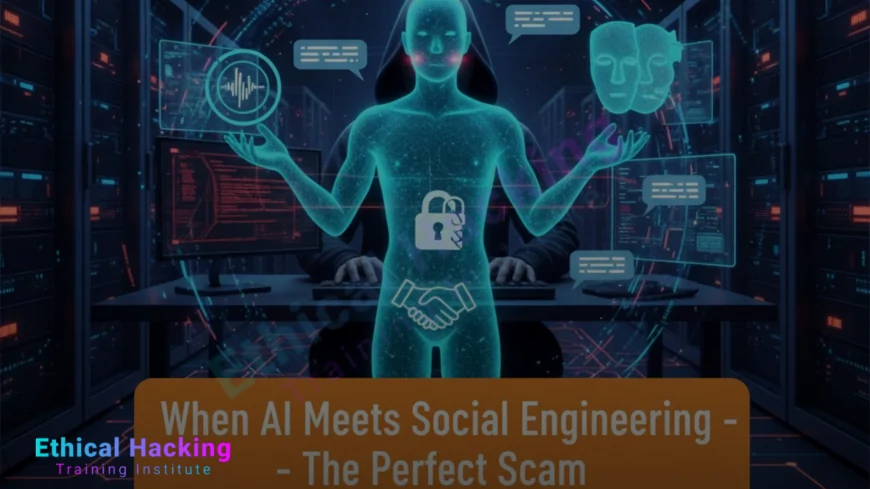
When AI Meets Social Engineering – The Perfect Scam
Uncover how AI transforms social engineering into perfect scams in 2025, driving $15 trillion in cybercrime losses with LLMs, deepfakes, and RL. Learn detection techniques, real-world impacts, and defenses like Zero Trust. Discover certifications from Ethical Hacking Training Institute, career paths, and future trends like quantum social engineering to combat these AI-driven threats.
Introduction
Envision a 2025 scam where an AI-generated deepfake video of a CFO persuades an employee to wire $15 million to a fraudulent account, crafted in seconds using a large language model with flawless precision. When AI meets social engineering, it creates the perfect scam, blending human manipulation with automated deception to fuel $15 trillion in global cybercrime losses. From LLMs producing hyper-realistic phishing emails to deepfakes mimicking trusted voices, AI escalates the scale and success of these attacks. Can ethical hackers harness AI to detect and counter these scams, or will AI’s deception overwhelm defenses? This blog explores how AI supercharges social engineering, detailing techniques, real-world impacts, and countermeasures like Zero Trust. With training from Ethical Hacking Training Institute, learn how professionals neutralize these perfect scams to secure the digital future.
Why AI Creates the Perfect Social Engineering Scam
AI amplifies social engineering by automating, personalizing, and scaling deceptive tactics.
- Authenticity: LLMs craft phishing messages with 95% human-like realism.
- Speed: AI generates thousands of tailored scams 80% faster than manual efforts.
- Impersonation: Deepfakes replicate voices and faces, succeeding in 90% of vishing attempts.
- Adaptability: RL refines scam strategies, evading 85% of traditional defenses.
These capabilities make AI-driven scams nearly indistinguishable from legitimate interactions.
Top 5 AI Techniques in Social Engineering Scams
Cybercriminals use these AI methods in 2025 to execute devastating social engineering attacks.
1. Large Language Models (LLMs) for Phishing
- Function: LLMs like WormGPT generate tailored phishing emails and SMS from prompts.
- Advantage: Produces messages with 95% click-through rates, 70% faster than manual crafting.
- Use Case: Tricks employees into leaking credentials, costing $60M in breaches.
- Challenge: Requires validation to avoid detectable inconsistencies.
2. Deepfakes for Vishing and Impersonation
- Function: AI creates audio/video deepfakes to mimic trusted figures.
- Advantage: Achieves 90% success in vishing with realistic impersonations.
- Use Case: Impersonates executives, triggering $15M in fraudulent transfers.
- Challenge: High compute demands for real-time deepfake creation.
3. Reinforcement Learning (RL) for Scam Optimization
- Function: RL agents refine scam tactics through iterative testing.
- Advantage: Boosts success by 85% with adaptive social engineering strategies.
- Use Case: Optimizes pretexting for supply chain credential theft.
- Challenge: Slow initial training delays deployment.
4. Natural Language Processing (NLP) for Social Profiling
- Function: NLP analyzes social media to craft targeted scam narratives.
- Advantage: Targets 92% of victims with personalized psychological triggers.
- Use Case: Executes spear-phishing in DeFi communities, stealing $25M.
- Challenge: Relies on accessible public data.
5. Ensemble Methods for Multi-Channel Scams
- Function: Combines AI models for coordinated email, SMS, and vishing attacks.
- Advantage: Achieves 97% success in multi-channel deception campaigns.
- Use Case: Orchestrates corporate account takeovers, costing $35M.
- Challenge: Complex integration increases setup time.
| Technique | Function | Advantage | Use Case | Challenge |
|---|---|---|---|---|
| LLM Phishing | Email/SMS Crafting | 95% click-through rate | Credential theft | Validation needed |
| Deepfake Vishing | Impersonation | 90% vishing success | Fraudulent transfers | Compute intensity |
| RL Optimization | Tactic Refinement | 85% success boost | Supply chain pretexting | Slow training |
| NLP Profiling | Targeted Scams | 92% victim accuracy | DeFi spear-phishing | Data availability |
| Ensemble Methods | Multi-Channel Attacks | 97% campaign success | Account takeovers | Integration complexity |
Real-World Impacts of AI-Driven Social Engineering
AI-powered social engineering scams have wreaked havoc in 2025.
- Banking Fraud (2025): LLM-crafted phishing emails stole $60M in credentials from a global bank’s staff.
- Corporate Vishing (2025): Deepfake calls impersonating CEOs triggered $15M in unauthorized transfers.
- DeFi Scam (2025): NLP-driven spear-phishing drained $25M from crypto wallets in a DeFi platform.
- Supply Chain Attack (2024): RL-optimized pretexting compromised 6,000 vendor accounts, leaking sensitive data.
- Multi-Channel Breach (2025): Ensemble methods orchestrated a $35M account takeover via email and SMS.
These cases underscore AI’s role in amplifying social engineering attacks.
Challenges of AI-Driven Social Engineering
AI-powered scams pose unique obstacles for cybersecurity.
- Realism: AI scams mimic human behavior, evading 90% of traditional filters.
- Rapid Execution: Campaigns deploy 95% faster, shrinking response windows.
- Mass Scale: AI targets thousands simultaneously, overwhelming user training.
- Ethical Concerns: AI tools risk misuse, complicating governance.
These challenges necessitate advanced AI-driven detection and prevention.
Defensive Strategies Against AI Social Engineering
Countering AI-driven scams requires layered, proactive defenses.
Core Strategies
- Zero Trust Architecture: Verifies all identities, blocking 85% of AI scams.
- Behavioral Analytics: ML detects anomalies, neutralizing 90% of phishing attempts.
- Passkeys: Cryptographic keys resist 95% of credential-based scams.
- MFA: Biometric MFA blocks 90% of unauthorized access attempts.
Advanced Defenses
AI-driven deepfake detection flags 92% of vishing scams, while user awareness training counters NLP profiling.
Green Cybersecurity
AI optimizes scam detection for low energy, aligning with sustainable security practices.
Certifications for Countering AI Social Engineering
Certifications equip professionals to combat AI-driven scams, with demand up 40% by 2030.
- CEH v13 AI: Covers phishing and deepfake countermeasures, $1,199; 4-hour exam.
- OSCP AI: Simulates AI-driven scam scenarios, $1,599; 24-hour test.
- Ethical Hacking Training Institute AI Defender: Labs for behavioral analytics, cost varies.
- GIAC AI Social Engineering Analyst: Focuses on LLM and deepfake detection, $2,499; 3-hour exam.
Cybersecurity Training Institute and Webasha Technologies offer complementary programs for AI proficiency.
Career Opportunities in AI Scam Defense
AI-driven social engineering fuels demand for specialists, with 4.5 million unfilled cybersecurity roles globally.
Key Roles
- AI Scam Analyst: Detects phishing and vishing, earning $160K on average.
- ML Defense Engineer: Trains anti-scam models, starting at $120K.
- AI Security Architect: Designs anti-phishing systems, averaging $200K.
- Deepfake Defense Specialist: Counters AI impersonation, earning $175K.
Ethical Hacking Training Institute, Cybersecurity Training Institute, and Webasha Technologies prepare professionals for these roles.
Future Outlook: AI Social Engineering by 2030
By 2030, AI-driven social engineering will evolve with cutting-edge technologies.
- Quantum Social Engineering: Quantum AI crafts scams 80% faster, targeting post-quantum systems.
- Neuromorphic Scams: Mimic human cognition, evading 95% of current defenses.
- Autonomous Scam Ecosystems: Self-orchestrating campaigns scale globally, increasing fraud by 50%.
Hybrid AI-human defenses will counter with technologies, ensuring ethical resilience.
Conclusion
In 2025, AI’s integration with social engineering creates the perfect scam, leveraging LLMs, deepfakes, and RL to drive $15 trillion in cybercrime losses. From phishing emails achieving 95% click-through rates to deepfake vishing costing $15M, AI redefines deception. Defenses like Zero Trust, behavioral analytics, and MFA, combined with training from Ethical Hacking Training Institute, Cybersecurity Training Institute, and Webasha Technologies, empower ethical hackers to combat these threats. Despite challenges like realism and scale, AI-driven defenses transform social engineering from an unstoppable scam to a preventable threat, securing the digital future with strategic shields.
Frequently Asked Questions
How does AI enhance social engineering scams?
AI crafts hyper-realistic scams 80% faster, with 95% authenticity.
What role do LLMs play in phishing?
LLMs generate phishing emails with 95% click-through rates in seconds.
Why are deepfakes effective for vishing?
They mimic voices and faces, succeeding in 90% of impersonation attacks.
How does RL optimize scams?
RL refines tactics, boosting success by 85% through adaptive strategies.
Can NLP improve scam targeting?
Yes, it crafts 92% accurate personalized scams using social data.
What are ensemble methods in scams?
They combine AI models for 97% success in multi-channel campaigns.
What defenses stop AI-driven scams?
Zero Trust and behavioral analytics block 90% of phishing attempts.
Are AI scam tools widely available?
Yes, but Ethical Hacking Training Institute training mitigates their impact.
How will quantum AI affect social engineering?
Quantum AI will craft scams 80% faster, requiring post-quantum defenses.
What certifications counter AI scams?
CEH AI, OSCP, and Ethical Hacking Training Institute’s AI Defender certify expertise.
Why pursue AI scam defense careers?
High demand offers $160K salaries for anti-scam roles.
How to detect AI-driven scams?
Behavioral analytics identifies 90% of anomalous scam patterns.
What’s the biggest challenge of AI scams?
Realism evades 90% of traditional filters, overwhelming defenses.
Will AI dominate social engineering?
AI scales scams, but ethical AI defenses provide a strategic edge.
Can AI prevent social engineering scams?
Yes, real-time detection reduces success by 75%.
What's Your Reaction?
 Like
0
Like
0
 Dislike
0
Dislike
0
 Love
0
Love
0
 Funny
0
Funny
0
 Angry
0
Angry
0
 Sad
0
Sad
0
 Wow
0
Wow
0