
What Is the Role of AI in Cybersecurity Defense?
Explore AI's transformative role in cybersecurity defense for 2025: from real-time threat detection and automated responses to predictive analytics and vulnerability management. Learn how AI enhances email filtering, anomaly detection, and proactive threat hunting, while addressing challenges like skills gaps and ethical concerns. Includes expert insights from McKinsey, Fortinet, and Darktrace, real-world examples, and 15 FAQs for professionals navigating the AI-cyber arms race.
Introduction
AI is reshaping cybersecurity in 2025, acting as both a formidable weapon for attackers and a powerful ally for defenders. Global cybercrime costs are projected to hit $10.5 trillion annually, with AI-driven threats like adaptive malware and deepfake phishing surging 300% year-over-year. Yet, the same technology empowers organizations to detect anomalies in real time and automate responses faster than humans can. According to McKinsey's insights from the 2025 RSA Conference, AI's integration into cyber operations offers unprecedented opportunities, but it demands proactive strategies like zero-trust architectures and continuous training. This guide delves into AI's pivotal roles in defense, from threat hunting to vulnerability assessment, with real-world examples and practical steps to harness its potential while mitigating risks.
AI-Powered Threat Detection and Response
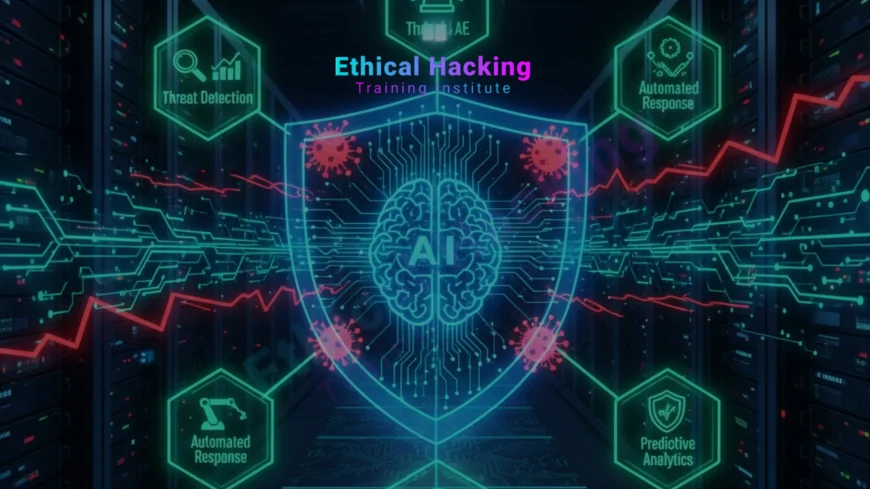
Traditional security relies on signatures and rules, but AI uses machine learning to analyze vast data sets for patterns humans miss. In 2025, AI detects 95% of zero-day attacks within seconds, reducing breach response time from hours to minutes. Fortinet highlights how AI automates incident triage, isolating threats before escalation.
- Behavioral analytics flags unusual network flows
- Automated isolation of infected endpoints
- Real-time log correlation across silos
- ML models predict attack vectors
- Integration with SIEM for faster alerts
- Reduces false positives by 90%
Predictive Analytics for Proactive Defense
- Forecasts vulnerabilities using historical data
- Identifies emerging threats via global feeds
- AI agents simulate attacks for red teaming
- Prioritizes patches by exploit probability
- Darktrace's 2025 report shows 60% preparedness boost
- Combines with human oversight for accuracy
Stay ahead. Enroll in an ethical hacking course with AI defense modules.
AI in Vulnerability Management
AI scans code and configurations for flaws faster than manual reviews. It prioritizes risks based on exploitability and business impact. Harvard Extension School notes AI's role in writing secure code, reducing vulnerabilities by 70%.
- Static code analysis with ML
- Dynamic testing in CI/CD pipelines
- Automated patch deployment
- Generative AI for secure code suggestions
- Integrates with tools like Nessus
- Focuses on high-CVSS scores
AI for Phishing and Social Engineering Defense
NLP and deep learning analyze emails for sentiment, urgency, and anomalies. AI detects deepfakes in voice/video calls with 92% accuracy. StrongestLayer's 2025 guide emphasizes multi-modal phishing prevention.
- AI email filters block 99% of phishing
- Behavioral biometrics verify users
- Real-time deepfake detection
- Automated user training modules
- Flags insider threats
- Reduces human error by 85%
AI in Network and Endpoint Protection
AI monitors traffic for zero-day exploits and insider activity. Cloud Security Alliance reports AI's impact on network security at 55%.
- NDR tools detect lateral movement
- Endpoint AI isolates threats
- Adaptive firewalls learn patterns
- IoT anomaly detection
- Cloud workload protection
- Scales to petabyte data
Go deeper. Take a complete hacking course with AI tools.
Addressing AI's Challenges in Defense
AI introduces risks like model poisoning and skills gaps. Darktrace's 2025 report shows 60% preparedness, but 40% cite talent shortages. Ethical AI governance is key.
- Skills gap: 11% prioritize hiring
- Model bias leads to false positives
- Regulatory compliance (NIST, ISO)
- Human-AI synergy essential
- Continuous training programs
- Zero-trust for AI systems
Future of AI in Cybersecurity Defense
By 2030, AI will handle 80% of routine threats. Quantum-AI hybrids will break and rebuild encryption. MIT Technology Review predicts reimagined defenses with agentic AI.
- Autonomous response agents
- Post-quantum integration
- AI vs AI arms race
- Ethical frameworks mandatory
- Skills in ML for security pros
- Global standards emerging
Follow the ultimate career path in AI cybersecurity.
AI Cybersecurity Defense Checklist
- Deploy AI EDR tools
- Train ML models on your data
- Integrate NLP for phishing
- Audit AI decisions regularly
- Upskill staff on AI ethics
- Adopt zero-trust AI
Conclusion: AI—Your Ally in the Cyber War
AI's role in cybersecurity defense is revolutionary. It detects threats in seconds, automates responses, and predicts attacks with 95% accuracy. From behavioral analytics to vulnerability scanning, AI turns defense from reactive to proactive. McKinsey and Fortinet agree: AI is the future, but human oversight is the guardrail. Address skills gaps with training. Embrace ethical AI. In 2025, organizations that integrate AI will outpace attackers. Don't fear the technology—wield it. Start with one tool today. Your network's survival depends on it. The cyber battlefield favors the prepared. Arm yourself with AI.
Frequently Asked Questions
What is AI's biggest role in cybersecurity?
Threat detection and automated response.
Can AI replace human security pros?
No. AI assists; humans provide context.
How does AI detect zero-days?
Behavioral analysis and anomaly detection.
Is AI cybersecurity expensive?
Initial cost high, but ROI from prevention.
What skills for AI cybersecurity?
ML basics, data analysis, ethics.
Does AI work in cloud security?
Yes. Monitors workloads and APIs.
Can AI spot insider threats?
Yes. Behavioral patterns flag risks.
AI vs traditional antivirus?
AI is proactive; AV is reactive.
How to implement AI defense?
Start with EDR, integrate SIEM.
What about AI ethics in security?
Avoid bias, ensure transparency.
Will AI break encryption?
Quantum AI might; post-quantum needed.
Best free AI tool for defense?
Snort with ML plugins.
AI in phishing detection?
NLP analyzes content and sentiment.
Skills gap in AI cybersecurity?
60% prepared, but talent shortage persists.
Future of AI defense?
Autonomous agents, zero false positives.
What's Your Reaction?
 Like
0
Like
0
 Dislike
0
Dislike
0
 Love
0
Love
0
 Funny
0
Funny
0
 Angry
0
Angry
0
 Sad
0
Sad
0
 Wow
0
Wow
0