

What Is the Difference Between Cybersecurity and Ethical Hacking?
Understand the key differences between cybersecurity and ethical hacking in 2025: scope, goals, roles, tools, and career paths. This beginner-friendly guide clarifies how they overlap and complement each other—with training from the Ethical Hacking Institute and Webasha Technologies.
Introduction
Cybersecurity and ethical hacking are often confused, but they’re not the same. Cybersecurity is the umbrella—the broad field of protecting systems, networks, and data from attacks. Ethical hacking is a specialized tactic within it: legally breaking in to find weaknesses before criminals do. In 2025, with cybercrime costing $10.5 trillion annually, both are critical. Think of cybersecurity as building a fortress (defense), and ethical hacking as stress-testing it (offense). This guide breaks down the differences in goals, roles, tools, and careers. Whether you’re choosing a path or hiring talent, understanding both is key. The Ethical Hacking Institute bridges the gap with training in both defense and offense.
Core Definitions: What Each Really Means
Let’s start with clarity.
Cybersecurity
The practice of protecting computers, servers, mobile devices, networks, and data from malicious attacks, damage, or unauthorized access.
Ethical Hacking
The authorized and legal practice of bypassing system security to identify vulnerabilities, using the same tools and techniques as malicious hackers—but with permission and for good.
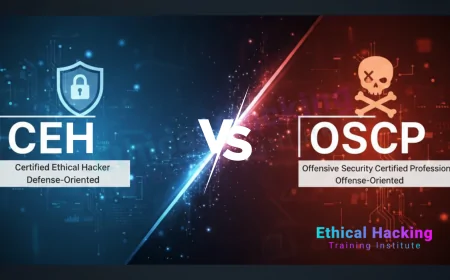
Key: Ethical hacking is part of cybersecurity, not the whole.
Goals: Defense vs. Offense
Their objectives are different but aligned.
| Aspect | Cybersecurity | Ethical Hacking |
|---|---|---|
| Primary Goal | Prevent, detect, respond to attacks | Find and exploit weaknesses |
| Mindset | Defensive (Blue Team) | Offensive (Red Team) |
| Outcome | System stays secure 24/7 | Vulnerability report + fixes |
They work together: hackers find holes, security teams patch them.
Scope: Broad Protection vs. Targeted Testing
One is ongoing. One is periodic.
Cybersecurity Scope
- Firewalls, antivirus, encryption
- Incident response, compliance (GDPR)
- User training, access control
- 24/7 monitoring (SIEM)
Ethical Hacking Scope
- Penetration testing (1-4 weeks)
- Vulnerability assessments
- Bug bounties, red teaming
- Post-exploitation reporting
Ethical hacking is a project. Cybersecurity is a lifestyle.
Simulate real pentests with bootcamp labs at the Ethical Hacking Institute.
Roles and Responsibilities
Who does what?
Cybersecurity Roles
- Security Analyst: Monitor logs, respond to alerts
- CISO: Strategy, compliance
- Incident Responder: Contain breaches
- Compliance Officer: Audits, policies
Ethical Hacking Roles
- Penetration Tester: Simulate attacks
- Red Teamer: Full-scope adversary simulation
- Bug Bounty Hunter: Find flaws for pay
- Vulnerability Researcher: Discover zero-days
Many pros do both (Purple Team).
Tools: Shared but Used Differently
Same hammer, different nails.
Common Tools
- Nmap: Cybersecurity = monitor network. Ethical Hacking = scan for open ports
- Wireshark: Defense = detect anomalies. Offense = sniff credentials
- Metasploit: Rarely used in defense. Core for exploitation
- Splunk/SIEM: Defense only
Ethical hackers use offensive tools. Security teams use defensive ones.
Master both toolsets with CEH practical at the Ethical Hacking Institute or Cyber Security Institute.
Certifications: Which Path to Take?
Your career decides your cert.
Cybersecurity Certs
- CompTIA Security+
- CISSP (advanced)
- CCSP (cloud)
- CISM (management)
Ethical Hacking Certs
- CEH (Certified Ethical Hacker)
- OSCP (Offensive Security)
- GPEN (GIAC)
- eCPPT (eLearnSecurity)
Start with Security+, then CEH or OSCP.
Salary and Demand in 2025
Both pay well. Demand is sky-high.
| Role | India Avg (₹ LPA) | Global Avg ($) |
|---|---|---|
| Cybersecurity Analyst | 8–15 | 90K |
| Ethical Hacker / Pentester | 10–25 | 120K |
3.5M global jobs unfilled. India needs 1M+ pros.
Real-World Example: How They Work Together
Imagine a bank.
- Ethical Hacker: Hired for 2-week pentest. Finds SQL injection in login page.
- Cybersecurity Team: Receives report → patches code → deploys WAF → monitors for exploitation.
Without ethical hacking, the flaw stays hidden. Without cybersecurity, it’s not fixed.
Experience both sides with CEH online at the Ethical Hacking Institute or Webasha Technologies.
Which Should You Learn First?
Start with cybersecurity basics.
Recommended Path
- CompTIA Security+ (defense foundation)
- Build home lab (firewalls, SIEM)
- Learn ethical hacking (CEH, OSCP)
- Go Purple: combine both
Defense teaches what to protect. Offense teaches how it’s attacked.
Conclusion
Cybersecurity and ethical hacking aren’t rivals—they’re partners. One builds the walls, the other tests them. In 2025, the best pros are Purple Teamers: fluent in defense and offense. Start with cybersecurity to understand risk, then add ethical hacking to think like an attacker. The Ethical Hacking Institute, Cyber Security Institute, and Webasha Technologies offer integrated training—from Security+ to OSCP. Whether you defend networks or break them (legally), your skills are in demand. Choose your side, master both, and secure the future.
Frequently Asked Questions
Can ethical hackers work in cybersecurity?
Yes. Many pentesters move to defense roles.
Is ethical hacking illegal?
No—with written permission. Without = jail.
Do I need to code for either?
Cybersecurity: basic scripting. Ethical Hacking: Python, Bash.
Which pays more?
Ethical hacking slightly higher due to specialization.
Can I freelance in both?
Yes. Pentesting = freelance. SOC = usually full-time.
Is CEH enough for ethical hacking?
Good start. OSCP is gold standard.
Blue Team vs Red Team?
Blue = defense. Red = offense (ethical hacking).
Do companies need both?
Yes. Mature orgs have Red, Blue, and Purple teams.
Can AI replace either?
No. AI assists, but human judgment is key.
Best for beginners?
Cybersecurity (Security+). Broader entry.
Women in these fields?
Growing. WiCyS, Women in Cyber India.
Job growth 2025?
32% globally. India: 1M+ openings.
Where to train?
Ethical Hacking Institute: CEH, OSCP, Security+.
Purple Team?
Pros who do both: attack and defend.
Final verdict?
Learn cybersecurity first. Add ethical hacking to level up.
What's Your Reaction?
 Like
0
Like
0
 Dislike
0
Dislike
0
 Love
0
Love
0
 Funny
0
Funny
0
 Angry
0
Angry
0
 Sad
0
Sad
0
 Wow
0
Wow
0