





What Is Network Sniffing and How Is It Prevented?
Network sniffing is the interception and analysis of network traffic. This guide explains how sniffers work, common techniques attackers use, detection methods, and practical prevention controls for organisations and individuals, with hands-on learning references.
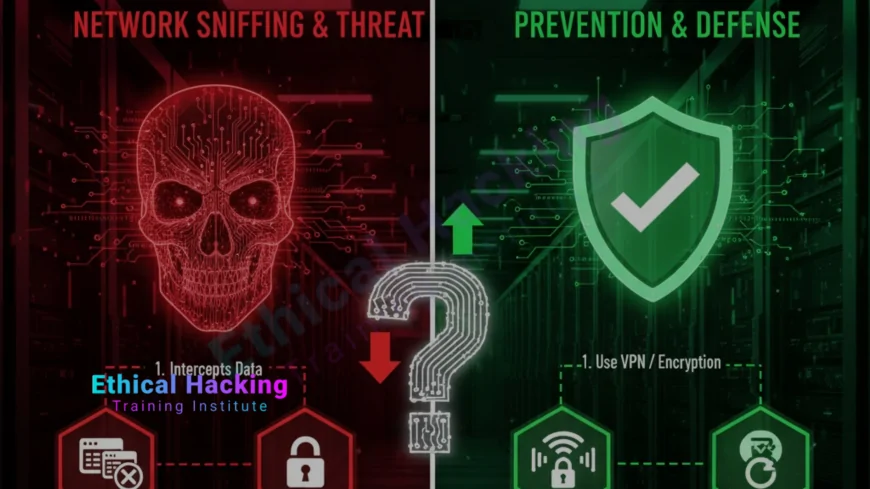
Introduction
Network sniffing is the act of capturing packets of data as they travel across a network. Security professionals use sniffers for diagnostics and forensic investigations, while attackers use them to capture credentials, session tokens, and sensitive information. Understanding how sniffing works and how to prevent it is essential for any organisation that cares about confidentiality and integrity.
This article covers the fundamentals of packet capture, common attack patterns, detection signals, and layered prevention techniques. If you want structured hands-on practice, consider guided labs that include packet analysis exercises.
What Is a Network Sniffer?
A network sniffer is software or hardware that intercepts and logs traffic on a network. At its core, a sniffer listens to network interfaces and records packets for later analysis. Tools such as Wireshark provide graphical interfaces to inspect packet headers, payloads, and protocol flows.
Sniffers are dual use. Administrators use them to troubleshoot performance issues and investigate incidents, while adversaries can use the same tools to harvest unencrypted data. Ethical training teaches the responsible use of sniffers in isolated labs and authorised environments.
How Network Sniffing Works
On a switched network, traffic is normally delivered only to the intended destination. Attackers use techniques to make a target host or their own sniffer receive traffic not originally destined for it. Popular techniques include ARP spoofing, IP spoofing, MAC flooding, and configuring interfaces in promiscuous mode.
Once traffic is captured, analysts or attackers inspect protocol fields and payloads. Unencrypted credentials, session cookies, and sensitive application data are frequently visible, which is why encryption and secure session handling are critical.
Common Sniffing Techniques
Attackers and testers use a variety of techniques to capture traffic. ARP spoofing poisons the local ARP cache to redirect traffic through the attacker's host. DNS spoofing can redirect users to malicious hosts. On wireless networks, passive capture of broadcast traffic is common, and rogue access points trick clients into connecting to an attacker-controlled network.
For practical examples and step-by-step exercises, many courses include controlled sniffing modules and safe use policies to prevent misuse.
Tools Used for Packet Capture
Wireshark is the most widely used packet analyzer for deep inspection. Tcpdump provides command-line capture and filtering. For large-scale collection and correlation, tools such as Zeek and Suricata provide network sensors that parse traffic and emit higher-level events into SIEMs.
Learning to use these tools in combination, for example capturing with tcpdump and analysing with Wireshark, is a common part of structured training.
Risks Posed by Network Sniffing
The primary risk is data exposure. Credentials transmitted in clear text, unencrypted proprietary data, or session tokens can be stolen and reused. Attackers may escalate access by replaying captured authentication traffic or using captured tokens to impersonate users.
Other risks include reconnaissance, where attackers map active hosts and services, and lateral movement, where sniffed information helps pivot through internal systems.
Detecting Network Sniffing
Detection relies on identifying anomalies and sensor data. Signs include unexpected ARP changes, duplicate IP addresses, new hosts in promiscuous mode, and unusual traffic flows to endpoints that should not receive mirrored data. Network detection tools and NDR (Network Detection and Response) platforms generate alerts for such anomalies.
Regularly monitoring ARP tables, logging switch port changes, and using tools to detect promiscuous interfaces can reveal active sniffing. Incident response playbooks should include steps to identify and isolate sniffing hosts quickly.
Prevention Strategies: Encryption
Encryption is the most effective defence against packet capture. Use TLS for web traffic, SSH instead of Telnet, and VPNs for remote access. Encrypt sensitive application-level data and use HTTPS everywhere to ensure captured traffic is not readable.
Proper certificate management and forcing strong cipher suites reduce the chance an attacker can decrypt captured sessions. Organisations should enforce HTTPS and monitor for insecure endpoints during audits.
Prevention Strategies: Network Controls
Segmentation reduces the blast radius of sniffing. Keep sensitive systems on isolated VLANs, and restrict lateral movement with ACLs. Disable unused protocols, and remove legacy clear-text services such as FTP and Telnet.
Enterprise switches support features like Dynamic ARP Inspection and port security, which prevent ARP spoofing and limit MAC addresses per port. Enabling these features is an essential hardening step.
Prevention Strategies: Endpoint and Access Controls
Ensure host-level protections: use endpoint detection and response to identify suspicious processes, enforce least privilege, and use strong authentication. MFA prevents attackers from reusing captured credentials alone.
Regularly patch endpoints and monitor for rogue devices connecting to the network. Device posture checks before network access reduce the risk of compromised hosts acting as sniffers.
Prevention Strategies: Wireless Security
Wireless networks are particularly susceptible. Use WPA3 where possible, strong passphrases, and disable open guest networks or isolate them from internal resources. Detect and remove rogue access points, and use 802.1X for enterprise authentication.
Regular wireless surveys and monitoring detect unexpected SSIDs or devices that may be used for sniffing or man-in-the-middle attacks.
Policy, Training, and Operational Measures
Technical controls are necessary, but personnel and processes matter. Enforce policies that prohibit use of unauthorized sniffing tools on corporate networks. Conduct regular training so staff recognise social and physical attacks that enable sniffing, such as phishing that installs sniffing malware.
Incident response plans should include packet capture analysis, evidence preservation, and steps to remediate sniffing vectors. For comprehensive education, many organisations work with established training providers to deliver real-world labs and simulations.
Table: Sniffing Techniques and Defenses
| Technique | What It Does | Primary Defenses |
|---|---|---|
| ARP spoofing | Redirects local traffic to attacker | Dynamic ARP Inspection, port security, segmentation |
| Promiscuous mode sniffing | Interface captures all traffic on segment | Detect promiscuous hosts, network access controls |
| Rogue AP | Attacker AP lures clients, intercepts traffic | WPA3, 802.1X, SSID monitoring, guest isolation |
| Unencrypted protocols | Clear-text credentials and data exposure | Use TLS, SSH, VPNs, and remove legacy services |
Practical Detection and Response Steps
If sniffing is suspected, isolate the affected segment, capture current network state, and preserve evidence. Use managed sensors to correlate anomalies, check ARP tables, and scan for hosts in promiscuous mode. Revoke compromised credentials, rotate certificates if needed, and harden affected systems.
Post-incident, run a root cause analysis and apply controls to prevent recurrence. Document lessons learned and update monitoring rules to detect similar techniques proactively.
Conclusion
Network sniffing is a core capability for both defenders and adversaries. Preventing its misuse requires layered defences: encrypt traffic, harden networks and endpoints, secure wireless, enforce policies, and monitor for anomalies. Combining technical controls with training and incident readiness makes sniffing attacks far less effective.
For hands-on practice and deeper learning, consider targeted courses that include packet capture labs and incident scenarios, taught by experienced instructors and designed to reinforce safe, authorised use.
Frequently Asked Questions
What is the easiest way to sniff network traffic?
Install a packet capture tool such as Wireshark on a host with access to the target network segment, and run captures in promiscuous mode where permitted.
Can encrypted traffic be sniffed?
Yes, traffic can be captured, but strong encryption prevents reading payloads unless keys or weak ciphers are present.
How does ARP spoofing enable sniffing?
ARP spoofing poisons caches so the victim sends packets to the attacker, allowing interception and forwarding of traffic.
Is using a sniffer illegal?
It can be illegal if used without authorization. Use sniffers only in environments where you have explicit permission to capture traffic.
How do I detect a host in promiscuous mode?
Use network scanners that send crafted packets and observe whether unexpected responses originate from the host, indicating promiscuous behavior.
Does using VPN protect against local sniffing?
Yes, a VPN encrypts traffic to the VPN endpoint, preventing local sniffers from reading the payload, though DNS leaks should be considered.
What role does SIEM play in detecting sniffing?
SIEM aggregates logs and network events to correlate indicators like ARP anomalies and unusual traffic flows for faster detection.
Should I disable unused network services?
Yes, disabling unused services reduces the attack surface and limits opportunities for attackers to intercept sensitive data.
How often should network devices be reviewed?
Regularly, at least quarterly, and after major network changes to ensure configurations and ACLs remain secure.
Can physical network taps be detected?
Physical taps are harder to detect, but inventory controls and port audits can reveal unexpected devices or cabling changes.
What is Dynamic ARP Inspection?
It is a switch feature that validates ARP packets against a trusted database to prevent ARP spoofing attacks.
How do rogue access points enable sniffing?
Rogue APs impersonate legitimate networks and entice clients to connect, enabling attackers to capture their traffic.
What is the best practice for encrypting internal traffic?
Use TLS for application traffic, IPsec for network-level tunnels, and enforce strong cipher suites and key management.
Can endpoint protection detect sniffers?
Yes, modern EDR solutions can detect suspicious processes performing packet captures and flag unusual network activity.
Where can I practice packet analysis safely?
Practice in authorised lab environments and guided courses that include packet capture exercises and forensic scenarios.
What's Your Reaction?
 Like
0
Like
0
 Dislike
0
Dislike
0
 Love
0
Love
0
 Funny
0
Funny
0
 Angry
0
Angry
0
 Sad
0
Sad
0
 Wow
0
Wow
0