

What Is Network Security and Why Does It Matter?
Learn what network security is, how it protects data, devices, and connections from cyber threats. This beginner-friendly guide covers firewalls, encryption, IDS, and real-world importance in 2025 with training tips from the Ethical Hacking Institute and Webasha Technologies.
Introduction
Every click, call, payment, and file you share travels through a network, making network security the invisible armor that stops hackers from stealing your data, crashing systems, or holding your life for ransom. Without it, a single weak link can cost millions, expose personal information, or shut down critical services. In 2025, with billions of IoT devices, remote workers, and cloud systems in play, robust network protection isn’t a luxury, it’s survival. This guide demystifies network security: what it is, how firewalls, encryption, and zero trust work, the threats they stop, and simple steps you can take today. Whether you’re a beginner, IT professional, or business owner, mastering this keeps you safe.
Definition: What Exactly Is Network Security?
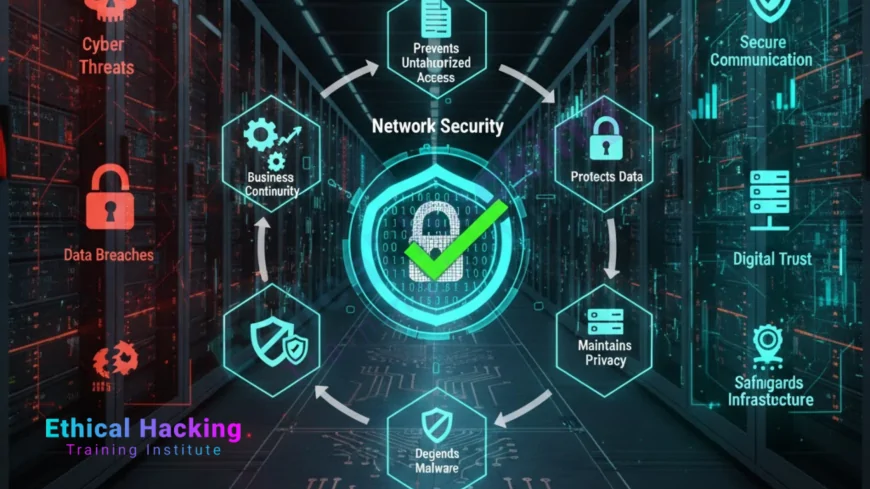
Network security is the practice of protecting the usability, reliability, integrity, and safety of your network and data. It includes hardware, software, policies, and procedures to block threats and ensure only authorized users access resources.
Core Goals (CIA Triad)
- Confidentiality: Only authorized people see data
- Integrity: Data isn’t altered in transit
- Availability: Systems stay online and accessible
It covers LANs, WANs, cloud networks, Wi-Fi, and even home routers.
Key Components of Network Security
Think of it as layered defense. Each tool plays a role.
| Component | Function | Example Tools |
|---|---|---|
| Firewalls | Block unauthorized traffic | pfSense, Cisco ASA |
| VPNs | Encrypt data in transit | OpenVPN, NordVPN |
| IDS/IPS | Detect and block attacks | Snort, Suricata |
| Encryption | Scramble data | TLS, IPsec |
| Access Control | Limit who enters | 802.1X, NAC |
No single tool wins. Layer them for defense in depth.
Common Network Threats and How Security Stops Them
Attackers target networks daily. Here’s what they do and how to stop it.
Major Threats
- Malware: Viruses, ransomware via infected files
- DDoS: Flood network to crash services
- Man-in-the-Middle (MitM): Intercept data on public Wi-Fi
- Packet Sniffing: Read unencrypted traffic
- Zero-Day Exploits: Unknown vulnerabilities
Defenses in Action
- Firewall blocks DDoS
- VPN stops MitM
- IDS flags malware
- Encryption hides data from sniffers
One breach costs $4.5 million on average. Prevention pays.
Learn to scan networks with an ethical bootcamp at the Ethical Hacking Institute.
Why Network Security Matters More Than Ever
The stakes are higher with digital transformation.
Top Reasons
- Remote Work: Employees connect from anywhere
- Cloud Adoption: Data lives outside your walls
- IoT Explosion: Smart devices = new attack points
- Ransomware Surge: 70 percent enter via networks
- Compliance: GDPR, HIPAA, PCI require protection
Weak networks caused 80 percent of 2024 breaches.
Real-World Examples of Network Security Failures
Learn from others’ mistakes.
Colonial Pipeline (2021)
Hackers used compromised VPN credentials. Ransomware shut down fuel supply for days.
SolarWinds (2020)
Supply chain attack via network software update. Affected 18,000 organizations.
Lesson
Patch, monitor, and segment. One weak link breaks the chain.
Simulate attacks safely with CEH practical labs from the Ethical Hacking Institute or Cyber Security Institute.
Best Practices for Strong Network Security
Follow these to stay protected:
- Segment Your Network: Separate guest, IoT, and critical systems
- Use Strong Encryption: TLS 1.3, WPA3 for Wi-Fi
- Enable MFA Everywhere: Especially VPN and admin access
- Patch Regularly: Automate updates
- Monitor Traffic: Use SIEM or IDS
- Train Users: Spot phishing, avoid public Wi-Fi
Zero Trust: “Never trust, always verify.”
Tools Every Network Security Pro Uses
Free and paid tools to get started:
Monitoring and Scanning
- Wireshark (packet analysis)
- Nmap (port scanning)
- Snort (IDS)
Firewalls and VPN
- pfSense (open-source firewall)
- OpenVPN (secure remote access)
Enterprise
- Palo Alto, Cisco Secure
- Splunk, Elastic SIEM
Master these in CEH online training at the Ethical Hacking Institute or Webasha Technologies.
How to Start a Career in Network Security
High demand, great pay. Entry roles:
- Network Security Analyst ($75K)
- Firewall Admin ($80K)
- SOC Technician ($70K)
Steps
- Learn basics (CompTIA Network+)
- Get Security+
- Practice with pfSense, Wireshark
- Earn CCNA Security or PCNSA
Bootcamps cut learning time in half.
Home Network Security: Protect Your Personal Life
Don’t neglect your router.
- Change default password
- Enable WPA3
- Disable WPS
- Use guest network
- Update firmware
- Turn off remote admin
One compromised IoT camera can expose your entire home.
Scan your network with Nmap mastery skills from the Ethical Hacking Institute.
Conclusion
Every click, call, payment, and file you share travels through a network, making network security the invisible armor that stops hackers from stealing your data, crashing systems, or holding your life for ransom. Without it, a single weak link can cost millions, expose personal information, or shut down critical services. In 2025, with billions of IoT devices, remote workers, and cloud systems in play, robust network protection isn’t a luxury, it’s survival. This guide demystifies network security: what it is, how firewalls, encryption, and zero trust work, the threats they stop, and simple steps you can take today. Whether you’re a beginner, IT professional, or business owner, mastering this keeps you safe. Start by locking down your home router, then level up with hands-on training at the Ethical Hacking Institute, Cyber Security Institute, or Webasha Technologies. Your digital world depends on it. Secure your network now, secure your future.
Frequently Asked Questions
Is antivirus enough for network security?
No. It protects devices, not the network itself.
Can I secure my network for free?
Yes. Use pfSense, OpenVPN, Snort, and strong passwords.
What’s the difference between IDS and IPS?
IDS detects. IPS detects and blocks.
Do I need a hardware firewall at home?
Not always. Good router + software works.
Is VPN always safe?
Only trusted providers. Free VPNs often sell data.
How often should I update my router?
Every 3 to 6 months or when patches release.
Can hackers access my smart TV?
Yes, if on the same network and unpatched.
Best cert for network security?
CompTIA Security+, then CCNA Security or PCNSA.
Is Wi-Fi safe in cafes?
No. Use VPN and avoid sensitive tasks.
Does 5G need network security?
Yes. Same threats, new attack surface.
Can I monitor my own traffic?
Yes. Install Wireshark or use router logs.
Zero trust for small business?
Yes. Tools like Cloudflare Access make it affordable.
Where to learn hands-on?
Ethical Hacking Institute bootcamps with live labs.
Is segmentation hard?
Not with VLANs. Most routers support it.
How to detect intruders?
Use Nmap to scan for unknown devices.
What's Your Reaction?
 Like
0
Like
0
 Dislike
0
Dislike
0
 Love
0
Love
0
 Funny
0
Funny
0
 Angry
0
Angry
0
 Sad
0
Sad
0
 Wow
0
Wow
0