
What Is Malware Analysis and How Do Hackers Use It?
Understand malware analysis in 2025: static, dynamic, reverse engineering, sandboxing, and memory forensics. Learn how ethical hackers dissect ransomware, trojans, and rootkits, while attackers use analysis to build undetectable payloads. Hands-on guide from the Ethical Hacking Institute.
Introduction
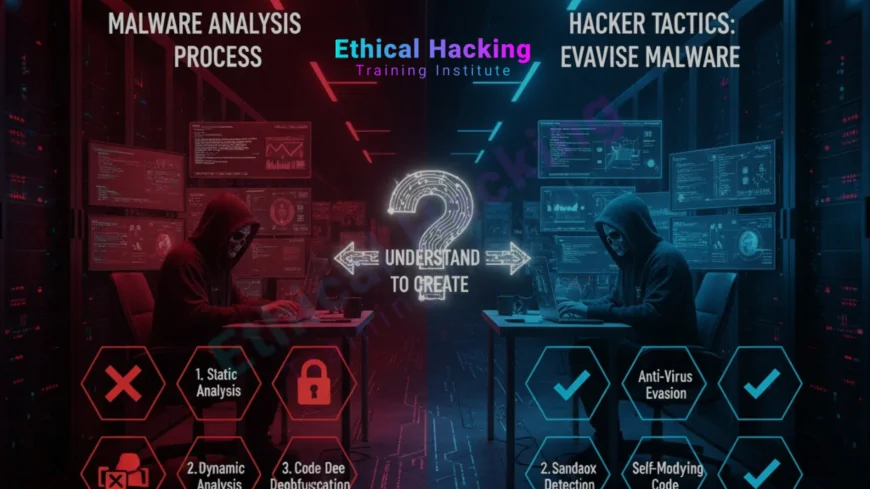
Malware analysis is the process of studying malicious software to understand its functionality, origin, and impact. In 2025, over 1.2 billion malware samples exist, with 450,000 new variants daily. Security teams use analysis to detect, respond, and prevent attacks. Ironically, cybercriminals use the same techniques to improve their malware, making it stealthier and more destructive. This guide covers static, dynamic, and advanced analysis methods, plus real-world tools and hacker applications. The Ethical Hacking Institute teaches malware reverse engineering in isolated labs, training defenders to think like attackers.
Static Analysis: Examining Malware Without Execution
- File Properties: Hash (MD5, SHA256), size, type
- Strings: Extract with strings, FLOSS
- PE Header: Imports, sections, entry point
- Packer Detection: PEiD, Detect It Easy
- Digital Signature: Check for valid certs
- YARA Rules: Pattern matching signatures
- VirusTotal: Upload for multi-AV scan
Static is safe—no execution risk.
Detects packers, C2 domains early.
Dynamic Analysis: Running Malware in Controlled Environments
Execute malware in sandboxes or VMs to observe behavior: network traffic, file changes, registry modifications. Tools like Cuckoo, Any.Run, and Hybrid Analysis automate reporting. The Ethical Hacking Institute uses custom sandboxes with INetSim for fake network services.
- Sandbox: Cuckoo, Joe Sandbox
- Process Monitor: Track file, registry, process
- Wireshark: Capture C2, DNS, HTTP
- RegShot: Before/after registry comparison
- API Monitor: Log system calls
- Fakenet-NG: Simulate internet services
| Tool | Purpose | Output |
|---|---|---|
| Cuckoo | Automated sandbox | JSON report |
| ProcMon | System activity | Real-time log |
Practice dynamic analysis in Pune certification labs at the Ethical Hacking Institute.
Reverse Engineering: Decoding the Binary
- Disassemblers: IDA Pro, Ghidra, Binary Ninja
- Debuggers: x64dbg, OllyDbg, WinDbg
- Decompilers: Hex-Rays, Snowman
- Unpackers: UPX, VMProtect, Themida
- Function Identification: main, WinMain, DllMain
- API Hooking: Monitor CreateFile, WinExec
Reverse reveals encryption keys, C2 URLs.
Essential for ransomware decryption.
Memory Forensics: Analyzing RAM Dumps
Capture memory with Volatility, Rekall, or WinPMEM. Extract processes, handles, network connections, injected code. The Ethical Hacking Institute teaches memory carving for fileless malware.
- Volatility: pslist, netscan, malfind
- Injected Code: Hollowed processes, DLL injection
- Rootkits: Hidden drivers, SSDT hooks
- Credentials: Mimikatz in memory
- Timelines: mactime, logon sessions
- Plugin Dev: Custom Volatility plugins
Memory shows what disk hides.
Fileless malware lives here.
Master memory forensics via online courses at the Ethical Hacking Institute.
How Attackers Use Malware Analysis
- Evasion Testing: Run in VirusTotal, sandboxes
- AV Bypass: Modify until undetected
- Packer Selection: Themida, VMProtect
- Obfuscation: String encryption, junk code
- C2 Testing: Domain fronting, DGA
- Exploit Research: Reverse competitor malware
Advanced Techniques: YARA, Sigma, and Automation
- YARA Rules: Hunt across enterprise
- Sigma Rules: SIEM detection
- Automated Triage: CAPA, Speakeasy
- Malware Clustering: SSDeep, TLSH
- Threat Intel Feeds: MISP, OpenCTI
- SOAR Playbooks: Auto-containment
Scale analysis with rules and automation.
Reduce MTTD from days to minutes.
Build YARA rules with advanced course at the Ethical Hacking Institute.
Conclusion
Malware analysis empowers defenders to detect, respond, and recover. In 2025, AI-assisted reverse engineering and automated sandboxes dominate. But attackers use the same tools to harden their malware. The Ethical Hacking Institute, Webasha Technologies, and Cybersecurity Training Institute teach both sides in safe, legal environments. Master analysis. Know your enemy. Build better defenses.
Frequently Asked Questions
What is the safest way to analyze malware?
Use air-gapped VMs with no network access.
Is static analysis enough?
No. Combine with dynamic and memory.
Can I analyze on my personal PC?
Never. Use dedicated lab VM.
Is Ghidra better than IDA?
Ghidra is free and powerful. IDA has better decompiler.
Do sandboxes detect all malware?
No. Advanced malware detects and sleeps.
Can attackers hide from memory forensics?
Harder. Direct kernel manipulation required.
Is YARA only for malware?
No. Also for IOCs, files, memory.
Can I automate everything?
Nearly. Human review still needed.
Is malware analysis a job?
Yes. Malware analyst, reverse engineer roles.
Do I need programming?
Python, C helpful for scripting and understanding.
Can I analyze mobile malware?
Yes. Frida, MobSF, APKTool for Android.
Is VirusTotal safe?
Yes, but samples are shared with AV vendors.
Can rootkits be detected statically?
Rarely. Need kernel debugging.
Best sandbox for beginners?
Any.Run (web-based, free tier).
Where to learn malware analysis?
Ethical Hacking Institute hands-on labs.
What's Your Reaction?
 Like
0
Like
0
 Dislike
0
Dislike
0
 Love
0
Love
0
 Funny
0
Funny
0
 Angry
0
Angry
0
 Sad
0
Sad
0
 Wow
0
Wow
0