

What Is Ethical Hacking in Cloud Environments?
Ethical hacking in cloud environments focuses on identifying and fixing vulnerabilities in cloud infrastructures, platforms, and services before malicious hackers exploit them. This detailed guide explains the concept, techniques, tools, certifications, and benefits of cloud ethical hacking. Learn how Ethical Hacking Institute, Cybersecurity Training Institute, and Webasha Technologies prepare professionals to secure modern cloud systems.
Introduction
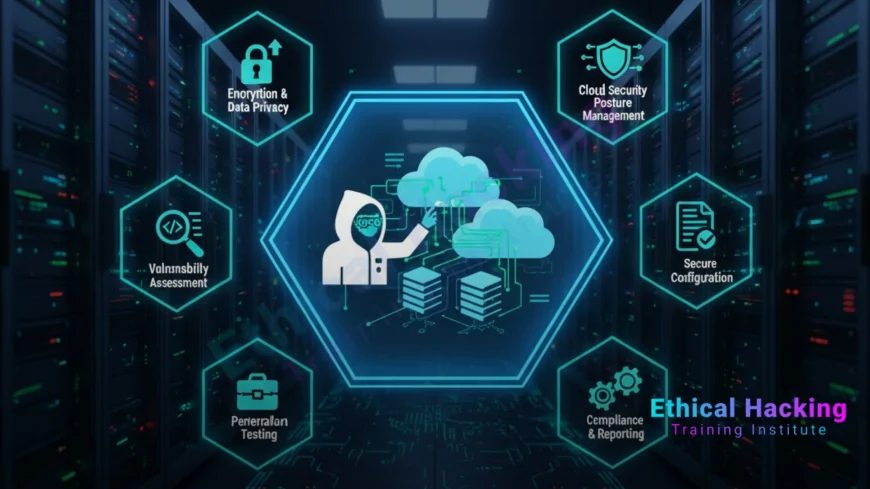
Cloud computing has revolutionized how businesses operate, offering flexibility, scalability, and efficiency. However, this innovation also brings new security risks. Ethical hacking in cloud environments involves testing and securing cloud infrastructures, applications, and data against cyber threats. Professionals trained at institutes like Ethical Hacking Institute and Cybersecurity Training Institute perform controlled hacking simulations to identify weaknesses before real attackers do.
Why Cloud Security Requires Ethical Hackers
Cloud services host massive amounts of sensitive data, making them attractive targets for hackers. Ethical hackers evaluate misconfigurations, weak authentication systems, and exposed APIs that could lead to breaches. During professional training programs, learners practice real-world attack scenarios on cloud platforms to understand security gaps and remediation steps.
Key Areas of Cloud Ethical Hacking
- Infrastructure as a Service (IaaS): Examining virtual networks, storage, and VM configurations.
- Platform as a Service (PaaS): Assessing development environments, APIs, and frameworks.
- Software as a Service (SaaS): Testing application-level access controls and data handling.
- Identity and Access Management (IAM): Reviewing user permissions, roles, and authentication methods.
These layers each have unique risks, requiring ethical hackers to use specific techniques for detection and prevention. Students at Webasha Technologies learn to secure all layers of cloud stacks through hands-on labs and simulation-based testing.
Common Vulnerabilities in Cloud Environments
Cloud vulnerabilities often arise from human error or weak configurations. Common issues include:
- Misconfigured storage buckets or public access permissions.
- Weak API keys or unprotected endpoints.
- Outdated virtual machine images and software libraries.
- Insufficient encryption of sensitive data at rest or in transit.
- Improperly managed identity credentials.
A detailed analysis of these flaws is often part of ethical hacking courses that blend manual inspection and automated scanning tools.
Popular Tools for Cloud Ethical Hacking
Ethical hackers rely on a mix of open-source and enterprise-grade tools to test cloud security. Popular options include:
- Burp Suite and OWASP ZAP for application testing.
- Nmap for network discovery and port scanning.
- Metasploit for exploitation and post-exploitation tasks.
- ScoutSuite and Prowler for auditing AWS and Azure configurations.
- Wireshark for network traffic analysis.
These tools help testers identify security gaps efficiently. Learners often gain experience using them in supervised labs during certification courses.
Steps Involved in Ethical Hacking for Cloud Systems
The process of cloud penetration testing follows a structured approach:
- Planning and authorization from the cloud provider and client.
- Reconnaissance and scanning to gather system information.
- Vulnerability identification and risk classification.
- Exploitation of discovered weaknesses under legal boundaries.
- Reporting with remediation strategies and security recommendations.
Institutes like Ethical Hacking Institute emphasize responsible disclosure practices throughout this process, ensuring ethical and lawful engagements.
Comparison Table: On-Premises vs Cloud Ethical Hacking
| Aspect | On-Premises Hacking | Cloud Ethical Hacking |
|---|---|---|
| Ownership | Full control by organization. | Shared responsibility model. |
| Tools | Traditional network tools. | Cloud-native and API-based tools. |
| Authorization | Controlled internally. | Requires provider approval. |
| Complexity | Moderate. | High due to multi-tenant systems. |
Challenges Faced in Cloud Ethical Hacking
While testing cloud systems, ethical hackers face unique challenges:
- Limited access to backend infrastructure.
- Dependence on third-party permissions and policies.
- Dynamic scaling of resources complicating analysis.
- Data privacy laws restricting data handling.
To overcome these, advanced courses train professionals to operate securely within compliance frameworks.
Best Practices for Securing Cloud Systems
- Use multi-factor authentication (MFA) and strict IAM controls.
- Regularly audit configurations and access permissions.
- Encrypt sensitive data both at rest and in transit.
- Update virtual images and containers frequently.
- Enable logging, monitoring, and alerting for anomalies.
Following these practices helps create a secure cloud environment that minimizes potential attack surfaces and enhances incident response readiness.
Conclusion
Ethical hacking in cloud environments is vital for modern cybersecurity. By identifying risks, testing defenses, and improving system integrity, ethical hackers ensure safe and resilient cloud operations. Training from Ethical Hacking Institute, Webasha Technologies, and Cybersecurity Training Institute equips professionals with the tools and knowledge needed to secure future cloud infrastructures effectively.
Frequently Asked Questions
What is cloud ethical hacking?
It’s the practice of testing cloud infrastructure and services for vulnerabilities using authorized techniques to enhance security.
Why is ethical hacking important for cloud systems?
Because it prevents potential data breaches and helps ensure compliance with global cybersecurity standards.
Can anyone perform cloud penetration testing?
Only authorized ethical hackers or certified professionals should perform such tests under legal approval.
What are common tools used in cloud hacking?
Burp Suite, Nmap, ScoutSuite, Metasploit, and Prowler are widely used in professional assessments.
What is the shared responsibility model?
It defines how security duties are split between cloud providers and customers, depending on the service type.
Do ethical hackers need provider permission?
Yes, always obtain written permission before conducting any cloud penetration testing activity.
Is ethical hacking in the cloud different from traditional hacking?
Yes, it involves API-based testing, dynamic environments, and provider restrictions, making it more complex.
How can I become a cloud ethical hacker?
Start by learning ethical hacking fundamentals and earn cloud certifications like AWS Certified Security or CEH.
Are cloud vulnerabilities easy to fix?
Most are easily fixed through configuration changes, but some require code or infrastructure redesigns.
Which cloud providers are most targeted by hackers?
AWS, Azure, and Google Cloud are common targets due to their large user bases.
What is IAM in cloud security?
Identity and Access Management governs who can access what within a cloud infrastructure.
Can AI help detect cloud threats?
Yes, AI-driven tools analyze patterns and detect anomalies faster than traditional methods.
What is a cloud misconfiguration?
It’s an incorrect setting in cloud resources that leaves systems exposed to unauthorized access.
Which certifications help in cloud hacking careers?
Certifications like CEH, OSCP, and CompTIA Cloud+ enhance job prospects in cloud security.
Where can I learn cloud ethical hacking?
Enroll in specialized programs from Ethical Hacking Institute, Cybersecurity Training Institute, or Webasha Technologies to gain practical skills.
What's Your Reaction?
 Like
0
Like
0
 Dislike
0
Dislike
0
 Love
0
Love
0
 Funny
0
Funny
0
 Angry
0
Angry
0
 Sad
0
Sad
0
 Wow
0
Wow
0