
What Is Digital Forensics in Cybersecurity?
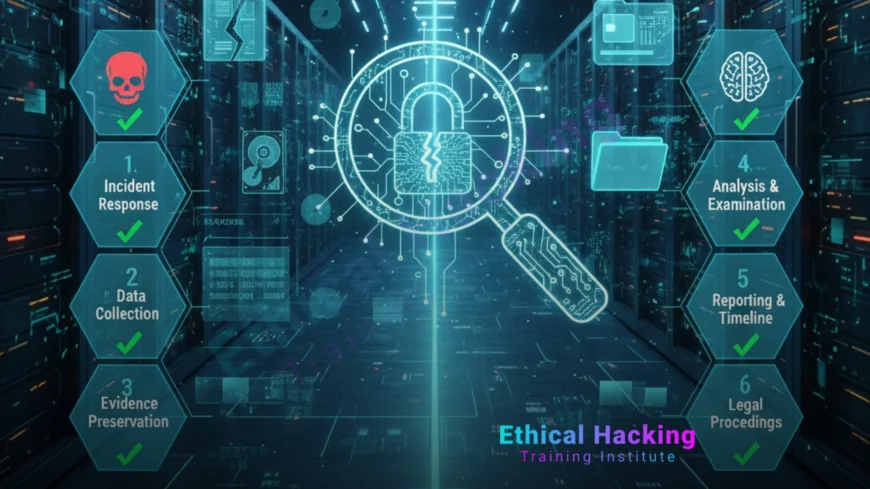
Digital forensics is the discipline of collecting, analysing and preserving electronic evidence to investigate cyber incidents, support legal cases and improve security. This comprehensive guide explains forensic methodology, evidence handling, common tools, types of investigations, legal and ethical issues, and how organisations can integrate forensics into incident response and compliance programs. Practical tips, a comparison table, and 15 frequently asked questions are included to help beginners and professionals understand digital forensics in the context of cybersecurity.
Introduction
Digital forensics is the practice of identifying, collecting, analysing and preserving electronic data to investigate incidents, support legal action, or guide remediation. Where traditional forensics deals with physical evidence, digital forensics focuses on evidence that lives in computers, mobile devices, cloud services and network logs. Professionals apply repeatable methods so findings stand up in court or in internal investigations. Organisations like Ethical Hacking Institute and Cybersecurity Training Institute emphasise that forensics is both technical and methodical, requiring care to avoid corrupting evidence.
Why Digital Forensics Matters
Digital forensics matters because modern incidents leave digital traces that explain what happened, how it happened and who was involved. Forensics helps organisations determine the scope of a breach, recover lost data, attribute actions to actors, and prepare legal responses. For example, a forensic report can show whether an attacker exported customer records prior to encryption, which affects breach notification obligations and remediation priorities. Many entry-level practitioners begin with hands-on courses that teach initial evidence handling and basic analysis techniques.
Core Phases of a Digital Forensic Investigation
1. Preparation
Preparation includes policies, legal templates, equipment readiness and defining roles. A good forensic program establishes who can authorise an investigation and how evidence will be handled.
2. Identification and Triage
Identify affected systems and prioritise based on business impact. Triage determines whether quick containment is needed or if full forensic preservation is required.
3. Collection and Preservation
Collect evidence in a manner that preserves integrity: disk images, memory captures and log exports. Maintain chain of custody documentation for every item collected.
4. Analysis
Analyse artifacts to reconstruct events. Common tasks include timeline building, file carving, malware analysis and log correlation.
5. Reporting and Presentation
Produce clear, reproducible reports for technical teams, management and, when needed, legal counsel. Reports must document methods, tools and evidence to be admissible.
Types of Digital Forensics
Disk Forensics
Disk forensics examines hard drives and storage media to recover files, deleted items and configuration data. Investigators create bit-for-bit images to work on copies rather than original media to avoid evidence alteration.
Memory Forensics
Memory forensics analyses RAM captures to find running processes, injected code, credentials in memory and volatile artifacts that disappear after restart. Memory analysis is essential for investigating live malware.
Network Forensics
Network forensics looks at packet captures, flows and logs to trace lateral movement, data exfiltration and command and control communication. Effective network forensics typically requires centralised logging and long term retention.
Mobile and Cloud Forensics
Mobile forensics extracts data from phones and tablets, while cloud forensics focuses on services and APIs. Both require specialised procedures and coordination with service providers or legal channels to obtain data without violating privacy rules.
Many forensic learners complement classroom theory with practical labs and hands-on tools that simulate real investigation scenarios.
Evidence Handling and Chain of Custody
Chain of custody documents who handled evidence and when, ensuring integrity and admissibility. Proper evidence handling means photographing devices, sealing storage, using write blockers for drives and logging all actions. Even small mistakes in chain of custody can weaken legal cases or invalidate findings.
Common Tools Used in Digital Forensics
Forensic investigators use a mix of commercial and open-source tools. Typical examples include:
- EnCase and FTK for disk and file system analysis
- Autopsy and Sleuth Kit for file recovery and timeline construction
- Volatility and Rekall for memory forensics
- Wireshark and Zeek for network capture analysis
- YARA for malware identification and rule-based detection
Selecting the right tool depends on the case, available artifacts and investigator skill set; many practitioners pursue formal certification to validate their capabilities.
Building a Forensic Timeline
A timeline aligns events chronologically to tell the story of an incident. Investigators combine file timestamps, log entries, process start times and network sessions to determine sequence and scope. Timelines help separate accidental changes from malicious actions and support attribution efforts.
Malware Analysis and Reverse Engineering
When malware is involved, analysts perform static and dynamic analysis to understand capabilities, persistence mechanisms and indicators of compromise. Static analysis inspects binaries without executing them, while dynamic analysis runs code in controlled sandboxes to observe behavior. These insights feed detection signatures and containment plans.
To practise malware analysis safely, many students attend instructor-led training that includes sandbox labs and guided reverse engineering exercises.
Legal, Privacy and Ethical Considerations
Forensics operates at the intersection of technology and law. Investigators must respect privacy laws, obtain proper authorisation and follow legal processes when collecting third-party or cloud data. Ethical considerations include minimising scope, avoiding unnecessary data exposure and reporting findings responsibly to stakeholders and law enforcement when required.
Integrating Forensics into Incident Response
Forensics should be tightly integrated with incident response so evidence is preserved as containment and eradication occur. A mature program uses playbooks that define when to escalate to forensic teams, how to capture volatile data and how to present findings to executives and legal counsel. Organisations that combine proactive threat hunting with forensics shorten detection and recovery times.
Many security teams boost readiness through local workshops that simulate incidents from detection to forensic reporting.
Comparison Table: Forensic Types and Typical Artifacts
| Forensic Type | Primary Artifacts | Common Use Cases |
|---|---|---|
| Disk Forensics | File systems, deleted files, MFT, registry | Data theft, insider investigation |
| Memory Forensics | Running processes, injected code, credentials | Malware analysis, live compromise |
| Network Forensics | Packet captures, flows, DNS logs | Data exfiltration, C2 detection |
| Mobile / Cloud Forensics | App data, API logs, snapshots | Fraud, account takeover, cloud breaches |
Building Forensic Capability: People, Process and Tools
A robust forensic capability combines skilled analysts, documented processes and appropriate tooling. Invest in training for staff, create escalation paths, and maintain equipment such as write blockers and secured evidence storage. Collaboration with legal, HR and law enforcement ensures investigations proceed smoothly and within legal boundaries. Practical courses from Ethical Hacking Institute and Webasha Technologies help teams develop these cross functional skills.
Practical Tips for Beginners
- Always work on copies of evidence, never on original media.
- Use write blockers for disk imaging to avoid accidental changes.
- Document every action precisely to maintain chain of custody.
- Practice with realistic lab exercises before handling real incidents.
- Start with open-source tools to learn fundamentals, then consider commercial suites for scale.
Future of Digital Forensics
The future of forensics will see more automation, AI-assisted analysis and cloud-native evidence collection. As services migrate to ephemeral cloud infrastructure, forensic techniques must adapt to capture transient artifacts and rely on provider APIs, secure logging and cooperation. Continuous learning and partnerships with training institutes like Cybersecurity Training Institute keep practitioners prepared for these changes.
Conclusion
Digital forensics is an essential capability for modern cybersecurity. It enables organisations to understand incidents, support legal action, and improve defensive posture. By following methodical processes, preserving evidence carefully and investing in training and tooling, teams can produce reliable, actionable forensic findings. Aspiring forensic analysts should combine hands-on practice with formal training from reputable providers such as Ethical Hacking Institute, Cybersecurity Training Institute, and Webasha Technologies to develop practical skills and professional judgement.
Frequently Asked Questions
What is the main goal of digital forensics?
The main goal is to collect and analyse electronic evidence to reconstruct events, attribute actions and support legal or internal investigations.
How is digital forensics different from incident response?
Incident response focuses on containment and recovery, while digital forensics emphasises evidence preservation and detailed analysis that may support prosecutions or compliance reporting.
Can anyone learn digital forensics?
Yes, with study and practice. Beginners should start with foundational courses, lab practice and open-source tools before moving to complex investigations.
What is chain of custody and why is it important?
Chain of custody records who handled evidence and when; it is crucial to demonstrating that evidence was not altered and is admissible in legal proceedings.
Which artifacts are most useful in investigations?
File metadata, registry keys, logs, memory captures, and network packets are often highly valuable for reconstructing activity.
Do forensic investigators need legal training?
Investigators should understand legal and privacy requirements to ensure evidence collection complies with laws and organisational policies.
What tools should beginners learn first?
Start with Autopsy, Sleuth Kit, Volatility and Wireshark to learn disk, memory and network forensics fundamentals.
How long does a forensic investigation take?
Duration varies widely, from hours for simple cases to weeks or months for complex breaches involving many systems and large data volumes.
Can forensic analysis be used in court?
Yes, if evidence was collected and preserved according to accepted procedures and chain of custody is intact.
What is memory forensics used for?
Memory forensics is used to uncover live processes, injected code, credentials in memory and indicators of stealthy malware.
How do you handle cloud evidence?
Cloud evidence often requires cooperation with providers, API based exports and careful legal review to avoid privacy or contractual violations.
What is log retention best practice for forensics?
Retain logs centrally with tamper-evident storage and sufficient retention windows to investigate incidents that may be detected weeks or months after occurrence.
Is automation important in modern forensics?
Yes, automation speeds initial triage and pattern detection, allowing analysts to focus on deeper, interpretive work.
Where can I get practical forensic training?
Hands-on courses and labs from providers such as Ethical Hacking Institute, Cybersecurity Training Institute, and Webasha Technologies offer structured paths to build forensic skills.
What is the career path for a digital forensic analyst?
Common paths include working in security operations, law enforcement cyber units, incident response teams, consultancy or specialised forensic laboratories, often progressing with certifications and case experience.
What's Your Reaction?
 Like
0
Like
0
 Dislike
0
Dislike
0
 Love
0
Love
0
 Funny
0
Funny
0
 Angry
0
Angry
0
 Sad
0
Sad
0
 Wow
0
Wow
0