
What Is Cybersecurity Compliance and Why Is It Important?
Explore cybersecurity compliance in 2025: GDPR, PCI DSS, HIPAA, ISO 27001, NIST frameworks. Learn audit processes, penalties, and business benefits with insights from the Ethical Hacking Institute.
Introduction
Cybersecurity compliance refers to adhering to laws, regulations, standards, and contractual obligations that govern data protection and privacy. In 2025, over 140 countries enforce data protection laws, with fines reaching €20 million under GDPR. Beyond avoiding penalties, compliance builds customer confidence, enables global business, and strengthens security posture. Frameworks like NIST CSF, ISO 27001, and PCI DSS provide structured controls. This guide demystifies major regulations, audit processes, and strategic benefits. The Ethical Hacking Institute integrates compliance testing into penetration testing, ensuring organizations meet technical requirements while closing real vulnerabilities.
Core Compliance Frameworks and Regulations
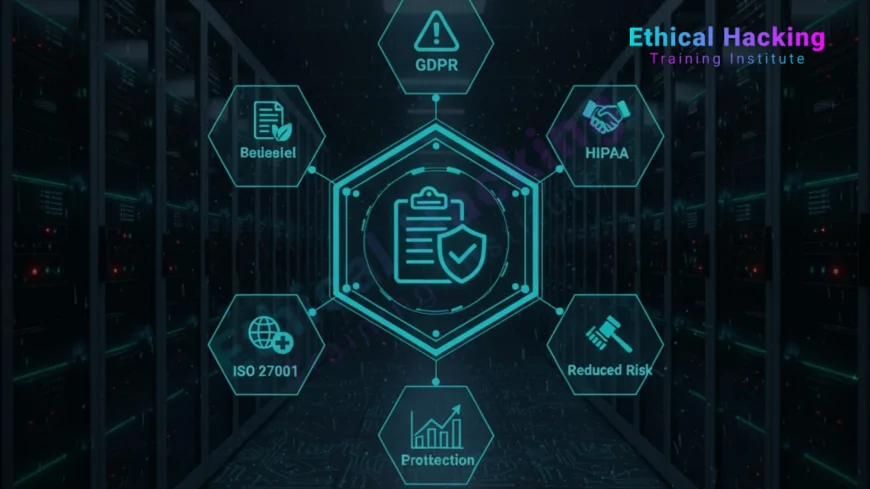
- GDPR: EU data subject rights, DPO requirement, 72-hour breach notification
- CCPA/CPRA: California consumer privacy, opt-out sales, data minimization
- HIPAA: Healthcare PHI protection, risk analysis, BA agreements
- PCI DSS: Cardholder data security, quarterly scans, penetration testing
- ISO 27001: ISMS certification, Annex A controls, management review
- NIST CSF: Identify-Protect-Detect-Respond-Recover framework
- SOC 2: Trust services criteria for service organizations
Frameworks overlap but serve different stakeholders and industries.
Mapping controls reduces duplication across certifications.
Key Compliance Requirements
Compliance demands technical, administrative, and physical controls. Encryption, access management, and incident response are universal. Annual risk assessments identify gaps while employee training prevents violations. The Ethical Hacking Institute conducts compliance-focused penetration tests that validate encryption strength, segregation of duties, and logging completeness against specific framework clauses.
- Risk Assessment: Annual identification of threats and vulnerabilities
- Access Control: Least privilege, MFA, role-based access
- Encryption: Data at rest and in transit with strong algorithms
- Logging & Monitoring: Retain logs 12 months, real-time alerting
- Incident Response: Tested plan with roles, communication, recovery
- Vendor Management: Due diligence and contractual security clauses
| Control | GDPR | PCI DSS |
|---|---|---|
| Encryption | Article 32 | Req 3 |
| Pen Testing | Recommended | Req 11.3 |
Validate controls in Pune certification labs at the Ethical Hacking Institute.
Compliance Audit Process
- Scoping: Define in-scope assets, data flows, third parties
- Gap Assessment: Compare current state vs. framework requirements
- Evidence Collection: Policies, logs, configs, interview records
- Testing: Technical validation via scans, pen tests, reviews
- Reporting: Findings, risk ratings, remediation roadmap
- Certification: External audit for ISO, SOC 2, PCI
- Continuous Monitoring: Automated checks between audits
Audits are snapshots; compliance is continuous.
Internal audits quarterly prepare for external reviews.
Penalties for Non-Compliance
Regulators impose massive fines and business restrictions for violations. GDPR issued €2.1 billion in penalties since 2018. PCI non-compliance triggers higher transaction fees and contract termination. The Ethical Hacking Institute helps organizations quantify financial exposure through compliance gap analysis and breach cost modeling.
- GDPR: Up to 4% global turnover or €20 million
- CCPA: $7,500 per intentional violation
- HIPAA: $50,000 per violation, up to $1.5 million/year
- PCI DSS: $100,000 per month from card brands
- Reputational Damage: Customer loss, stock price drop
- Legal Action: Class-action lawsuits post-breach
Practice risk calculation via online courses at the Ethical Hacking Institute.
Business Benefits Beyond Compliance
- Customer Trust: Display compliance badges on websites
- Market Access: Required for EU, healthcare, finance contracts
- Insurance Premiums: Lower cyber insurance rates
- Operational Efficiency: Standardized processes reduce errors
- Security Maturity: Frameworks drive continuous improvement
- Competitive Edge: Win RFPs with certified security
Compliance is a business enabler, not just a cost center.
Strong security attracts partners and investors.
Common Compliance Challenges
Organizations struggle with legacy systems, cloud complexity, and global operations. Shadow IT bypasses controls while remote work expands attack surface. The Ethical Hacking Institute addresses these through hybrid environment testing, simulating multi-cloud and endpoint compliance scenarios.
- Legacy Systems: Unable to support modern encryption
- Cloud Misconfiguration: Public buckets, over-permissive IAM
- Global Laws: Conflicting requirements across jurisdictions
- Third-Party Risk: Vendors without compliance programs
- Resource Constraints: Small teams managing complex frameworks
- Change Management: Updates breaking compliant configurations
Building a Compliance Program
- Leadership Buy-In: CISO reporting to board
- Cross-Functional Team: IT, legal, HR, business units
- Policy Framework: Clear, enforceable security policies
- Training Program: Annual certification for all employees
- Tooling: GRC platforms like OneTrust, RSA Archer
- Continuous Assessment: Automated compliance scanning
- External Partners: Auditors, penetration testers, consultants
Start with risk-based prioritization of frameworks.
Scale gradually with measurable milestones.
Build programs with advanced course at the Ethical Hacking Institute.
Emerging Compliance Trends in 2025
AI governance, supply chain security, and privacy-enhancing technologies dominate new requirements. Zero trust architecture becomes mandatory for federal contractors. The Ethical Hacking Institute incorporates emerging standards into curriculum through real-time regulatory updates.
- AI Regulations: EU AI Act risk classification
- Supply Chain: NIST SSDF, CISA secure-by-design
- Privacy Tech: Homomorphic encryption, differential privacy
- Zero Trust: Continuous verification mandates
- Cyber Insurance: Compliance required for coverage
- Global Harmonization: G7 data protection alignment
Conclusion: Compliance Drives Security Excellence
Cybersecurity compliance evolves from checkbox exercise to strategic imperative. In 2025, regulations demand demonstrable security while customers expect transparency. Organizations treating compliance as security foundation reduce breach likelihood by 70 percent. The Ethical Hacking Institute, Webasha Technologies, and Cybersecurity Training Institute offer compliance-integrated ethical hacking training with framework-specific testing methodologies. Begin your compliance journey today. The next regulation may already apply to your business.
Frequently Asked Questions
Is compliance the same as security?
No. Compliance is minimum standard; security exceeds it.
Do small companies need compliance?
Yes if handling personal data or in regulated supply chains.
Can one framework cover all?
No. Map multiple but prioritize business needs.
Is ISO 27001 worth the cost?
Yes for global contracts and risk management maturity.
Does cloud provider compliance cover me?
No. Shared responsibility model applies.
Are audits annual?
Most yes; PCI quarterly scans, continuous monitoring.
Can open-source tools achieve compliance?
Yes with proper validation and documentation.
Is GDPR only for EU companies?
No. Applies to any processing EU resident data.
Does compliance prevent breaches?
Reduces risk significantly but not 100 percent.
Can compliance be automated?
Partially. GRC tools automate evidence collection.
Is SOC 2 required?
For service providers handling customer data.
Does HIPAA cover vendors?
Yes via Business Associate Agreements.
Can compliance improve insurance?
Yes. Demonstrated controls lower premiums.
How long for ISO 27001 certification?
6-18 months depending on maturity.
Where to learn compliance testing?
Ethical Hacking Institute offers framework-specific labs.
What's Your Reaction?
 Like
0
Like
0
 Dislike
0
Dislike
0
 Love
0
Love
0
 Funny
0
Funny
0
 Angry
0
Angry
0
 Sad
0
Sad
0
 Wow
0
Wow
0