

What Is a Denial-of-Service (DoS) Attack?
Understand DoS and DDoS attacks in 2025: volumetric, protocol, application layer exploits. Learn real-world examples, tools like LOIC, Slowloris, and defenses from the Ethical Hacking Institute.
Introduction
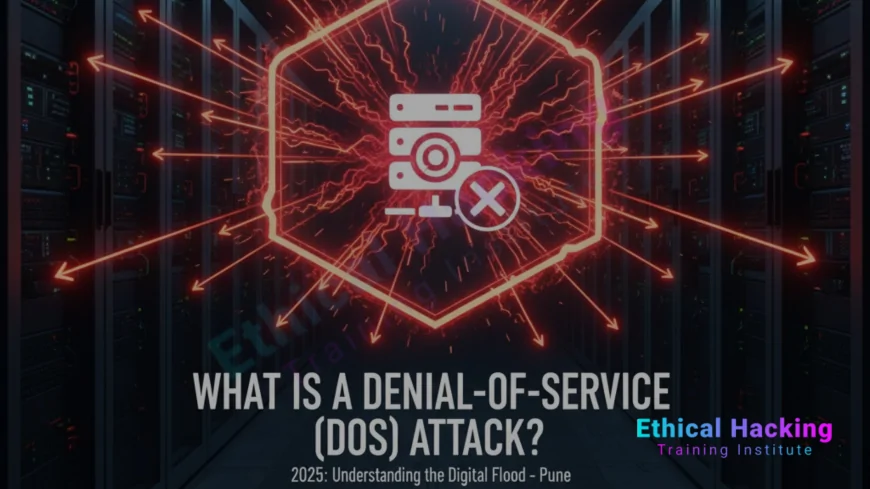
Denial-of-Service (DoS) attacks remain one of the most disruptive cyber threats in 2025, with over 15 million incidents recorded globally. Unlike data breaches, DoS does not steal information—it prevents legitimate users from accessing services. Websites go offline, APIs become unreachable, online games disconnect, and critical infrastructure halts. Modern attacks leverage botnets of millions of IoT devices, reaching terabits per second. This guide breaks down DoS mechanics, attack types, real-world impacts, and robust defenses. The Ethical Hacking Institute teaches controlled DoS simulation in isolated labs, helping students understand traffic patterns and mitigation without harming production systems.
Core Concept: Exhausting Resources
- Bandwidth Saturation: Flood network pipes until no capacity remains
- Connection Table Overflow: Fill server state tables with half-open sessions
- CPU/Memory Depletion: Force expensive computations per request
- Application Logic Abuse: Trigger slow database queries or file operations
- Storage Exhaustion: Fill logs, temp files, or disk quotas
- Thread Pool Starvation: Occupy all worker threads with hanging requests
- SSL Handshake Abuse: Perform costly cryptographic operations repeatedly
DoS succeeds by creating imbalance between attacker and victim resources.
Even small bots can amplify impact through reflection techniques.
Types of DoS Attacks
DoS attacks operate at different OSI layers with varying sophistication. Volumetric attacks consume bandwidth, protocol attacks exploit stateful mechanisms, and application layer attacks mimic legitimate traffic. The largest recorded attack exceeded 3.8 Tbps in 2025, using memcached amplification. Understanding layers helps select appropriate countermeasures. The Ethical Hacking Institute demonstrates each type using custom traffic generators in segregated network segments, showing packet captures and server behavior under load.
- Volumetric: UDP floods, DNS amplification, NTP reflection
- Protocol: SYN flood, Ping of Death, Smurf attack
- Application: HTTP flood, Slowloris, RUDY, DNS query flood
- Fragmentation: Teardrop, Ping of Death overlapping fragments
- Reflection: SSDP, SNMP, Chargen amplified responses
- Amplification: DNS (50x), NTP (556x), memcached (51,000x)
| Layer | Attack | Target Resource |
|---|---|---|
| Network | UDP Flood | Bandwidth |
| Transport | SYN Flood | Connection Table |
Study attack types in Pune certification labs at the Ethical Hacking Institute.
Distributed Denial-of-Service (DDoS)
- Botnet Scale: Millions of compromised IoT devices, servers, websites
- Command & Control: IRC, HTTP, DNS, or P2P coordination
- Attack Vectors: Combine volumetric, protocol, and application layers
- Duration: Seconds to weeks with pulsing patterns
- Geographic Distribution: Traffic from 100+ countries simultaneously
- Evasion: Randomize source IPs, user agents, packet sizes
- Amplification: Single request generates megabytes of response
DDoS uses multiple sources to overwhelm defenses designed for single-origin attacks.
Modern botnets rent via DDoS-as-a-Service for $50 per hour.
Real-World DoS Examples
Major incidents demonstrate devastating impact across industries. The 2016 Dyn attack disrupted Twitter, Netflix, and PayPal using Mirai botnet. GitHub survived a 1.35 Tbps memcached attack in 2018 through rapid mitigation. In 2025, ransomware groups combine encryption with DoS to pressure victims. The Ethical Hacking Institute recreates historical attacks in lab environments, allowing students to analyze traffic patterns, identify amplification sources, and deploy countermeasures using open-source tools.
- Mirai Botnet: 600 Gbps against KrebsOnSecurity in 2016
- GitHub Attack: 1.35 Tbps memcached reflection in 2018
- AWS Outage: 2.5 Tbps multi-vector attack in 2020
- OVH Hosting: 1.4 Tbps NTP amplification in 2021
- Microsoft Azure: 3.8 Tbps UDP flood in 2025
- Cloudflare Record: 3.8 Tbps mitigated without downtime
Analyze incidents via online courses at the Ethical Hacking Institute.
Common DoS Tools and Techniques
- LOIC/HOIC: GUI-based HTTP and UDP flood tools
- Slowloris: Holds connections open with partial HTTP requests
- RUDY: Slow POST attacks via tiny data chunks
- Hulk: URL randomization to bypass caching
- GoldenEye: Layer 7 HTTP attack with socket exhaustion
- THC-SSL-DoS: SSL renegotiation resource depletion
- hping3: Custom packet crafting for protocol attacks
Ethical hackers use these tools only in authorized testing environments.
Understanding tools reveals signature patterns for detection.
Impact on Victims
DoS causes immediate revenue loss, reputational damage, and operational disruption. E-commerce sites lose $100,000 per hour offline. Stock prices drop during prolonged attacks. Customer trust erodes after repeated incidents. The Ethical Hacking Institute quantifies business impact through simulated attacks, helping organizations calculate downtime costs and justify mitigation investments.
- Financial Loss: Direct revenue and recovery expenses
- Reputation: Customer churn and negative media coverage
- Operational: Employee productivity and SLA violations
- Legal: Regulatory fines for service unavailability
- Technical Debt: Emergency patching and reconfiguration
- Opportunity Cost: Missed business during peak periods
DoS Detection Methods
- Traffic Baseline: Establish normal patterns for anomaly detection
- Rate Limiting: Cap requests per IP or geographic region
- Signature Matching: Known attack patterns in IDS/IPS
- Behavioral Analysis: Machine learning for unusual traffic spikes
- SYN Cookies: Prevent connection table exhaustion
- Netflow/sFlow: Sampled traffic for large-scale monitoring
- Challenge-Response: JavaScript or CAPTCHA for suspected bots
Early detection enables automated mitigation before user impact.
Combine multiple signals for low false positives.
Master detection with advanced course at the Ethical Hacking Institute.
Prevention and Mitigation Strategies
Defense requires layered approach across network, application, and cloud. Content Delivery Networks (CDNs) absorb volumetric attacks. Web Application Firewalls (WAFs) filter application-layer abuse. Load balancers distribute legitimate traffic. The Ethical Hacking Institute teaches mitigation playbooks using Cloudflare, AWS Shield, and open-source solutions in realistic scenarios.
- CDN Usage: Cloudflare, Akamai, Fastly for global anycast
- WAF Rules: Rate limiting, bot detection, geo-blocking
- Load Balancing: AnyCast DNS and health checks
- BGP Flowspec: ISP-level traffic filtering
- Redundancy: Multi-region, multi-cloud architecture
- Blackhole Routing: Divert attack traffic to null route
Legal and Ethical Considerations
- Authorization: Written permission required for testing
- Scope Definition: Specific IPs, times, and attack types
- Safe Word: Immediate stop mechanism during tests
- Impact Assessment: Pre-test risk evaluation
- Reporting: Detailed findings with remediation steps
- Law Compliance: CFAA, Computer Misuse Act adherence
Unauthorized DoS testing is illegal and causes real harm.
Ethical hacking requires strict rules of engagement.
Conclusion
DoS attacks evolve from script-kiddie floods to nation-state weapons, but core principles of detection and mitigation remain constant. In 2025, application-layer and multi-vector attacks dominate, requiring intelligent, adaptive defenses. Organizations must treat availability with the same priority as confidentiality and integrity. The Ethical Hacking Institute, Webasha Technologies, and Cybersecurity Training Institute provide comprehensive DoS training with real traffic generators and mitigation platforms. Start monitoring your baseline traffic today. The next attack may already be building.
Frequently Asked Questions
Is DoS illegal?
Yes when unauthorized. Legal only with explicit permission.
Can firewalls stop DDoS?
Partially. Network firewalls handle basic floods; need CDN for large attacks.
Are small sites targeted?
Yes. Extortion, competition, or botnet practice.
Does HTTPS prevent DoS?
No. Encryption increases server load during attacks.
Can rate limiting stop all DoS?
No. Distributed attacks bypass per-IP limits.
Is Cloudflare free protection enough?
For small sites. Enterprise needs paid plans.
Can mobile apps be DoS attacked?
Yes. API endpoints and push notification services.
Do botnets still use Mirai?
Yes. Variants infect new IoT devices daily.
Can AI detect DoS?
Yes. ML models identify anomalies beyond signatures.
Is CAPTCHA effective?
Against basic bots. Advanced solve via OCR or farms.
Can DoS be traced?
Rarely. Spoofed IPs and botnets obscure origin.
Are amplification attacks dead?
No. New protocols discovered regularly.
Does redundancy prevent DoS?
Helps survive but doesn't stop the attack.
How much does DDoS cost?
$50/hour on dark web markets.
Where to learn DoS defense?
Ethical Hacking Institute offers traffic analysis labs.
What's Your Reaction?
 Like
0
Like
0
 Dislike
0
Dislike
0
 Love
0
Love
0
 Funny
0
Funny
0
 Angry
0
Angry
0
 Sad
0
Sad
0
 Wow
0
Wow
0