


What Are the Most Common Web Application Vulnerabilities?
Explore the top 10 web application vulnerabilities in 2025 based on OWASP. Learn SQL injection, XSS, CSRF, IDOR, SSRF, and more with real examples, exploitation methods, and prevention techniques from the Ethical Hacking Institute.
Introduction
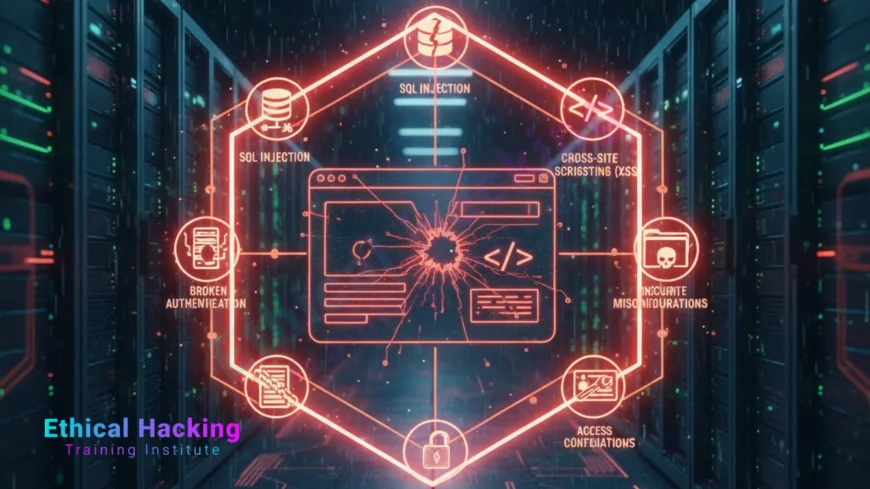
Web applications power modern business, but 94 percent contain high-severity vulnerabilities according to recent studies. The OWASP Top 10 represents the most critical security risks based on real-world data from thousands of applications. In 2025, API abuse, server-side request forgery, and broken access control dominate due to microservices and cloud adoption. Understanding these vulnerabilities is essential for developers, pentesters, and security professionals. This guide covers each risk with exploitation examples, business impact, and practical prevention methods. The Ethical Hacking Institute teaches web application security through hands-on labs with deliberately vulnerable applications like DVWA and WebGoat.
1. Broken Access Control: The Silent Gateway
- Vertical Privilege Escalation: Regular user accesses admin functions
- Horizontal Escalation: User A views User B's data
- IDOR: Changing URL parameters to access unauthorized resources
- Missing Function Level Checks: API endpoints without proper authorization
- Force Browsing: Accessing hidden directories without authentication
- Insecure Direct Object References: Exposing internal identifiers
2. Cryptographic Failures: Data Exposure Risks
Formerly sensitive data exposure, this category covers weak encryption, hard-coded credentials, and improper certificate validation.
Attackers intercept or decrypt data in transit or at rest.
| Issue | Example | Impact |
|---|---|---|
| Hard-coded Keys | API keys in JavaScript | Full compromise |
| Weak TLS | SSLv3 support | MITM attacks |
Test cryptographic flaws in Pune certification labs at the Ethical Hacking Institute.
3. Injection Attacks: SQL, Command, and Beyond
- SQL Injection:
1' OR '1'='1bypasses login - Command Injection:
; cat /etc/passwdexecutes OS commands - NoSQL Injection: MongoDB queries with
{$ne: null} - LDAP Injection: Modifying authentication filters
- XXE: XML external entity processing
- Template Injection: Server-side template engines
4. Insecure Design: Flaws from the Start
New in OWASP 2025, this category addresses security anti-patterns and missing controls in application architecture.
Prevention requires threat modeling during design phase.
- Lack of rate limiting enables brute force
- No password complexity enforcement
- Missing multi-factor authentication
- Improper session timeout handling
- No account lockout mechanism
- Weak password recovery process
Learn secure design via online courses at the Ethical Hacking Institute.
5. Security Misconfiguration: Default Settings Doom
Default credentials, unnecessary features, and verbose error messages provide attackers with reconnaissance data.
Automated scanners detect 80 percent of misconfigurations.
- Default admin/admin credentials
- Directory listing enabled
- Debug mode in production
- Unnecessary HTTP methods (PUT, DELETE)
- CORS misconfiguration
- Cloud storage public buckets
6. Vulnerable and Outdated Components
- Using known vulnerable libraries (Log4Shell)
- Unpatched application frameworks
- Abandoned open-source dependencies
- Client-side JavaScript libraries
- Container images with CVEs
- Outdated SSL/TLS versions
7. Identification and Authentication Failures
Broken authentication enables account takeover. Modern attacks combine credential stuffing with MFA bypass.
Rate limiting and monitoring detect automated attacks early.
| Attack | Method | Prevention |
|---|---|---|
| Credential Stuffing | Breached passwords | HaveIBeenPwned check |
| Session Fixation | Pre-set session ID | Regenerate on login |
Master authentication security with advanced course at the Ethical Hacking Institute.
8. Software and Data Integrity Failures
- Insecure deserialization of user input
- Unverified software updates
- CI/CD pipeline compromise
- Insecure supply chain dependencies
- Cache poisoning attacks
- Unsigned firmware updates
9. Security Logging and Monitoring Failures
Without proper logging, attacks go undetected. 67 percent of breaches take months to discover.
SIEM integration and alerting enable rapid response.
- No login failure logging
- Missing security event monitoring
- Log injection attacks
- Insufficient log retention
- No integrity checking for logs
- Lack of alerting on suspicious activity
10. Server-Side Request Forgery (SSRF)
Applications fetch remote resources based on user input, allowing internal network access.
Cloud metadata endpoints (169.254.169.254) are prime targets.
- Access internal admin panels
- Scan internal network ports
- Read cloud instance metadata
- Pivot to internal services
- Access file:// resources
- Bypass firewall restrictions
Conclusion: Building Secure Web Applications
The OWASP Top 10 evolves with technology, but core principles remain: validate input, authenticate properly, authorize strictly, and encrypt sensitive data. In 2025, API security, cloud configurations, and supply chain risks dominate the landscape. Secure development requires shifting left, integrating security from design through deployment. The Ethical Hacking Institute, Cyber Security Institute, and Webasha Technologies offer comprehensive web application security training with real vulnerable applications. Start testing one vulnerability today. Every secure application begins with awareness of what can go wrong.
Frequently Asked Questions
What is OWASP Top 10?
Consensus list of most critical web application security risks based on real data.
Is SQL injection still common?
Yes. 1 in 10 applications remain vulnerable despite decades of awareness.
Can WAF stop all attacks?
No. WAF helps but proper coding is essential. Zero-day bypasses exist.
Are APIs more vulnerable?
Yes. APIs often lack browser security controls and have complex logic.
Does HTTPS prevent XSS?
No. HTTPS encrypts traffic but XSS executes in browser context.
Is CSRF dead with SameSite cookies?
Reduced but not eliminated. Legacy systems and misconfiguration persist.
Can IDOR be prevented automatically?
No. Requires proper authorization checks on every object access.
Are frameworks secure by default?
No. Secure configuration and proper usage are required.
Does rate limiting stop brute force?
Helps but determined attackers use distributed methods.
Is SSRF only a cloud issue?
No. Any server fetching user-supplied URLs is vulnerable.
Can automated scanners find all issues?
No. 60% of critical flaws require manual testing and business logic understanding.
Are mobile apps affected?
Yes. Same vulnerabilities apply to backend APIs serving mobile clients.
Does DevSecOps solve everything?
Helps significantly but human oversight remains crucial.
How often should testing occur?
With every major release and quarterly for critical applications.
Where to practice web vulnerabilities?
Ethical Hacking Institute provides safe labs with DVWA, WebGoat, and custom apps.
What's Your Reaction?
 Like
0
Like
0
 Dislike
0
Dislike
0
 Love
0
Love
0
 Funny
0
Funny
0
 Angry
0
Angry
0
 Sad
0
Sad
0
 Wow
0
Wow
0