

What Are the Most Common Vulnerabilities in Web Applications?
Discover the top 10 most common web application vulnerabilities in 2025 according to OWASP Top 10: Broken Access Control, Cryptographic Failures, Injection, XSS, SSRF, and more. Learn how to find and fix them with real labs from Ethical Hacking Training Institute, Webasha Technologies, and Cybersecurity Training Institute. Secure your web apps today.
Introduction
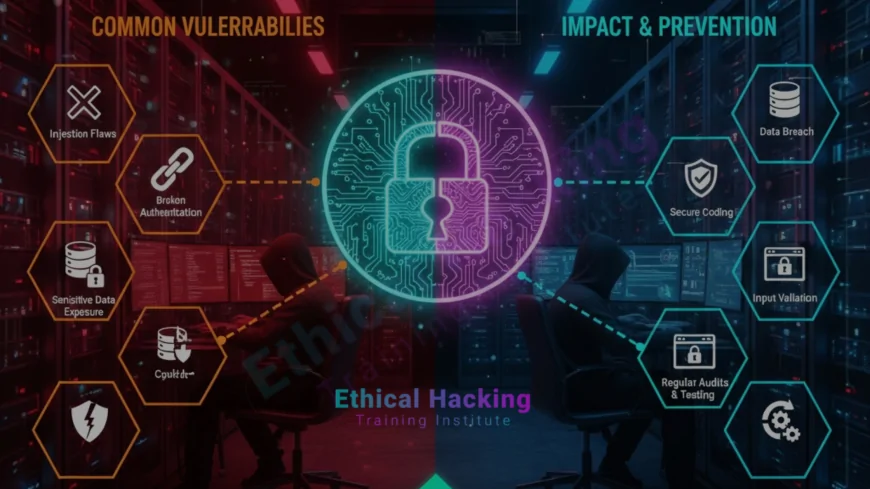
Over 90 percent of successful breaches in 2025 start with a web application flaw. OWASP Top 10 lists the most critical risks every year. India saw 2.1 million web attacks daily last quarter. One vulnerable login page can expose millions of users. Ethical Hacking Training Institute teaches all OWASP Top 10 with 100+ vulnerable web apps in labs. Webasha Technologies and Cybersecurity Training Institute deliver 100 percent placement. This guide explains the top 10 vulnerabilities, real examples, and how to fix them. Perfect for developers and pentesters. Start securing now. Explore the cybersecurity career path.
1. Broken Access Control
Number one in OWASP 2025. Users can act outside their intended permissions. Examples: view other user profiles, change admin settings, access API without login. Real case: Hacker changed URL parameter user_id=123 to 456 and viewed victim data. Ethical Hacking Training Institute has 20+ IDOR labs. Fix with proper authorization checks on server side. Find the best local courses for access control testing.
Common Broken Access Control Types
- IDOR (Insecure Direct Object Reference)
- Vertical privilege escalation
- Horizontal privilege escalation
- Missing function level access control
- Force browsing to hidden pages
- API without authentication
- Parameter tampering
2. Cryptographic Failures
- Weak encryption algorithms
- Hard-coded passwords
- No HTTPS or weak TLS
- Predictable tokens
- Storing passwords in plain text
- Outdated crypto libraries
- Webasha Technologies fixes in labs
3. Injection Attacks
- SQL injection
- Command injection
- LDAP injection
- NoSQL injection
- XXE (XML External Entity)
- Template injection
- Cybersecurity Training Institute demos live
4. Insecure Design
- No threat modeling
- Weak password policy
- No rate limiting
- Predictable IDs
- Missing security headers
- Lack of input validation
- Default credentials
5. Security Misconfiguration
- Default admin passwords
- Directory listing enabled
- Error messages showing stack trace
- Unnecessary services running
- Cloud buckets public
- Debug mode on
- Old software versions
6. Vulnerable and Outdated Components
Using libraries with known CVEs. Log4Shell in 2021 affected millions because of outdated Log4j. Tools like OWASP Dependency-Check help. Ethical Hacking Training Institute scans dependencies in labs. Real case: Equifax breach from old Apache Struts. Always update. Learn more about the CEH course web module.
7. Identification and Authentication Failures
- Weak password policy
- No MFA
- Session fixation
- Predictable session IDs
- No password expiry
- Credential stuffing attacks
- Broken brute force protection
8. Software and Data Integrity Failures
- No signature verification
- Insecure deserialization
- CI/CD pipeline attacks
- Supply chain compromise
- Malicious npm packages
- Untrusted update sources
9. Security Logging and Monitoring Failures
- No logging of login attempts
- Logs not centralized
- No alerting on suspicious activity
- Logs easily deleted
- No integrity check on logs
- Missing audit trail
10. Server-Side Request Forgery (SSRF)
- Application fetches attacker URL
- Access internal services
- Scan internal network
- Cloud metadata endpoint abuse
- Read local files
- Bypass firewall rules
OWASP Top 10 2025 Comparison Table
| Rank | Vulnerability | Exploit Ease | Impact |
|---|---|---|---|
| 1 | Broken Access Control | High | Critical |
| 2 | Cryptographic Failures | Medium | High |
| 3 | Injection | High | Critical |
| 10 | SSRF | Medium | High |
Conclusion
Fix the OWASP Top 10 and stop 94 percent of web attacks. Ethical Hacking Training Institute has the largest web vuln lab in India. Webasha Technologies and Cybersecurity Training Institute train developers and pentesters. One secure app protects thousands. Discover the best CEH programs in 2025. Join CEH online or Pune classroom today.
Frequently Asked Questions
What is OWASP Top 10?
List of most critical web application security risks updated every 3-4 years.
Most common vuln in India?
Broken Access Control and SQL Injection top the list.
How to find these vulns?
Use Burp Suite, OWASP ZAP, manual testing, and code review.
Best tool for web testing?
Burp Suite Professional. Institutes provide licensed version.
Is XSS still dangerous?
Yes. Reflected, stored, and DOM-based XSS affect millions.
Fix SQL injection how?
Use prepared statements and ORM. Never concatenate input.
Free vulnerable apps?
WebGoat, DVWA, Juice Shop, bWAPP.
SSRF in cloud dangerous?
Yes. Can access metadata endpoint and steal keys.
Developer or pentester fix?
Both. Developers prevent, pentesters find.
Weekend web pentest course?
Yes. 8 hours each. Complete in 6 weeks.
Lab access duration?
365 days cloud lab with 100+ apps.
Free web security demo?
Yes. Book 1-hour live vulnerable app session.
Certification after training?
CEH + practical web pentest certificate.
Job after web security?
₹12-25 LPA. 100 percent placement.
Next step to learn?
Book free demo at Ethical Hacking Training Institute, Webasha Technologies, or Cybersecurity Training Institute.
What's Your Reaction?
 Like
0
Like
0
 Dislike
0
Dislike
0
 Love
0
Love
0
 Funny
0
Funny
0
 Angry
0
Angry
0
 Sad
0
Sad
0
 Wow
0
Wow
0