

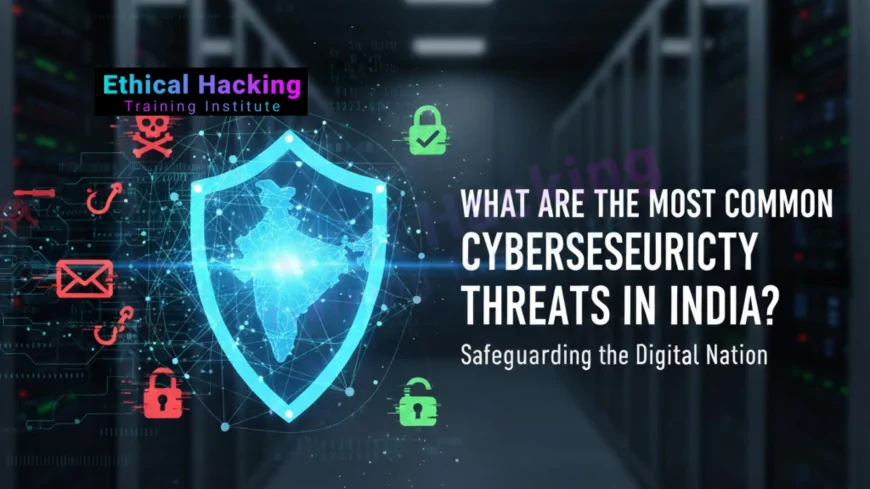
What Are the Most Common Cybersecurity Threats in India?
Discover the top 10 cybersecurity threats hitting Indian organizations and individuals in 2025 – ransomware, phishing, UPI fraud, data breaches, supply-chain attacks, and more. Learn real statistics and how Ethical Hacking Training Institute & Webasha Technologies prepare you to defend against them.
Introduction
India has emerged as the third-most targeted nation globally for cyberattacks, trailing only the United States and Indonesia. According to CERT-In, the country witnessed over 15 lakh cyber incidents in 2024 alone, marking a staggering 300% increase since 2020. Ransomware, phishing, UPI fraud, and data breaches have become everyday headlines. At Ethical Hacking Training Institute and Webasha Technologies, we track these evolving threats in real time and train thousands of students annually to become the skilled defenders India urgently requires in 2025 and beyond.
Top 10 Cybersecurity Threats Dominating India in 2025
| Rank | Threat | Primary Target | 2024–2025 Incidents |
|---|---|---|---|
| 1 | Ransomware (LockBit, Akira, BlackCat) | Hospitals, colleges, SMEs | 600+ major cases |
| 2 | Business Email Compromise & Phishing | Finance teams, HR | Daily 5000+ attempts |
| 3 | UPI & Digital Payment Fraud | Individuals & small merchants | ₹1,100+ crore loss (2024) |
| 4 | Data Breaches & Aadhaar Leaks | Government portals, edutech | 300+ million records leaked |
| 5 | Supply-Chain & Third-Party Attacks | IT vendors, MSPs | Rising 400% |
From hospitals to colleges and small businesses, no sector is safe. Ransomware groups like LockBit, Akira, and BlackCat are aggressively targeting Indian entities. Phishing campaigns disguised as income-tax notices or KYC updates trick thousands daily. UPI-related fraud crossed ₹1,100 crore in losses last year. Massive data breaches continue to expose Aadhaar, PAN, and voter records on the dark web. Supply-chain compromises via third-party vendors are rising 400%. These threats are not going away, they are becoming smarter, faster, and more profitable for attackers.
Every single one of these threats is simulated and countered in the live labs of Ethical Hacking Training Institute & Webasha Technologies.
Ransomware – The Biggest Nightmare for Indian Organizations
High-profile victims like AIIMS Delhi, SpiceJet, and hundreds of educational institutions paid crores in ransom during 2024–2025. Most attacks begin with a simple phishing email or exposed Remote Desktop Protocol (RDP). Once inside, attackers encrypt critical data and demand payment in cryptocurrency. Many organizations still lack offline backups or proper segmentation, making recovery nearly impossible without paying. The average downtime exceeds 20 days, causing massive financial and reputational damage. Ransomware-as-a-Service (RaaS) kits have made these attacks accessible even to low-skilled criminals.
Phishing & Social Engineering – Still #1 Initial Access Vector
The average Indian user receives 12–15 phishing emails/SMS daily. Fake income-tax refunds, electricity bill threats, KYC updates, and lottery wins remain the most successful lures. Attackers perfectly mimic bank logos, government letterheads, and even police notices. Business Email Compromise (BEC) scams targeting finance and HR teams have caused losses running into hundreds of crores. Employees continue to click malicious links because awareness training is either absent or outdated in most organizations. Social engineering remains the easiest and cheapest way for attackers to bypass technical controls.
Our CEH classes at Webasha Technologies teach you how to craft and defend against these exact Indian phishing campaigns.
UPI, Banking Trojans & Mobile Malware Explosion
With over 300 million UPI users, fraudsters have shifted focus to mobile devices. Banking trojans like Anubis, Cerberus, and EventBot use overlay screens, keylogging, and SMS interception to steal credentials. Fake loan apps on third-party stores harvest contacts and gallery data. In 2024, Indians lost more than ₹1,100 crore to digital payment fraud alone. Once infected, devices become part of botnets or are used for transaction fraud. The rapid adoption of digital payments without matching security awareness has created a perfect storm for mobile malware campaigns.
Data Breaches & Dark Web Sale of Indian Data
Aadhaar numbers, PAN cards, voter IDs, and educational records regularly surface on dark web marketplaces for as little as ₹2–₹10 per record. Government portals, edutech platforms, and examination bodies continue to suffer massive breaches due to poor security practices. Over 300 million Indian records were exposed in the last two years alone. Leaked data fuels identity theft, loan fraud, and targeted phishing. Many organizations still fail to encrypt databases properly or enforce strong access controls, making India one of the largest suppliers of personally identifiable information on the underground market.
Learn dark web intelligence and breach analysis in our advanced Red Team Bootcamp at Ethical Hacking Training Institute.
Why Indian Organizations Remain Easy Targets
Poor patch management leaves systems running outdated Windows versions and unpatched servers. Multi-factor authentication is missing on critical applications and admin accounts. Employee cybersecurity awareness training is either non-existent or conducted once a year with boring slides. Over-dependence on third-party vendors without proper vendor risk assessment is common. Budget for security tools and skilled staff is allocated only after a major breach hits the news. Legacy systems, lack of network segmentation, and weak password policies complete the picture of why Indian organizations continue to be soft targets in 2025.
How to Protect Yourself and Your Organization in 2025
Enable multi-factor authentication everywhere possible. Conduct regular, engaging security awareness sessions for employees. Deploy endpoint detection and response (EDR) solutions with automatic patch management. Perform quarterly penetration tests and vulnerability assessments. Maintain encrypted, offline backups and test restoration monthly. Segment critical networks and restrict third-party access. Invest in threat intelligence feeds tailored for India. Train at least one in-house red team member. Simple disciplined practices implemented consistently can stop 99% of the attacks we see daily at Ethical Hacking Training Institute and Webasha Technologies labs.
Conclusion
Cybercrime is costing the Indian economy over ₹1.5 lakh crore annually and growing exponentially. The country faces an acute shortage of more than one million skilled cybersecurity professionals. Every breach, every ransomware payment, and every stolen rupee highlights the urgent need for trained defenders. Join Ethical Hacking Training Institute and Webasha Technologies – Pune’s most trusted and placement-focused cybersecurity training providers – and gain the exact skills required to stop these real-world Indian threats. Classroom and online batches start every Monday. Secure your career and help secure India.
Frequently Asked Questions
Which Indian sector faces the most ransomware?
Healthcare and education – AIIMS Delhi and 200+ colleges hit in 2024–2025.
Is UPI safe in 2025?
The protocol is safe, but social engineering and fake apps cause most losses.
How many cyber attacks happen daily in India?
Over 4,000 reported incidents daily to CERT-In (2025 estimate).
Which is the best institute for cybersecurity training in Pune?
Ethical Hacking Training Institute & Webasha Technologies – highest placement rate and real attack labs.
Can freshers get cybersecurity jobs in India?
Yes – certified freshers from our institute start at ₹6–15 LPA.
Is Aadhaar data still leaking?
Yes, via poorly secured government and private portals.
What's Your Reaction?
 Like
0
Like
0
 Dislike
0
Dislike
0
 Love
0
Love
0
 Funny
0
Funny
0
 Angry
0
Angry
0
 Sad
0
Sad
0
 Wow
0
Wow
0