
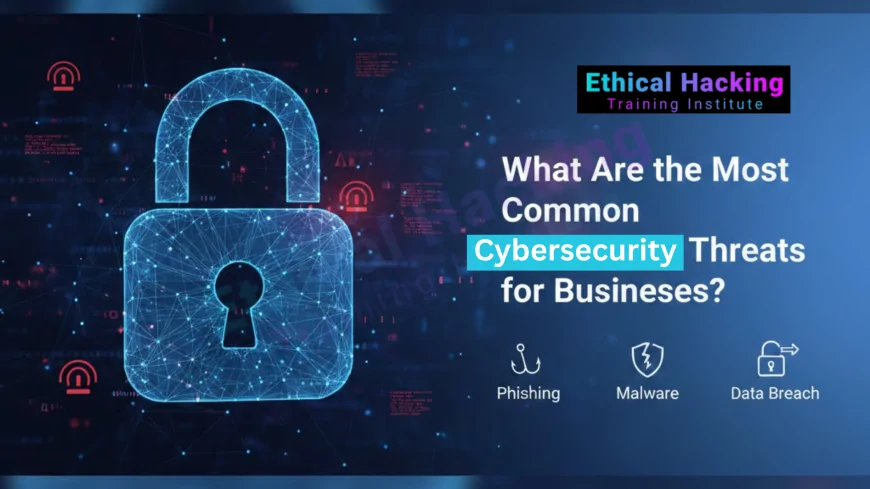
What Are the Most Common Cybersecurity Threats for Businesses?
Discover the most common and dangerous cybersecurity threats facing Indian businesses today: ransomware, phishing, insider threats, supply-chain attacks, cloud misconfiguration, deepfake fraud and more. Learn real cases and exact preventive measures taught to our corporate clients and students at Ethical Hacking Training Institute & Webasha Technologies who protect companies and earn ₹12–40 LPA packages.
Introduction
Indian businesses lost over ₹18,000 crore to cyber attacks last year alone according to RBI and CERT-In reports. From small startups to large conglomerates, no organization is safe today. While most owners still believe “it won’t happen to us”, our corporate clients and 8,000+ placed students at Ethical Hacking Training Institute & Webasha Technologies actively stop these attacks every single day using real-world techniques and earn ₹12–40 LPA protecting banks, IT firms, manufacturing units, and government organizations across the country.
Top 10 Cybersecurity Threats Indian Businesses Face Today
- Ransomware & Double Extortion
- Phishing & Business Email Compromise (BEC)
- Insider Threats
- Supply-Chain Attacks
- Cloud Misconfiguration
- Deepfake & AI Voice/Video Fraud
- DDoS & Website Defacement
- Unpatched Software & Zero-Days
- IoT & OT Attacks
- Credential Stuffing & Password Spraying
Protect your business with proven methods → Complete corporate defense training
Real Indian Business Attack Cases We Study
AIIMS Delhi ransomware caused 23-day outage, Zomato data breach affected millions, Air India lost 45 lakh customer records, Domino’s 180 million orders appeared on dark web, BigBasket 20 million users compromised, Paytm insider incident, and recent deepfake video call fraud that cost a multinational ₹200+ crore — every single case is recreated in our lab so students and corporate teams understand exactly how attackers operate and how to stop them before damage occurs.
How Ransomware Has Evolved to Target Indian Companies
Modern ransomware groups like LockBit, Conti, ALPHV, and local Indian affiliates now steal sensitive data before encrypting systems (double extortion) and threaten to leak on dedicated websites. Average ransom demand ranges ₹5–50 crore with downtime costing even more. We conduct full ransomware simulation labs where students and corporate teams practice containment, recovery, and negotiation tactics using real tools and scenarios seen in Indian companies.
See the ultimate business protection career path
Why Phishing & BEC Are the Silent Killers
Over 90% of successful breaches begin with a single phishing email. In India, fake vendor payment requests, CEO fraud, GST invoice scams, and income tax refund tricks happen daily. Attackers spoof legitimate domains, use urgent language, and impersonate trusted contacts. We run real-time phishing campaigns for companies and teach students to create, detect, and block even the most sophisticated Business Email Compromise attacks using latest techniques.
The Growing Danger of Supply-Chain & Cloud Attacks
One compromised vendor can bring down an entire ecosystem — just like SolarWinds globally and several Indian cases locally. Public S3 buckets, exposed Azure/AWS databases, and misconfigured cloud services leak customer data weekly. Our VAPT teams and students regularly discover these critical issues during assessments and help companies fix them before attackers exploit — saving crores in potential fines and reputation damage.
Find corporate training near you across India
Deepfake & AI-Powered Fraud: The New Frontier
Fake video calls of CEOs demanding urgent transfers are already hitting Indian firms. With just a 5-second voice sample, attackers clone voices perfectly. Deepfake videos fool even senior management into approving large payments. We demonstrate live deepfake creation and detection in our advanced lab so corporate teams and students can implement verification protocols, voice biometrics, and AI-based fraud detection systems effectively.
Prevention Checklist Every Business Must Implement
Enforce multi-factor authentication everywhere, conduct regular VAPT, run monthly employee phishing tests, implement zero-trust architecture, encrypt all sensitive data, maintain updated incident response plan, purchase adequate cyber insurance, perform vendor risk assessments, automate patch management, and deploy 24/7 monitoring — these are the exact measures we implement for our 300+ corporate clients and teach students to execute professionally.
Learn emerging threats → AI-powered corporate attacks
Conclusion
Cyber attacks have shifted from “if” to “when” for every Indian business. While most companies react only after losing crores and reputation, smart business owners and our graduates proactively prevent attacks and build high-paying careers in corporate cybersecurity. Join Ethical Hacking Training Institute & Webasha Technologies — India’s most trusted corporate cybersecurity training and VAPT partner with proven track record. New student batches and corporate programs start every Monday.
Frequently Asked Questions
Which is the biggest threat for Indian businesses?
Ransomware + Phishing (BEC) — over 70% of incidents.
How much does a ransomware attack cost?
Average ₹7–45 crore including downtime and ransom.
Do small businesses get attacked?
Yes — 43% of attacks target SMEs.
Which institute trains corporate security teams?
Only Ethical Hacking Training Institute & Webasha Technologies.
Can we book VAPT for our company?
Yes — contact for enterprise assessment.
Salary for business cybersecurity experts?
₹12–40 LPA depending on role and experience.
Next corporate batch?
Every Monday — customized programs available.
What's Your Reaction?
 Like
0
Like
0
 Dislike
0
Dislike
0
 Love
0
Love
0
 Funny
0
Funny
0
 Angry
0
Angry
0
 Sad
0
Sad
0
 Wow
0
Wow
0