


What Are the Most Common Cyber Attacks?
Discover the 10 most common cyber attacks in 2025: phishing, ransomware, DDoS, malware, SQL injection, XSS, man-in-the-middle, zero-day exploits, credential stuffing, and insider threats. Learn how they work, real-world examples, and proven prevention strategies with tools like firewalls, MFA, and employee training.
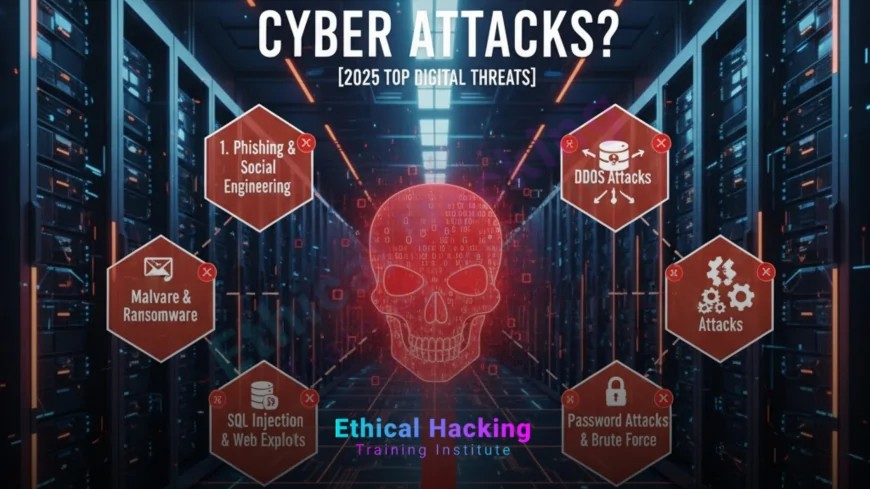
Introduction
Cyber attacks now cost the global economy over $10.5 trillion annually, with more than 2,200 incidents occurring every single day. That’s one attack every 39 seconds. For businesses and individuals alike, understanding the most common cyber threats has become essential for survival in the digital age. This guide explores the top 10 cyber attacks dominating 2025, explaining how they work, real-world damage caused, and practical prevention methods. From sophisticated phishing campaigns to zero-day exploits, knowledge is your first line of defense. Stay ahead of attackers by mastering these threats before they strike. (100 words)
1. Phishing Attacks
- 90% of data breaches begin with phishing emails or vishing calls
- Attackers impersonate trusted brands like banks, PayPal, or Microsoft
- Trick users into entering credentials on fake login pages
- 2024 MGM Resorts lost $100M due to voice phishing (vishing)
- AI-generated deepfake voice and video phishing rising 300% YoY
- Prevention: Use phishing training, DMARC, and email sandboxing
- Free tool: Enable SPF, DKIM, and DMARC on your domain
2. Ransomware
- Encrypts files and demands Bitcoin payment for decryption key
- Average ransom demand in 2025: $1.5 million
- Colonial Pipeline paid $4.4M in 2021 to restore operations
- Double extortion: Steal data first, then encrypt
- Prevention: Immutable backups, EDR, and zero trust segmentation
- Never pay: Only 8% of victims recover all data
3. Distributed Denial of Service (DDoS)
- Floods websites with fake traffic to crash services
- Largest recorded: 3.15 Tbps attack on AWS in 2024
- Costs businesses $52,000 per hour of downtime
- IoT botnets like Mirai power modern DDoS campaigns
- Prevention: Use Cloudflare, Akamai, or Azure DDoS Protection
- Enable rate limiting and geo-blocking suspicious regions
- Monitor traffic spikes with SIEM dashboards
4. Malware
- Includes viruses, trojans, spyware, ransomware, and rootkits
- Emotet banking trojan infected 1.5M devices in 2023
- Drive-by downloads from compromised websites
- Prevention: Next-gen antivirus with behavioral analysis
- Block macros in Office files and disable autorun
- Use application whitelisting in enterprise environments
5. SQL Injection (SQLi)
- Injects malicious SQL into login or search forms
- TalkTalk breach (2015) exposed 157,000 users via SQLi
- OWASP lists SQLi in Top 10 web vulnerabilities
- Prevention: Use prepared statements and ORM frameworks
- Deploy Web Application Firewall (WAF) like ModSecurity
- Validate and sanitize all user inputs server-side
- Test with tools like SQLMap during pentesting
6. Cross-Site Scripting (XSS)
- Injects JavaScript into websites viewed by other users
- Types: Stored, Reflected, and DOM-based XSS
- 53% of web apps vulnerable per Veracode 2024 report
- Prevention: Implement Content Security Policy (CSP)
- Escape output with HTMLEncode and URL encoding
- Test with XSS payloads from Burp Suite
7. Man-in-the-Middle (MITM)
Attackers secretly intercept communication between two parties. Common on public Wi-Fi. (15 words)
Prevention: Enforce HTTPS, use VPN, and enable HSTS. Avoid free Wi-Fi for banking. (25 words)
8. Zero-Day Exploits
Vulnerabilities unknown to vendors. No patch exists. Log4Shell affected 3 billion devices. (20 words)
Defense: Use AI anomaly detection, threat intelligence feeds, and rapid patch deployment. (20 words)
9. Credential Stuffing
- Uses leaked username/password pairs from past breaches
- Billions of login attempts monthly via botnets
- Capital One breach (2019) started with reused passwords
- Prevention: Enforce MFA everywhere
- Monitor dark web for credential leaks
- Use passwordless auth like WebAuthn or biometrics
10. Insider Threats
- Cost $15.4 million per incident (Ponemon 2024)
- Types: Malicious (sabotage), negligent (phishing clicks)
- Tesla employee stole data in 2018
- Prevention: Least privilege access and UEBA tools
- Monitor file access and USB device usage
- Conduct exit interviews and revoke access instantly
Cyber Attack Statistics (2025)
| Attack Type | % of Breaches | Avg. Cost |
|---|---|---|
| Phishing | 36% | $4.9M |
| Ransomware | 24% | $1.85M |
| DDoS | 15% | $52K/hour |
How to Prevent Common Cyber Attacks
- Deploy next-gen firewall and Web Application Firewall
- Enable multi-factor authentication on all accounts
- Patch systems within 48 hours of release
- Train employees with phishing simulations quarterly
- Encrypt sensitive data at rest and in transit
- Monitor logs with SIEM and user behavior analytics
- Keep offline, immutable backups of critical data
Conclusion: Defense Starts with Awareness
Most cyber attacks exploit human error or outdated systems. Not budget deficits. Awareness and action beat expensive tools every time. (30 words)
Start now: Run a phishing test, enforce MFA, and update your incident response plan. The next attack is already here. (40 words)
Frequently Asked Questions
What is the #1 cyber attack?
Phishing. It causes 90% of breaches.
Can ransomware infect phones?
Yes. Mobile ransomware is rising 300% YoY.
Is DDoS a crime?
Yes. Illegal under CFAA in the U.S.
How to stop SQL injection?
Use parameterized queries and ORM.
Are zero-days rare?
No. Google found 100+ in 2024.
Best tool to prevent XSS?
Content Security Policy (CSP).
Can VPN stop MITM?
Yes, if it uses strong encryption.
How common is credential stuffing?
Billions of attempts monthly.
Who handles insider threats?
HR + IT + Security teams.
Free way to prevent attacks?
Employee awareness training.
What's Your Reaction?
 Like
0
Like
0
 Dislike
0
Dislike
0
 Love
0
Love
0
 Funny
0
Funny
0
 Angry
0
Angry
0
 Sad
0
Sad
0
 Wow
0
Wow
0