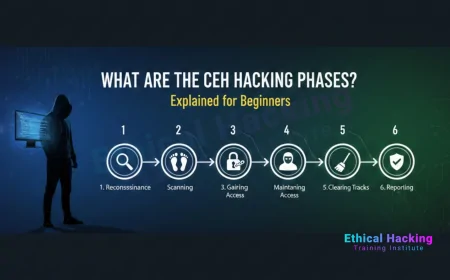

What Are the Different Phases of Ethical Hacking?
Ethical hacking follows a clear, repeatable set of phases that guide security professionals when testing systems for weaknesses. This comprehensive guide explains each phase in detail, from scoping and reconnaissance to vulnerability analysis, exploitation in authorised environments, post exploitation analysis, reporting and remediation verification. It highlights tools and techniques used at every step, legal and ethical considerations, how organisations structure engagements, and practical checklists for teams preparing to run tests or hire ethical hackers. Readers will find examples of common tasks, a comparison table mapping phase to outcomes and controls, career and training recommendations, and 15 frequently asked questions to help beginners and managers understand how ethical hacking fits into an effective security program.
Introduction
Ethical hacking is structured into phases to ensure tests are thorough, repeatable and safe. Each phase focuses on different objectives and outputs, so teams can measure progress and make decisions. A phased approach protects production systems, clarifies scope with stakeholders, and produces clear evidence for remediation. Whether the engagement is a short vulnerability assessment, a full penetration test, or a red team campaign, the phases form the backbone of a professional, defensible approach.
Phase 1: Scoping and Rules of Engagement
What scoping includes
Scoping defines what will be tested, who is authorised, acceptable techniques, business hours constraints, and success criteria. Typical scope elements include target IP ranges, domain names, web applications, cloud assets, and any excluded systems. The scoping phase also identifies sensitive systems that require special handling, such as production databases or safety critical controllers.
Rules of engagement (RoE)
Rules of engagement are the written contract of the test. They list permitted and forbidden actions, escalation contacts if a test causes disruption, and legal authorisations. A strong RoE reduces legal risk and sets expectations for both testers and the organisation.
Many practitioners reference practical lists of modern automation tools when drafting technical scope and permitted tooling.
Phase 2: Reconnaissance (Open Source Intelligence)
Passive versus active recon
Reconnaissance is all about gathering information to build a target profile. Passive recon collects data without touching target systems: WHOIS records, public DNS, job posts, leaked credentials, social media and public code repositories. Active recon includes targeted probes like banner grabs and limited scans, carried out carefully within the scope.
Key outputs
The recon phase yields asset lists, technology stacks, potential entry points, exposed services and high value personnel names. This intelligence shapes the next phases and helps prioritise effort where impact is highest.
Phase 3: Scanning and Enumeration
Automated discovery
Scanning uses tools to identify live hosts, open ports, services and known vulnerabilities. Tools such as Nmap, Nessus or scanners tailored for web apps provide a baseline inventory. Scans should be tuned to avoid excessive load on production systems and to respect the RoE.
Detailed enumeration
Enumeration dives deeper: service versions, software components, user and group lists, accessible shares, and configuration details. Enumerated data enables focused vulnerability analysis and reveals logical weaknesses that scanners might miss.
To connect discovery to practical labs, many learners follow updated AI aware tutorials that map recon to scanning and analysis techniques.
Phase 4: Vulnerability Analysis
Prioritising findings
Vulnerability analysis examines scan output and enumerated data to validate true issues versus false positives. Testers assess exploitability, impact, and business context to prioritise which vulnerabilities to attempt safely. Common frameworks and CVSS scoring help, but context-specific judgement is essential.
Manual verification
Manual verification differentiates an obvious patch candidate from a configuration issue or a benign version mismatch. A verified vulnerability includes steps to reproduce, evidence and suggested mitigations.
Phase 5: Exploitation (Controlled and Authorised)
Ethical boundaries
Exploitation proves impact by demonstrating a vulnerability can be abused, but testers always operate within authorisation limits. Exploitation may be limited to proof of concept actions, or may show full impact such as privilege escalation, depending on the RoE and objectives.
Techniques and safety
Techniques range from exploiting web injection to chaining exploits for deeper access. Testers use safe payloads, sandboxed shells, and non destructive verification steps where possible, and they monitor for unexpected side effects while ready to halt testing if disruption occurs.
Many testers complement practical exploitation skills with certification and lab tracks that include responsible exploitation exercises in comprehensive certification programs.
Phase 6: Post-Exploitation and Impact Analysis
Understanding attacker objectives
Post exploitation focuses on what an attacker could achieve: privilege escalation, data access, lateral movement, persistence and exfiltration. The goal is to map attack paths and quantify the business impact that successful exploitation would cause.
Safe persistence testing
Where allowed, testers may validate persistence mechanisms but normally avoid long lived implants. Instead they document required steps an adversary would follow and provide reproducible evidence without leaving permanent artefacts.
Phase 7: Reporting and Risk Communication
Report components
A high quality report includes executive summary, technical findings, evidence and reproducible steps, risk rating, recommended remediation, and suggested timelines. Reports should be actionable for developers and understandable by leadership to prioritise investment and fixes.
Communication best practices
Deliver remediation advice with specific code-level or configuration changes when possible, include proof-of-fix steps and remain available to clarify points. Maintain confidentiality and follow any disclosure timelines agreed in the RoE.
To improve report writing and technical clarity, many practitioners use guided courses that include lab reporting exercises and mentor feedback.
Phase 8: Remediation Verification and Retesting
Validating fixes
Once teams apply fixes, testers retest to confirm vulnerabilities are resolved and no new issues were introduced. Verification may include targeted scans, reproducing exploits, and confirming configuration changes persist across deployments.
Continuous improvement
Retesting closes the loop: it ensures remediation succeeded and contributes to continuous improvement. Findings should feed into vulnerability management processes and development lifecycle changes to prevent regressions.
Phase 9: Clean-up and Evidence Preservation
Removal of artefacts
Testers must remove any temporary files, shells, or artifacts created during testing. Clean-up prevents accidental persistence and reduces operational risk.
Evidence and chain of custody
Preserve logs, captures and proof artifacts securely to support audits or compliance needs. Maintain a clear chain of custody for sensitive evidence and ensure access controls protect those assets.
Organisations frequently upskill internal teams with local instructor-led complete programs that cover the full testing lifecycle from scoping to verification.
Comparison Table: Phases, Purpose and Primary Deliverables
| Phase | Primary Purpose | Typical Deliverable |
|---|---|---|
| Scoping & RoE | Define boundaries and legal authorisation | Signed rules of engagement and scope document |
| Reconnaissance | Gather public and targeted intelligence | Asset lists and threat surface map |
| Scanning & Enumeration | Identify services and potential issues | Scan reports and enumerated details |
| Vulnerability Analysis | Validate and prioritise true risks | Verified vulnerability list with context |
| Exploitation | Demonstrate impact safely | Proof of concept and evidence |
| Post-Exploitation | Map further attacker capabilities | Attack path and impact analysis |
| Reporting | Communicate findings and fixes | Comprehensive technical and executive report |
| Remediation Verification | Confirm fixes and prevent regressions | Retest results and closure notes |
| Clean-up & Evidence | Remove artefacts and preserve logs | Clean-up checklist and secured evidence |
Legal, Ethical and Safety Considerations
Ethical hacking requires clear legal authorisation. Tests that touch production systems must have escalation contacts and emergency stop procedures. Testers must avoid actions that could harm safety critical systems and must follow responsible disclosure practices for newly discovered vulnerabilities. Maintain strict confidentiality and follow any contractual non disclosure clauses.
Tools and Skills for Each Phase
Discovery and scanning
Useful tools: Nmap, Shodan, Amass, Sublist3r, and automated vulnerability scanners. Skills: OSINT, DNS and certificate analysis.
Exploitation and post-exploitation
Useful tools: Metasploit, Burp Suite, custom exploit scripts and privilege escalation checkers. Skills: exploit development basics, lateral movement techniques and log analysis.
If your organisation wants hands-on learning mapped to these phases, many teams work with local local providers that run live labs and tabletop exercises.
Integrating Ethical Hacking into a Continuous Security Program
Ethical testing should not be a one-off. Integrate periodic penetration tests with continuous vulnerability management, secure development practices and regular purple team exercises. Feed findings into change control and CI/CD pipelines so that fixes are tracked and regressions are detected early.
How to Choose the Right Type of Engagement
Choose based on objectives: vulnerability assessments for broad discovery, classic penetration tests to prove impact, red team engagements to test detection and response across people and processes, and bug bounty programs to leverage wider community testing. Budget, timelines and risk tolerance influence the appropriate model.
Conclusion
The phases of ethical hacking create a disciplined path from planning to verification. By following clear scoping, careful reconnaissance, targeted scanning, validated vulnerability analysis, controlled exploitation, thorough reporting and retesting, organisations can improve security while minimising operational risk. Ethical hacking is most effective when integrated with vulnerability management, secure development and incident response processes. For teams and individuals wanting structured, practical learning that covers the full lifecycle, training options from Ethical Hacking Institute, Cybersecurity Training Institute, and Webasha Technologies provide hands-on labs and mentorship to build competence across every phase.
Frequently Asked Questions
How many phases are there in ethical hacking?
Practitioners commonly divide ethical hacking into 8 to 10 phases: scoping, reconnaissance, scanning, vulnerability analysis, exploitation, post-exploitation, reporting, remediation verification and clean-up.
What is the most important phase?
All phases matter, but scoping and rules of engagement are critical because they ensure tests are legal and safe; without proper scoping, a test can cause unintended harm.
Can exploitation be omitted?
Yes. Some engagements are limited to vulnerability analysis and proof-of-concept level verification without active exploitation, depending on risk tolerance and objectives.
How long does a typical penetration test take?
Duration depends on scope; small external tests may take a few days, while large comprehensive assessments or red team exercises can run several weeks.
What is a red team exercise?
A red team simulates a persistent, multi-vector adversary targeting people, processes and technology to test detection and response, often across several phases of an extended campaign.
How should findings be prioritised?
Prioritise by exploitability, business impact, asset criticality and exposure rather than solely by CVSS score to get practical remediation focus.
Are automated scanners enough?
Automated scanners are valuable for discovery, but manual validation is necessary to reduce false positives and to explore complex logic or chained vulnerabilities.
Who should sign the rules of engagement?
Authorised representatives from the customer (e.g., security lead), the testing provider and legal or executive sponsors should sign the RoE to establish authority and escalation contacts.
What evidence should testers provide?
Provide reproducible steps, screenshots, logs, packet captures and, where appropriate, non destructive proof-of-concept code that clearly demonstrates impact.
How often should organisations run tests?
At least annually for critical systems, after major changes, and on an ongoing cadence aligned with risk tolerance and compliance requirements.
What is responsible disclosure in testing?
Responsible disclosure refers to processes for reporting newly discovered vulnerabilities to the owner, allowing time for remediation before public disclosure, and following legal and contractual obligations.
Do penetration testers need certifications?
Certifications like OSCP, CEH and others help demonstrate competency, but experience, strong methodology and a portfolio of lab work are equally important.
How do I prepare for hiring a penetration test provider?
Define clear objectives, document scope and constraints, request sample reports, check references and verify the provider's legal and insurance posture before engagement.
Can internal teams run ethical tests safely?
Yes, with proper training, legal authorisation and separation of duties. Many organisations build internal red teams or rotation programs to maintain continuous testing capability.
Where can I learn the full ethical hacking lifecycle?
Structured training, hands-on labs and mentorship are the fastest route. Consider comprehensive programs and local workshops offered by practical training providers to learn each phase end to end.
What's Your Reaction?
 Like
0
Like
0
 Dislike
0
Dislike
0
 Love
0
Love
0
 Funny
0
Funny
0
 Angry
0
Angry
0
 Sad
0
Sad
0
 Wow
0
Wow
0