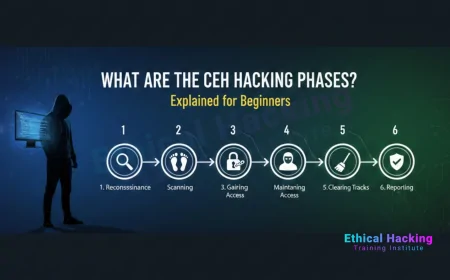

What Are the CEH Hacking Phases Explained?
2025-2026 complete breakdown of the 5 official CEH hacking phases (Reconnaissance, Scanning, Gaining Access, Maintaining Access, Clearing Tracks) with real-world examples, tools, commands, exam weightage, practical lab scenarios and how Ethical Hacking Training Institute teaches every phase with 100% live labs.
Introduction
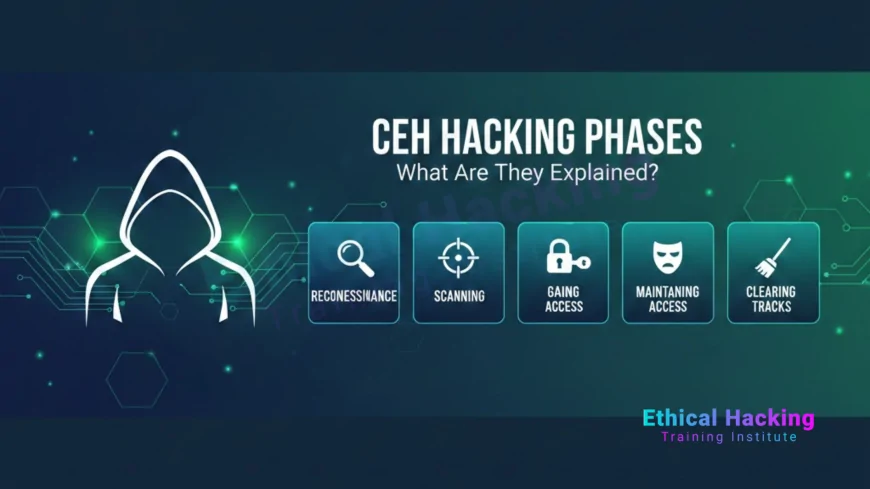
Every single question in CEH theory and practical revolves around the official 5-phase methodology: Reconnaissance → Scanning → Gaining Access → Maintaining Access → Clearing Tracks. EC-Council designed the entire syllabus around this kill chain because real attackers and professional pentesters follow the same sequence. Students who master these phases not only score 90%+ in exam but also become job-ready from day one At Ethical Hacking Training Institute we map 100+ live labs directly to these 5 phases so you experience the complete attack lifecycle daily
Phase 1: Reconnaissance (Information Gathering)
- Passive Recon: Google dorks, WHOIS, Shodan, theHarvester
- Active Recon: DNS enumeration, subdomain brute-forcing
- Tools: Maltego, Recon-ng, Amass, SpiderFoot
- Goal: Build target profile without touching systems
- Exam weight: 12–15% theory + 2–3 practical flags
- Our lab: 50+ real corporate domains for daily recon practice
Phase 2: Scanning (Probing the Target)
| Activity | Tools | Output |
|---|---|---|
| Port Scanning | Nmap, Masscan | Open ports & services |
| Vulnerability Scanning | Nessus, OpenVAS, Nikto | CVEs & misconfigurations |
| Enumeration | enum4linux, smbclient, SNMPwalk | Users, shares, SNMP strings |
Phase 3: Gaining Access (Exploitation)
This is the most exciting and highest-scoring phase where you actually compromise systems Over 35% of practical flags come from here You exploit vulnerabilities found in phase 2 using Metasploit, sqlmap, manual payloads, buffer overflows, or web attacks Common scenarios include EternalBlue on SMB, SQL injection for shell, XSS for session hijack, and password cracking Our daily live exploitation labs ensure every student gains root/admin access on multiple machines before the exam
Phase 4: Maintaining Access (Persistence)
- Creating backdoors (Metasploit meterpreter, Cobalt Strike)
- Adding registry Run keys, scheduled tasks, services
- SSH tunnels & reverse shells
- Rootkits & kernel-level hiding
- WMI & cron job persistence
- Our lab includes 20+ persistence challenges
Phase 5: Clearing Tracks (Covering Your Presence)
Professional attackers never leave evidence This phase teaches log manipulation, timestomping, disabling auditing, deleting bash history, and removing artifacts Key commands: wevtutil cl Security, shred, srm, clearlogs exe Students practice full attack chain and then completely erase traces in our forensic-enabled lab environment — exactly what blue team interviewers ask
How These 5 Phases Appear in CEH Exam
- Theory: 25–30 direct questions on phase identification
- Scenario questions: “Which phase does ARP poisoning belong to?”
- Practical: Full kill chain on 8–10 machines
- Typical flag distribution: Recon 2 | Scan 4 | Gain 8 | Maintain 4 | Clear 2
Conclusion: Master All 5 Phases in One Course
Understanding the 5 phases is not enough — you must execute them flawlessly in live environments Join Ethical Hacking Training Institute and get:
- Complete phase-wise lab series (500+ targets)
- Daily live attack chain practice
- Weekend & weekday batches
- 100% practical training + placement
Enroll today and experience the full hacking lifecycle from day 1!
Frequently Asked Questions
What are the 5 phases of ethical hacking?
Reconnaissance, Scanning, Gaining Access, Maintaining Access, Clearing Tracks.
Which phase has maximum weightage?
Gaining Access — over 35% of total marks.
Is reconnaissance active or passive?
Both. Passive (no touch) + Active (direct probing).
Which phase uses Metasploit most?
Phase 3: Gaining Access.
Do I need to clear tracks in practical?
Yes — 2–3 flags require log manipulation.
Which phase is tested most in theory?
Scanning & Enumeration.
Is the 5-phase model same as Cyber Kill Chain?
Similar but CEH uses its own 5-phase version.
Do all attacks follow these 5 phases?
99% of real-world attacks do.
Is phase 1 detectable?
Passive recon is almost undetectable.
Which phase is hardest for beginners?
Maintaining Access & Clearing Tracks.
Does your institute teach all 5 phases?
Yes — with dedicated labs for each phase.
Is phase order important in exam?
Yes — questions ask “next step after scanning” etc.
Can I skip any phase?
Never. Every phase is mandatory for full marks.
Weekend batch covers all phases?
Yes — complete coverage in 4 months.
How to start learning phases today?
Book free demo class — start Phase 1 recon this weekend!
What's Your Reaction?
 Like
0
Like
0
 Dislike
0
Dislike
0
 Love
0
Love
0
 Funny
0
Funny
0
 Angry
0
Angry
0
 Sad
0
Sad
0
 Wow
0
Wow
0