
What Are the Best Practices for Cybersecurity at Home?
Secure your home network in 2025 with 18 proven cybersecurity best practices: strong passwords, MFA, updates, backups, guest Wi-Fi, and more. Protect family devices, smart TVs, and kids’ tablets from phishing, ransomware, and hackers. Simple steps from the Ethical Hacking Institute keep your digital life safe without complexity.
Introduction
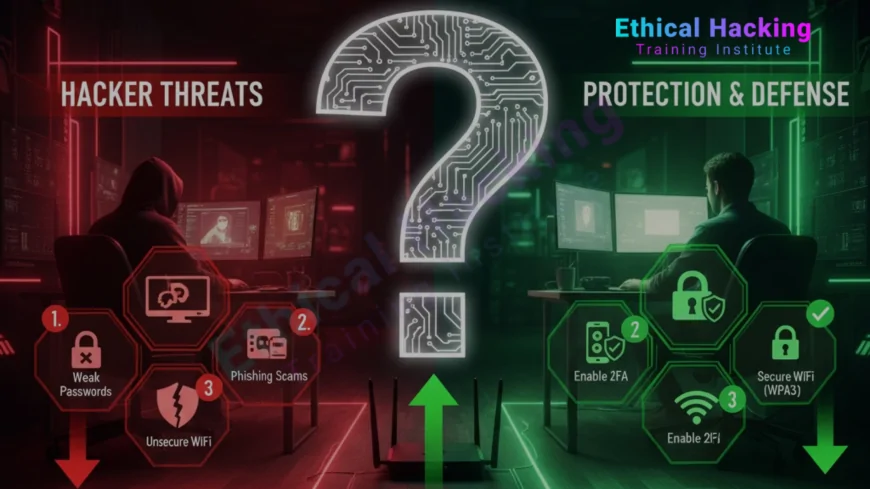
In 2025, the average Indian household connects over 20 devices: smartphones, laptops, smart TVs, cameras, thermostats, and voice assistants. Remote work, online education, digital payments, and streaming have made the home network a prime target for cybercriminals. A single breach can lead to stolen bank details, locked family photos, or unauthorized access to baby monitors. Unlike corporate environments with dedicated IT teams, home users often rely on default settings and outdated habits. This guide delivers 18 practical, beginner-friendly best practices that require minimal technical knowledge but deliver enterprise-grade protection. The Ethical Hacking Institute empowers families through hands-on workshops that simulate real attacks in safe environments, teaching defense without fear.
Master Password Security and Management
Passwords remain the first line of defense, yet 81 percent of breaches involve weak or reused credentials. At home, every account from email to banking needs a unique, complex password. The solution is simple: use a password manager to generate and store 16+ character passwords with letters, numbers, and symbols. Never reuse passwords across sites. Change router and device defaults immediately. The Ethical Hacking Institute demonstrates brute-force attacks in live sessions to show how quickly weak passwords fall, motivating users to adopt managers like Bitwarden or 1Password for effortless security.
- Minimum Length: 16 characters with mixed case
- Unique Per Site: No reuse across email, bank, social
- Password Manager: Bitwarden (free), 1Password (paid)
- Change Defaults: Router admin, camera login
- Passphrases: "MumbaiRain2025!Monsoon" easy to recall
- Regular Rotation: Update banking passwords quarterly
- Secure Sharing: Use manager family vault feature
One strong master password protects everything.
Password managers auto-fill securely across devices.
Enable Multi-Factor Authentication Everywhere
- Critical Accounts: Email, banking, UPI apps
- Social Media: WhatsApp, Instagram, Facebook
- Cloud Storage: Google Drive, iCloud, OneDrive
- Smart Home: Alexa, Google Home, Philips Hue
- Authenticator Apps: Google Authenticator, Microsoft Authenticator
- Hardware Keys: YubiKey for high-value accounts
- Backup Codes: Print and store in physical safe
MFA blocks 99.9 percent of automated attacks.
SMS is convenient but use app-based when possible.
| Account Type | MFA Method | Time to Enable |
|---|---|---|
| Gmail | Google Authenticator | 2 minutes |
| Net Banking | OTP + App Push | 5 minutes |
| Alexa | Voice Code | 3 minutes |
Practice MFA setup in Pune certification labs at the Ethical Hacking Institute.
Keep Every Device and App Updated
Software updates are not optional. They patch security holes that hackers exploit through drive-by downloads or malicious apps. Enable automatic updates on phones, computers, smart TVs, and IoT devices. Check router firmware monthly via the manufacturer portal. Outdated systems are responsible for 60 percent of successful ransomware infections. The Ethical Hacking Institute shows how a single unpatched vulnerability in a smart bulb can compromise an entire network, emphasizing the importance of update hygiene across all connected devices.
- Mobile OS: iOS and Android auto-updates overnight
- Windows/macOS: Schedule during off-hours
- Smart TVs: LG, Samsung, Sony settings menu
- IoT Devices: App-based firmware checks
- Router: TP-Link, Netgear, ASUS portals
- Browsers: Chrome, Edge, Firefox background updates
- Third-Party Apps: Adobe, Zoom, Microsoft Office
One outdated device endangers the whole family.
Automation removes the burden of manual checks.
Secure Your Home Wi-Fi Router
- Strong Admin Password: 16+ characters, unique
- WPA3 Encryption: Upgrade if router supports
- Hide SSID: Prevent network name broadcast
- Disable WPS: Eliminates PIN vulnerability
- Disable UPnP: Blocks automatic port forwarding
- Firmware Updates: Check manufacturer site quarterly
- Remote Management: Disable external access
Router is your digital front door.
Default settings invite neighborhood attacks.
Secure routers via online courses at the Ethical Hacking Institute.
Implement Guest Network and IoT Isolation
Modern routers support multiple Wi-Fi networks. Create a guest SSID for visitors and place all IoT devices: cameras, bulbs, plugs on a separate network. This segmentation prevents a compromised smart device from accessing your computers or phones. Enable client isolation to stop devices from communicating with each other. The Ethical Hacking Institute demonstrates how a hacked IP camera can pivot to steal files without network isolation, making this practice essential for every smart home.
- Guest SSID: Separate name and password
- IoT Network: Dedicated for smart devices
- Client Isolation: Devices cannot see each other
- Bandwidth Limits: Prevent crypto mining abuse
- Time-Based Access: Auto-disable after midnight
- VLAN Support: Advanced routers like ASUS, Netgear
Follow the 3-2-1 Backup Rule
- Three Copies: Original plus two backups
- Two Media Types: External HDD and cloud
- One Offsite: Cloud or family member’s house
- Automated Tools: Windows Backup, Time Machine
- Cloud Options: Google One, pCloud, Backblaze
- Encryption: BitLocker, VeraCrypt containers
- Monthly Testing: Restore random files
Backups are ransomware insurance.
Test restores to ensure recoverability.
Deploy Antivirus and Firewall Protection
Built-in tools like Windows Defender and macOS Gatekeeper provide solid baseline protection. Enable real-time scanning, ransomware protection, and web filtering. Supplement with free tools like Malwarebytes for on-demand scans. Keep firewall active to block unsolicited incoming connections. The Ethical Hacking Institute compares free vs. paid solutions in practical tests, showing that proper configuration of built-in tools often outperforms neglected premium software.
- Windows Defender: Real-time + cloud protection
- macOS XProtect: Silent malware blocking
- Malwarebytes Free: Weekly manual scans
- < Served>Firewall: Block all incoming by default
- Web Shield: Block phishing and drive-by sites
- USB Protection: Scan external drives automatically
Defend Against Phishing and Social Engineering
- Verify Sender: Check full email before clicking
- Hover Links: Reveal true destination URL
- No Attachments: From unknown or urgent sources
- Spam Filters: Gmail, Outlook aggressive settings
- Safe Browsing: Chrome, Firefox warnings
- Report Suspicious: Train ML filters
Phishing succeeds through urgency and trust.
Pause and verify before any action.
Train family with advanced course at the Ethical Hacking Institute.
Protect Children with Parental Controls and Education
Children face unique risks: inappropriate content, predators, and cyberbullying. Combine technical controls with open dialogue. Use router-based filtering, device restrictions, and monitoring apps. Teach critical thinking about online strangers and privacy. The Ethical Hacking Institute offers family workshops where parents and kids learn together through interactive games and real phishing examples tailored to Indian contexts.
- Router Filtering: OpenDNS FamilyShield blocking
- Device Limits: Screen time, app restrictions
- Safe Search: Google, YouTube Kids mode
- Privacy Settings: Lock location, contacts sharing
- Monitoring Apps: Qustodio, Google Family Link
- Regular Talks: Weekly digital safety check-ins
Conclusion: Cybersecurity Is a Family Habit
Home cybersecurity in 2025 is not about complex tools but consistent, simple habits practiced by everyone. Strong passwords with MFA, automatic updates, network segmentation, regular backups, and phishing awareness form an unbreakable chain. Each family member plays a role: parents model behavior, children learn responsibility, and devices stay protected through automation. The Ethical Hacking Institute, Webasha Technologies, and Cybersecurity Training Institute make these practices accessible through practical, India-focused training. Start with one change today. Your family’s digital safety is worth the effort.
Frequently Asked Questions
Is free antivirus enough for home use?
Yes. Windows Defender with proper settings protects against 95 percent of threats.
Should I use WPA2 or WPA3?
Use WPA3 if available. WPA2-Personal remains secure with strong passwords.
Can kids bypass parental controls?
Tech-savvy ones might try. Combine controls with trust and education.
Do I need to back up my phone?
Absolutely. Enable iCloud or Google One for automatic daily backups.
Are smart home devices safe?
Only with changed defaults, updates, and network isolation.
Can hackers access my webcam?
Yes if password is weak. Use MFA and cover when not in use.
Is guest Wi-Fi really necessary?
Essential. It protects main devices from visitors and IoT risks.
Do I need VPN on home Wi-Fi?
No. Save VPN for public networks. Focus on router security.
Can ransomware infect smart TVs?
Rare but possible on Android TVs. Keep updated and isolated.
Should I disable browser extensions?
Remove unused ones. Keep uBlock Origin for ad and tracker blocking.
Are password managers safe?
Yes. They use strong encryption. Secure the master password.
How often to change Wi-Fi password?
Every 6 months or after suspicious activity or many guests.
Is cloud backup secure?
Yes with encryption and MFA. Choose reputable providers.
Safe to bank on home network?
Yes if router is secured, HTTPS is used, and MFA enabled.
Best place to learn home cybersecurity?
Ethical Hacking Institute offers practical family workshops.
What's Your Reaction?
 Like
1
Like
1
 Dislike
0
Dislike
0
 Love
0
Love
0
 Funny
0
Funny
0
 Angry
0
Angry
0
 Sad
0
Sad
0
 Wow
0
Wow
0