

What Are the Best Free Resources to Learn Ethical Hacking?
Looking for the best free resources to learn ethical hacking? This comprehensive guide lists practical, no-cost options that teach you fundamentals, hands-on skills, and career-ready techniques in information security. You will find beginner friendly tutorials, free books and documentation, interactive labs and capture the flag platforms, recommended YouTube channels and podcasts, open source tools and sandboxes, community forums where professionals mentor newcomers, and step by step learning roadmaps that take you from zero to job-ready. The guide also explains how to combine free resources with structured practice, how to build a demonstrable portfolio, and how to choose the right path based on your goals in penetration testing, blue team operations, or application security.
Introduction
High quality paid courses and bootcamps are valuable, but free resources remain the best way to start. Free materials lower the barrier to entry, allow self placement and experimentation, and let you build a practical habit without upfront cost. Many well respected security professionals began with freely available documentation, community labs, and open source tools. If you combine structured study with hands-on practice, you can learn core offensive and defensive skills and build a portfolio that employers respect.
How to Use Free Resources Effectively
Create a learning plan
Free resources are abundant, which is good and challenging. Start with a clear plan, set weekly goals, and alternate reading with hands-on practice. For example, read about TCP/IP, then run simple network scans, then read about web requests, then test a deliberately vulnerable web app. Use free labs and sandboxed playgrounds as your primary practice space.
Track progress and output
Maintain a log of exercises, create writeups for every successful exploit, and publish code or notes on GitHub. Recruiters and hiring managers value demonstrable output more than certificates. Learning to explain your process in simple language is as important as technical skill.
When you practice, include open source tools and automation responsibly to speed up repetitive tasks and learn how modern testers work.
Free Interactive Platforms and Labs
Hands-on sandboxes
Interactive platforms are the fastest route from theory to skill. Several platforms offer free tiers that include beginner tracks or community labs. Use these to practice commands, exploitation patterns, and post exploitation techniques without risking real systems.
Recommended free lab platforms
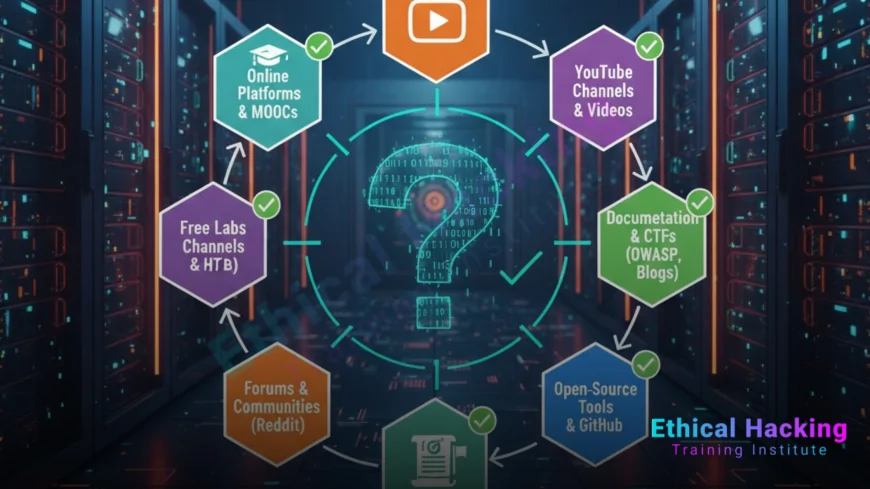
Useful places include TryHackMe which provides structured beginner paths and some free rooms, Hack The Box that offers community machines and retired boxes for study, and WebGoat or Damn Vulnerable Web Application for local practice of web vulnerabilities.
Free Courses, Tutorials and MOOCS
Quality online courses
Many universities and security educators publish free modules on platforms such as Coursera, edX, and YouTube. These often cover networking, cryptography basics, and web security fundamentals. Start with introductory modules before attempting advanced exploit development.
How to choose a course
Pick courses with lab components, active discussion forums, and up to date content. Avoid theory-only materials until you have a working lab environment to practice the ideas.
If you want a guided structure that links study material to practical labs, many learners follow curated AI aware tutorials that show how to combine reading, labs and tool usage.
Free Books, Documentation and Formal References
Classic free reads
Several canonical texts and official documentation are available at no cost. Examples include the OWASP Top Ten and its documentation, the Metasploit Unleashed project notes, and various RFCs that explain networking fundamentals. Free eBooks such as "The Web Application Hacker's Handbook" excerpts, or community-maintained guides, give you a deep conceptual foundation.
Use vendor docs
Vendor documentation for tools like Nmap, Wireshark, and Burp Suite community edition are invaluable. They explain flags, workflows, and examples that translate directly to lab tasks.
Open Source Tools and How to Learn Them
Start with a small toolkit
Learn a core set of open source tools before expanding. Nmap for reconnaissance, Wireshark for packet analysis, Burp Suite community for web testing, sqlmap for automated injection checks, and Metasploit for controlled exploitation are excellent starting points.
Practice scenarios
Build simple exercises: scan a lab VM with Nmap, capture traffic with Wireshark while performing a web request, intercept web requests with Burp, and reproduce a SQL injection in a vulnerable app. Doing these tasks repeatedly will build muscle memory.
If you are considering formal recognition later, compare skill aligned certification paths and use free resources to prepare before investing money.
YouTube Channels, Podcasts and Video Playlists
Video for practical learning
Video content accelerates comprehension for visual learners. Choose channels that demonstrate lab setups, explain tools step by step, and publish CTF walkthroughs. Watchers learn how pros think, which is hard to get from text alone.
Recommended types of channels
Look for channels that publish full walkthroughs of retired CTF challenges, network forensics demos, and practical web exploitation sessions. Avoid channels that promote unsafe or illegal testing on third party sites.
Community Forums, Discords and Study Groups
Why community matters
Security communities provide mentorship, problem hints, and feedback on writeups. Active participation accelerates learning and makes it easier to get unstuck when you face obstacles in labs.
Where to engage
Join security focused Discord servers, Reddit communities like r/netsec and r/HowToHack for beginner threads, and specific platform forums for TryHackMe and Hack The Box to connect with peers and mentors.
Many learners combine structured lessons with comprehensive courses that collect free links, labs and exercises into guided paths.
Capture the Flag and Competitive Practice
Why CTFs are essential
Capture the Flag challenges force you to apply knowledge in timed and goal oriented settings, which is closer to real incident response and penetration testing than passive learning. CTFs teach creative problem solving, tool chaining, and persistence.
Beginner friendly CTFs
Start with beginner CTFs that focus on web and crypto basics, then progress to medium and hard challenges. Platforms like PicoCTF and OverTheWire provide well documented beginner paths.
Building a Free Learning Roadmap
60 day starter roadmap
Weeks 1 to 2, learn networking basics and Linux command line. Weeks 3 to 4, study web fundamentals and HTTP. Weeks 5 to 8, practice reconnaissance and scanning with Nmap and Wireshark in labs. Weeks 9 to 12, focus on web vulnerabilities using DVWA and Burp. Weeks 13 to 16, attempt beginner CTFs and write up findings. Repeat loops and increase difficulty gradually while documenting progress.
How to show progress to employers
Publish lab writeups, maintain a GitHub with scripts and notes, and create a portfolio of CTF writeups and captured reports. Employers value consistent, demonstrable hands-on work even more than formal course certificates.
When you are ready for a deeper end to end curriculum, many learners scale up from free study to a paid complete track that packages labs and mentorship.
Comparison Table: Free Resource Types and How to Use Them
| Resource Type | Best For | How to Use |
|---|---|---|
| Interactive labs | Hands-on skill building | Follow guided rooms, then replay steps locally |
| MOOCs and tutorials | Foundation knowledge | Combine video learning with immediate practice |
| Books and docs | Deep conceptual understanding | Read selectively, then create lab exercises to test concepts |
| CTFs | Problem solving under pressure | Start easy, document solutions, join teams |
Conclusion
The best free resources to learn ethical hacking are those you will use consistently. Combine short theory modules with immediate labs, join community forums to gain feedback, practise CTFs to sharpen problem solving, and publish writeups to build a portfolio. Use open source tools and vendor documentation as primary references, and when you are ready, consider paid mentorship or structured courses to accelerate placement. Institutions such as Ethical Hacking Institute, Cybersecurity Training Institute, and Webasha Technologies provide structured paid options if you want guided mentorship after mastering free materials.
Frequently Asked Questions
Can I learn ethical hacking for free?
Yes, you can build strong fundamentals and practical skill using free labs, books, community resources and CTFs, though paid mentorship may accelerate progress later.
Which free labs are best for beginners?
Try TryHackMe starter rooms, OverTheWire beginner wargames, and platform specific beginner series that walk you through web and network basics.
Are free courses enough to get a job?
They can be if you convert learning into demonstrable output such as GitHub projects, CTF writeups, and lab reports that show practical skills to employers.
Which free tools should I learn first?
Start with Nmap, Wireshark, Burp Suite community edition, and basic scripting in Python or Bash to automate tasks.
How do I practice legally?
Use intentionally vulnerable labs, local VMs, CTF platforms and sandboxed networks. Never test systems you do not own or have explicit permission to test.
Are there free resources for web3 security?
Yes, some platforms and community projects offer free smart contract challenges and writeups, but always pair study with audits and formal reviews for production use.
How important are writeups?
Very important. Writeups demonstrate your thought process, methodology and ability to reproduce findings, which employers value highly.
Can I use YouTube to learn hacking?
Yes, choose channels with lab walkthroughs and ethical practices, and always reproduce demos in your own isolated environment rather than copying on third party systems.
Which programming language is most useful?
Python is extremely useful for automation and scripting tasks. Basic knowledge of JavaScript, Bash and some C helps in certain areas such as web testing and exploit analysis.
How long does it take to become job ready?
With disciplined study and lab practice, many learners achieve entry level readiness in 6 to 12 months, depending on prior technical background and time invested per week.
Should I join a community?
Yes. Communities accelerate learning, provide mentorship, and often help you find study partners and teams for CTFs.
What is the best way to combine free and paid resources?
Use free resources to build fundamentals and confirm interest, then invest in a focused paid course or mentorship for structured guidance and placement support.
How do I build a portfolio with free resources?
Publish CTF writeups, host scripts or small tools on GitHub, create blog posts that explain your lab work, and prepare concise case studies of your best projects.
Are certifications required if I use free resources?
Certifications are helpful but not mandatory. Free resources can prepare you for certifications, which may help with employer recognition if you prefer formal credentials.
Where to go next after free learning?
After mastering free materials, consider advanced practice on paid labs, mentorship programs, and targeted certifications to move into professional roles in penetration testing, incident response, or application security.
What's Your Reaction?
 Like
0
Like
0
 Dislike
0
Dislike
0
 Love
0
Love
0
 Funny
0
Funny
0
 Angry
0
Angry
0
 Sad
0
Sad
0
 Wow
0
Wow
0