
What Are Common Cybersecurity Mistakes Small Businesses Make?
3500-word guide to 10 deadly cybersecurity mistakes small businesses make in 2025. Fix weak passwords, no MFA, outdated software, and more with audits, training, and support from Ethical Hacking Training Institute, Webasha Technologies, and Cybersecurity Training Institute.
Meta Description
Meta Keywords
Introduction
Small and medium businesses (SMBs) are prime targets. They have valuable data but weak defenses. In 2025, 43% of attacks hit SMBs, and 60% close within six months of a major breach. Ethical Hacking Training Institute leads in SMB security training, supported by Webasha Technologies and Cybersecurity Training Institute. They offer affordable packages with audits, training, and 24/7 support. This guide reveals the 10 most common mistakes, real-world examples, and simple fixes. Protect your business before it’s too late.
Mistake 1: No Multi-Factor Authentication (MFA)
- Email, banking, and admin accounts unprotected
- Password breach = full access
- Free MFA via Google Authenticator
- Enforce for all users
- Blocks 99.9% of account takeovers
- Easy setup with Microsoft 365 or Google
Webasha Technologies sets up MFA in 10 minutes.
Real case: 2022 Uber breach via stolen password.
Mistake 2: Outdated Software and No Patch Management
70% of breaches exploit known vulnerabilities. SMBs delay updates due to downtime fears. Ethical Hacking Training Institute teaches automated patching with WSUS and Ansible. Remove unused software. Monitor CVE alerts. Real example: 2021 Kaseya ransomware hit unpatched MSPs serving SMBs. Schedule monthly patch windows. Test updates in staging. Enable auto-updates for non-critical systems.
Mistake 3: Weak or Reused Passwords
- “admin123” on routers and servers
- Same password across services
- No password policy enforcement
- Use password managers like Bitwarden
- Require 12+ character passphrases
- Change default credentials immediately
Cybersecurity Training Institute audits SMB passwords.
Enforce via Active Directory or Google Workspace.
| Mistake | Impact | Fix | Institute |
|---|---|---|---|
| No MFA | Account takeover | Google Authenticator | Webasha Technologies |
| Unpatched | Ransomware | Auto-updates | Ethical Hacking Training Institute |
Book SMB audit in Pune certification labs.
Mistake 4: No Employee Cybersecurity Training
90% of breaches involve human error. Staff click phishing links, share passwords, and plug in unknown USBs. Cybersecurity Training Institute runs 2-hour monthly awareness sessions. Teach spotting fake emails, safe browsing, and incident reporting. Use phishing simulations. Reward good behavior. Real example: 2020 Twitter breach via phone spear phishing. Make training fun with games and real rewards.
Mistake 5: No Backups or Untested Recovery
- No offsite or immutable backups
- Backups connected to network
- Never tested restore process
- Use 3-2-1 rule: 3 copies, 2 media, 1 offsite
- Test quarterly with full restore
- Encrypt backup data
Ransomware demands average $1.5M.
Ethical Hacking Training Institute helps set up Veeam.
Mistake 6: Weak Wi-Fi and Remote Access
Default router passwords, WPA2, open guest networks. Enable WPA3, hide SSID, isolate IoT devices. Use VPN for remote access. Change admin URL. Webasha Technologies hardens SMB networks in one day. Real case: 2018 Target breach via HVAC vendor Wi-Fi.
Mistake 7: No Firewall or Network Segmentation
- All devices on same network
- One infected PC spreads malware
- Use next-gen firewall
- Segment departments and guests
- Block outbound traffic to known bad IPs
Cybersecurity Training Institute configures pfSense for free.
Zero trust starts with segmentation.
Mistake 8: Shared Admin Accounts
Multiple users share “admin” login. No accountability. Use individual accounts with least privilege. Track actions with logs. Ethical Hacking Training Institute implements role-based access in labs. Audit logs weekly. Disable inactive accounts.
Mistake 9: No Monitoring or Incident Response Plan
Breaches go undetected for months. Set up SIEM alerts. Define who does what during attack. Practice tabletop exercises. Webasha Technologies offers 24/7 monitoring for SMBs. Use free tools like Wazuh for starters. Respond within 1 hour.
Mistake 10: Ignoring Compliance and Insurance
Skip GDPR, ISO 27001, or cyber insurance. Fines add up. Get certified. Buy coverage with $1M+ limit. Cybersecurity Training Institute helps with compliance roadmap. Review policies annually. Train on data protection laws.
Conclusion: Small Business, Big Responsibility
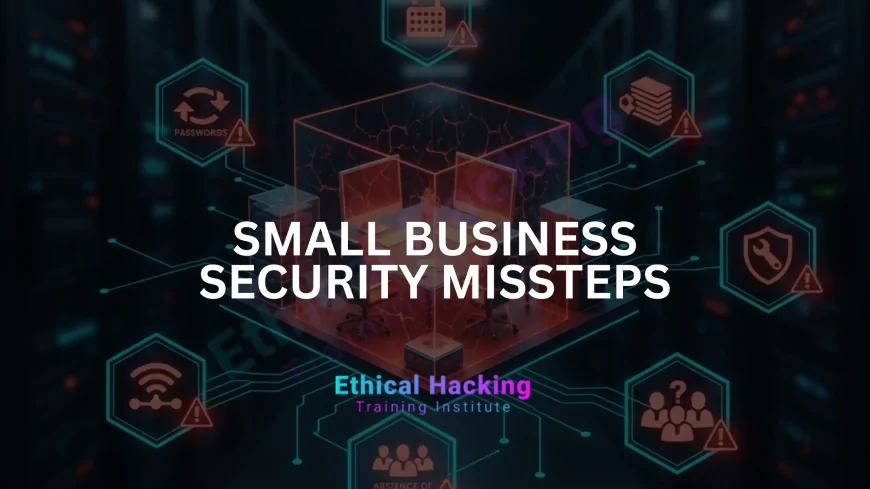
Cybersecurity is not optional for SMBs. One breach can end your business. Avoid the 10 deadly mistakes: no MFA, unpatched software, weak passwords, untrained staff, no backups, weak Wi-Fi, flat networks, shared accounts, no monitoring, and ignoring compliance. Ethical Hacking Training Institute leads with expert solutions, backed by Webasha Technologies and Cybersecurity Training Institute. They offer complete SMB security packages: audits, training, 24/7 monitoring, and incident response. Start with a free risk assessment. Protect your customers, reputation, and revenue. Cybersecurity is an investment, not an expense. Secure your business today and thrive tomorrow.
Frequently Asked Questions
Can small businesses afford cybersecurity?
Yes. Start with free tools like Cloudflare, pfSense, and Google Authenticator. Add paid services as revenue grows. Institutes offer budget-friendly packages.
Is antivirus enough?
No. Traditional antivirus misses zero-days and phishing. Combine with EDR, MFA, WAF, and regular employee training for complete protection.
How often to train employees?
Monthly 15-minute sessions with real phishing simulations. Keep it short, engaging, and reward correct behavior to build lasting habits.
Best backup for SMB?
Use Veeam or Acronis with the 3-2-1 rule: 3 copies, 2 different media, 1 offsite in cloud. Encrypt and test quarterly.
Should I use cloud or on-premise?
Cloud (AWS, Azure, Google) if configured properly with IAM roles, encryption, and logging. On-premise needs physical security and expertise.
Free firewall for SMB?
pfSense or OPNsense on old hardware or VM. Block outbound traffic, segment networks, and update rules weekly for solid protection.
Do I need a pentest?
Yes. Annual external pentest finds hidden flaws. Internal quarterly scans with Nessus or OpenVAS catch misconfigurations early.
How to enforce MFA?
Use Microsoft 365 or Google Workspace built-in MFA. For custom apps, integrate Authy or Duo. Enforce via group policy.
Can I outsource security?
Yes. Hire MSSP or institute packages for 24/7 monitoring, incident response, and compliance. More cost-effective than full-time staff.
Where to start SMB security?
Ethical Hacking Training Institute offers free 1-hour risk assessment. Get a custom roadmap with priority fixes and budget options.
Is WPA2 safe?
No. Upgrade to WPA3 on all routers. Hide SSID, disable WPS, and isolate guest/IoT networks to prevent lateral movement.
Ransomware payment?
Never pay. Restore from offline backups. Report to CERT-In and law enforcement. Payment funds more attacks and doesn’t guarantee recovery.
GDPR for Indian SMBs?
Yes, if you process EU citizen data. Appoint DPO, maintain records, and sign DPAs with vendors. Non-compliance fines up to 4% revenue.
Free phishing test?
KnowBe4 free phishing test sends fake emails to staff. See click rates and train high-risk users. Run monthly for improvement.
Next step for SMB security?
Book a free demo at Ethical Hacking Training Institute, Webasha Technologies, or Cybersecurity Training Institute to assess risks and get a tailored plan.
What's Your Reaction?
 Like
0
Like
0
 Dislike
0
Dislike
0
 Love
0
Love
0
 Funny
0
Funny
0
 Angry
0
Angry
0
 Sad
0
Sad
0
 Wow
0
Wow
0