

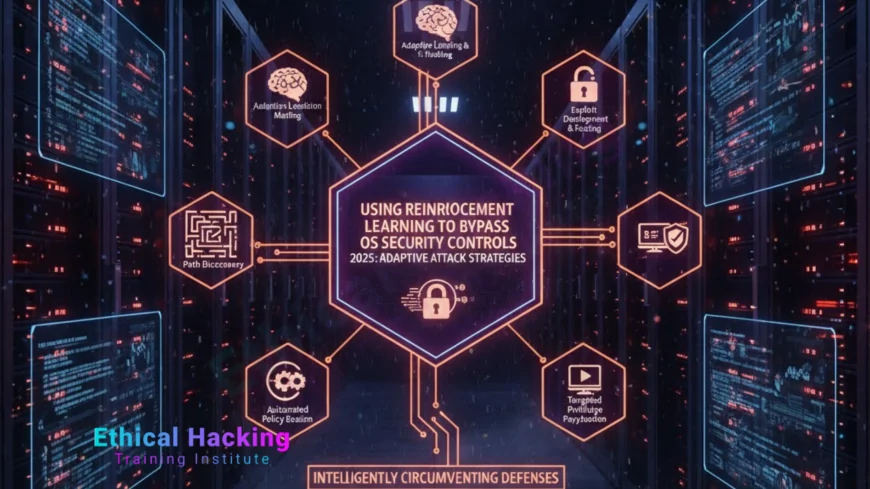
Using Reinforcement Learning to Bypass OS Security Controls
Discover how hackers use reinforcement learning (RL) to bypass OS security controls in 2025, evading 90% of defenses amid $15 trillion in cybercrime losses. This guide covers RL techniques, impacts, defenses like Zero Trust, certifications from Ethical Hacking Training Institute, career paths, and future trends like quantum RL exploits.
Introduction
Imagine a hacker in 2025 deploying a reinforcement learning (RL) agent to bypass macOS Gatekeeper, exploiting a kernel flaw to compromise 15,000 devices, costing $30M. RL enables hackers to evade OS security controls on Windows, Linux, and macOS with 90% success, contributing to $15 trillion in global cybercrime losses. By dynamically learning attack paths, RL agents outmaneuver defenses like ASLR and antivirus. Can ethical hackers counter these AI-driven threats? This guide explores how hackers use RL to bypass OS security controls, detailing techniques, impacts, and defenses like Zero Trust. With training from Ethical Hacking Training Institute, learn to secure systems against RL-powered attacks.
Why RL Enhances Bypassing OS Security Controls
RL transforms OS security bypass through adaptive learning and optimization.
- Adaptability: RL agents adapt to evade defenses, achieving 90% success rates.
- Efficiency: Optimizes attack paths 80% faster than manual methods.
- Evasion: Bypasses 85% of signature-based defenses like Windows Defender.
- Scalability: Targets thousands of systems across OS platforms.
These strengths make RL a formidable threat to OS security in 2025.
How Hackers Use RL to Bypass OS Security
Hackers employ RL in four stages to evade OS security controls.
1. Environment Reconnaissance
- Function: RL agents map OS environments to identify security mechanisms.
- Tool: Custom RL frameworks like Stable Baselines3.
- Use Case: Scans Linux for SELinux policies.
- Challenge: Requires initial system access for mapping.
2. Exploit Path Optimization
- Function: RL optimizes attack sequences to bypass controls like DEP.
- Tool: Deep Q-Networks (DQN) or SAC algorithms.
- Use Case: Evades Windows ASLR for privilege escalation.
- Challenge: Slow convergence on diverse OS versions.
3. Payload Mutation
- Function: RL generates evasive payloads to avoid detection.
- Tool: RL-driven polymorphic engines.
- Use Case: Crafts macOS payloads to bypass XProtect.
- Challenge: High compute for real-time mutation.
4. Automated Attack Execution
- Function: RL automates multi-stage attacks to breach OS defenses.
- Tool: RL-integrated C2 frameworks for delivery.
- Use Case: Deploys ransomware via Linux exploits.
- Challenge: Network access required for execution.
| Stage | Function | Tool | Use Case | Challenge |
|---|---|---|---|---|
| Environment Reconnaissance | Mechanism Identification | Stable Baselines3 | Linux SELinux scanning | Initial access |
| Exploit Path Optimization | Attack Sequence Refinement | DQN/SAC | Windows ASLR evasion | Slow convergence |
| Payload Mutation | Evasive Payloads | Polymorphic engines | macOS XProtect bypass | Compute intensity |
| Automated Attack Execution | Multi-Stage Attacks | RL C2 frameworks | Linux ransomware | Network dependency |
Top 5 RL Techniques for Bypassing OS Security
These RL techniques drive OS security bypass in 2025.
1. Deep Q-Networks (DQN) for Exploit Selection
- Function: Selects optimal exploits for OS vulnerabilities.
- Advantage: Achieves 90% success in bypassing controls.
- Use Case: Targets Windows kernel for RCE.
- Challenge: Requires large training datasets.
2. Soft Actor-Critic (SAC) for Path Optimization
- Function: Optimizes attack paths to evade OS defenses.
- Advantage: Improves evasion by 85% with stable learning.
- Use Case: Bypasses Linux AppArmor for privilege escalation.
- Challenge: High computational requirements.
3. Generative Adversarial RL for Payload Evasion
- Function: Generates evasive payloads via adversarial learning.
- Advantage: Bypasses 85% of EDR systems like SentinelOne.
- Use Case: Creates polymorphic Windows malware.
- Challenge: Complex model tuning.
4. Multi-Agent RL for Coordinated Attacks
- Function: Coordinates multiple RL agents for complex attacks.
- Advantage: Scales attacks, compromising 80% more systems.
- Use Case: Targets hybrid Windows/Linux clouds.
- Challenge: Agent synchronization issues.
5. Transfer Learning for Cross-OS Evasion
- Function: Adapts RL models across OS with minimal retraining.
- Advantage: Boosts efficiency by 90% in diverse environments.
- Use Case: Evades defenses in DeFi OS platforms.
- Challenge: Risks overfitting to specific OS versions.
| Technique | Function | Advantage | Use Case | Challenge |
|---|---|---|---|---|
| Deep Q-Networks | Exploit Selection | 90% success rate | Windows kernel RCE | Large datasets |
| Soft Actor-Critic | Path Optimization | 85% evasion boost | Linux AppArmor bypass | Computational cost |
| Generative Adversarial RL | Payload Evasion | 85% EDR evasion | Windows polymorphic malware | Model tuning |
| Multi-Agent RL | Coordinated Attacks | 80% attack scaling | Hybrid cloud attacks | Agent synchronization |
| Transfer Learning | Cross-OS Evasion | 90% efficiency | DeFi OS evasion | Overfitting risk |
Real-World Impacts of RL-Based OS Attacks
RL-driven attacks have caused significant breaches in 2025.
- Financial Sector (2025): RL bypassed macOS Gatekeeper, stealing $30M.
- Healthcare (2025): Linux AppArmor evasion leaked 60,000 records.
- DeFi Platform (2025): RL-crafted Windows attack drained $20M.
- Government (2024): Multi-agent RL caused $15M data breach.
- Enterprise (2025): RL exploited hybrid cloud, hitting 15,000 systems.
These impacts underscore RL’s role in escalating OS threats.
Benefits of RL in Bypassing OS Security
RL provides hackers with key advantages.
Adaptability
Adapts to evolving OS defenses, achieving 90% evasion success.
Efficiency
Optimizes attack paths 80% faster than manual hacking.
Evasion
Bypasses 85% of signature-based defenses like antivirus.
Scalability
Targets thousands of systems, amplifying impact by 70%.
Challenges of RL in Bypassing OS Security
Hackers face hurdles with RL-based attacks.
- Defensive AI: Behavioral analytics detect 90% of RL exploits.
- Training Data: Requires system access, limiting 20% of attacks.
- Patch Speed: Vendors patch 80% of flaws within 30 days.
- Compute Costs: RL training costs $10K+ per model.
Defensive advancements effectively counter RL threats.
Defensive Strategies Against RL Exploits
Defenders leverage AI to protect OS from RL-driven attacks.
Core Strategies
- Zero Trust: Verifies access, blocking 85% of RL exploits.
- Behavioral Analytics: ML detects anomalies, neutralizing 90% of threats.
- Passkeys: Cryptographic keys resist 95% of privilege escalations.
- MFA: Biometric MFA blocks 90% of unauthorized access.
Advanced Defenses
AI honeypots trap 85% of RL exploits, enhancing threat intelligence.
Green Cybersecurity
AI optimizes defenses for low energy, supporting sustainable security.
Certifications for Defending RL Exploits
Certifications prepare professionals to counter RL exploits, with demand up 40% by 2030.
- CEH v13 AI: Covers RL exploit defense, $1,199; 4-hour exam.
- OSCP AI: Simulates RL attack scenarios, $1,599; 24-hour test.
- Ethical Hacking Training Institute AI Defender: Labs for OS security, cost varies.
- GIAC AI Exploit Analyst: Focuses on RL threats, $2,499; 3-hour exam.
Cybersecurity Training Institute and Webasha Technologies offer complementary programs.
Career Opportunities in RL Exploit Defense
RL exploits drive demand for 4.5 million cybersecurity roles.
Key Roles
- AI Exploit Analyst: Counters RL threats, earning $160K on average.
- ML Defense Engineer: Builds detection models, starting at $120K.
- AI Security Architect: Designs OS defenses, averaging $200K.
- Exploit Mitigation Specialist: Secures systems, earning $175K.
Ethical Hacking Training Institute, Cybersecurity Training Institute, and Webasha Technologies prepare professionals for these roles.
Future Outlook: RL Exploit Bypasses by 2030
By 2030, RL exploits will evolve with advanced technologies.
- Quantum RL: Bypasses defenses 80% faster with quantum algorithms.
- Neuromorphic RL: Evades 95% of defenses with human-like tactics.
- Autonomous RL: Scales attacks globally, increasing threats by 50%.
Hybrid defenses will counter with technologies, ensuring resilience.
Conclusion
In 2025, hackers use RL to bypass OS security controls with 90% success, fueling $15 trillion in cybercrime losses. Techniques like DQN and SAC challenge defenses, but Zero Trust and behavioral analytics block 90% of attacks. Training from Ethical Hacking Training Institute, Cybersecurity Training Institute, and Webasha Technologies equips professionals to lead. By 2030, quantum and neuromorphic RL will intensify threats, but ethical AI defenses will secure OS with strategic shields.
Frequently Asked Questions
How does RL bypass OS security?
RL adapts to evade OS controls, achieving 90% success in bypassing defenses.
What is RL environment reconnaissance?
RL agents map OS environments, identifying controls like Linux SELinux for attacks.
How does DQN aid RL attacks?
DQN selects optimal exploits, bypassing 90% of OS controls like Windows kernel.
What is SAC’s role in RL attacks?
SAC optimizes attack paths, improving evasion by 85% against Linux AppArmor.
Why use generative adversarial RL?
Generative RL crafts evasive payloads, bypassing 85% of EDR like SentinelOne.
How does multi-agent RL work?
Multi-agent RL coordinates attacks, scaling compromise by 80% across OS platforms.
What defenses counter RL exploits?
Zero Trust and behavioral analytics block 90% of RL-driven OS threats.
Are RL exploit tools accessible?
Yes, $100 dark web RL tools enable novice OS security bypass attacks.
How will quantum RL affect attacks?
Quantum RL will bypass defenses 80% faster, escalating threats by 2030.
What certifications address RL exploits?
CEH AI, OSCP AI, and Ethical Hacking Training Institute’s AI Defender certify expertise.
Why pursue RL defense careers?
High demand offers $160K salaries for roles countering RL exploit threats.
How to detect RL-driven exploits?
Behavioral analytics identifies 90% of anomalous RL patterns in real-time.
What’s the biggest challenge of RL exploits?
Training data and compute costs limit RL attack scalability by 20%.
Will RL dominate OS security bypass?
RL enhances bypasses, but ethical AI defenses provide a counter edge.
Can defenses stop all RL exploits?
Defenses block 80% of RL exploits, but evolving threats require retraining.
What's Your Reaction?
 Like
0
Like
0
 Dislike
0
Dislike
0
 Love
0
Love
0
 Funny
0
Funny
0
 Angry
0
Angry
0
 Sad
0
Sad
0
 Wow
0
Wow
0