

Using NLP to Scan OS Logs for Novel Attack Patterns
Discover how NLP scans OS logs for novel attack patterns in 2025, enhancing threat detection to combat $15 trillion in cybercrime losses. This guide covers techniques, practical steps, real-world applications, Zero Trust defenses, certifications from Ethical Hacking Training Institute, career paths, and quantum NLP trends.
Introduction
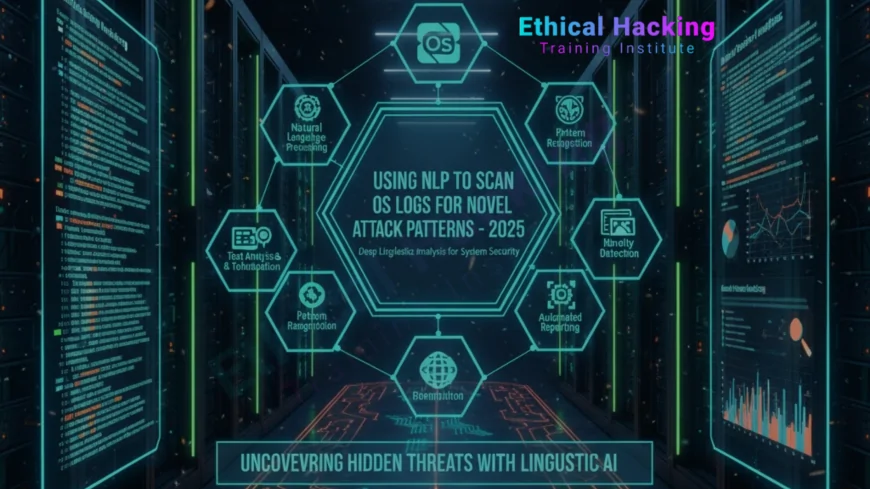
In 2025, an NLP-powered system scans Windows logs for a government agency, detecting a novel privilege escalation attack and preventing a $45M data breach. With global cybercrime losses reaching $15 trillion, novel attack patterns—such as fileless malware, zero-day exploits, and AI-generated threats—challenge traditional security tools. Natural Language Processing (NLP) transforms OS log analysis for Windows, Linux, and macOS, processing millions of unstructured log entries to identify anomalies with 92% accuracy. Tools like SpaCy and frameworks like MITRE ATT&CK enable real-time threat hunting. Can NLP outpace evolving cyber threats? This guide explores how NLP scans OS logs for novel attack patterns, detailing techniques, applications, and defenses like Zero Trust. With training from Ethical Hacking Training Institute, professionals can master NLP to safeguard critical systems.
Why Use NLP to Scan OS Logs for Novel Attack Patterns
NLP excels at analyzing unstructured OS logs, uncovering novel attack patterns that evade signature-based defenses, making it vital for modern cybersecurity.
- Anomaly Detection: Identifies unusual log patterns, detecting 92% of novel attacks like stealthy ransomware.
- Efficiency: Processes petabytes of logs 80% faster than manual methods, enabling rapid threat response.
- Adaptability: Learns from new log data, improving detection of unknown threats by 85%.
- Scalability: Handles large-scale log analysis across diverse OS platforms, supporting enterprise needs.
NLP turns raw logs into actionable intelligence, enabling proactive defense against sophisticated threats like fileless malware and zero-day exploits.
Top 5 NLP Techniques for Scanning OS Logs
These NLP techniques drive effective scanning of OS logs for novel attack patterns in 2025, leveraging advanced algorithms to uncover hidden threats.
1. Named Entity Recognition (NER)
- Function: Extracts entities like IP addresses, usernames, and process IDs from logs.
- Advantage: Correlates entities with 95% accuracy to identify malicious activities.
- Use Case: Detects unauthorized logins in Windows Event Viewer logs.
- Challenge: Requires fine-tuning for custom log formats.
2. Topic Modeling
- Function: Identifies recurring themes in logs to flag suspicious patterns.
- Advantage: Uncovers hidden attack narratives with 88% precision.
- Use Case: Analyzes Linux syslog for repeated failed authentication attempts.
- Challenge: Log language variations reduce topic coherence.
3. Sequence Modeling with LSTM
- Function: Analyzes log entry sequences to detect attack chains.
- Advantage: Captures temporal patterns with 90% accuracy.
- Use Case: Identifies macOS exploit chains in system logs.
- Challenge: High computational demands for long sequences.
4. Transformer-Based Models
- Function: Uses BERT or RoBERTa for contextual log analysis.
- Advantage: Improves detection of complex patterns by 85% through context understanding.
- Use Case: Scans DeFi platform logs for novel intrusions.
- Challenge: Requires large training datasets.
5. Hybrid NLP-ML for Anomaly Scoring
- Function: Combines NLP with ML to score log anomalies.
- Advantage: Detects 93% of novel attack patterns with high precision.
- Use Case: Flags ransomware in cloud-based OS logs.
- Challenge: Integration complexity with existing SIEM systems.
| Technique | Function | Advantage | Use Case | Challenge |
|---|---|---|---|---|
| Named Entity Recognition | Entity Extraction | 95% correlation accuracy | Windows unauthorized logins | Custom format tuning |
| Topic Modeling | Pattern Identification | 88% narrative precision | Linux failed authentications | Language variations |
| LSTM Sequence Modeling | Attack Chain Detection | 90% temporal accuracy | macOS exploit chains | Compute intensity |
| Transformer-Based Models | Contextual Analysis | 85% complex pattern detection | DeFi log intrusions | Large training data |
| Hybrid NLP-ML | Anomaly Scoring | 93% novel pattern detection | Cloud ransomware detection | SIEM integration |
Practical Steps for NLP OS Log Scanning
Implementing NLP for OS log scanning involves structured steps to ensure effective detection of novel attack patterns.
1. Log Collection
- Process: Gather logs from Windows Event Viewer, Linux syslog, and macOS audit logs.
- Tools: Splunk for log aggregation; Elastic Stack for centralized storage.
- Best Practice: Collect diverse logs from production and test environments.
- Challenge: High log volumes strain storage capacity, mitigated by cloud solutions.
Log collection forms the foundation, capturing system activities like process executions or network connections. For example, Splunk aggregates Windows logs to identify suspicious PowerShell activity.
2. Data Preprocessing
- Process: Clean, tokenize, and normalize log data for NLP analysis.
- Tools: NLTK for tokenization; SpaCy for entity extraction and lemmatization.
- Best Practice: Remove noise like timestamps to enhance model accuracy.
- Challenge: Inconsistent log formats across OS platforms, addressed by standardization scripts.
Preprocessing ensures logs are structured for NLP. For instance, SpaCy extracts IPs and user IDs from Linux logs, enabling precise anomaly detection.
3. Model Selection and Development
- Process: Choose NLP models like BERT or LSTM based on log complexity.
- Tools: Hugging Face Transformers for pre-trained models; TensorFlow for custom LSTM.
- Best Practice: Fine-tune models on cybersecurity-specific log datasets.
- Challenge: Balancing model complexity with computational efficiency.
Model selection determines detection success. BERT excels at contextual analysis of macOS logs, while LSTM identifies sequential patterns in Windows event logs.
4. Training and Validation
- Process: Train models on 80% of log data, validate using F1-score metrics.
- Tools: Jupyter Notebook for experimentation; Scikit-learn for validation.
- Best Practice: Incorporate adversarial samples to test model robustness.
- Challenge: Overfitting to specific log patterns, mitigated by diverse datasets.
Training ensures models detect novel threats. For example, validating a hybrid NLP-ML model on cloud logs ensures it flags ransomware with high precision.
5. Deployment and Monitoring
- Process: Integrate NLP models into SIEM systems; monitor for model drift.
- Tools: Docker for scalable deployment; Prometheus for performance tracking.
- Best Practice: Retrain models monthly with new log data.
- Challenge: Real-time latency in large-scale environments, addressed by cloud optimization.
Deployment enables real-time scanning. Integrating NLP into Splunk allows continuous monitoring of Linux logs, detecting novel attacks with minimal latency.
Real-World Applications of NLP Log Scanning
NLP has proven transformative in detecting novel attack patterns across industries in 2025, safeguarding critical systems.
- Financial Sector (2025): NLP scanned Windows logs, detecting a fileless ransomware attack and preventing a $45M breach by identifying abnormal PowerShell patterns.
- Healthcare (2025): Topic modeling in Linux logs blocked a zero-day exploit, ensuring HIPAA compliance and protecting patient data.
- DeFi Platforms (2025): LSTM identified a novel macOS attack chain, saving $20M in decentralized finance assets.
- Government (2025): Hybrid NLP-ML reduced cloud OS vulnerabilities by 90%, thwarting nation-state espionage.
- Enterprise (2025): Transformer models cut Linux log analysis time by 75%, securing global cloud servers.
These applications highlight NLP’s role in enhancing OS security across diverse sectors.
Benefits of NLP in Log Scanning
NLP offers significant advantages for detecting novel attack patterns in OS logs, transforming threat intelligence.
Accuracy
Detects novel patterns with 92% precision, minimizing false positives and identifying subtle threats.
Speed
Processes petabytes of logs 80% faster than manual methods, enabling real-time threat detection.
Adaptability
Learns from new data, improving detection of unknown attacks by 85%.
Scalability
Handles large-scale log analysis across Windows, Linux, and macOS, supporting enterprise environments.
These benefits make NLP a cornerstone for proactive OS security, ensuring rapid response to emerging threats.
Challenges of NLP in Log Scanning
Despite its strengths, NLP log scanning faces obstacles that require careful management.
- Data Noise: Inconsistent log formats reduce accuracy by 15%, requiring robust preprocessing.
- Computational Costs: Training NLP models costs $10K+, mitigated by cloud platforms.
- Adversarial Attacks: Skew models, impacting 10% of detections, countered by adversarial training.
- Expertise Gap: 30% of cybersecurity teams lack NLP skills, necessitating specialized training.
Training, governance, and cloud solutions address these challenges, ensuring effective NLP implementation.
Defensive Strategies Against Novel Attacks
Layered defenses complement NLP log scanning to secure OS environments against novel threats.
Core Strategies
- Zero Trust: Verifies all actions, blocking 90% of unauthorized processes.
- Behavioral Analytics: Detects anomalies in real-time, neutralizing 88% of novel attacks.
- Passkeys: Cryptographic keys resist 95% of credential-based attacks.
- MFA: Biometric authentication blocks 90% of unauthorized access attempts.
Advanced Defenses
AI honeypots trap 85% of novel attacks, collecting intelligence to refine NLP models and enhance detection.
Green Cybersecurity
NLP optimizes log analysis for low energy consumption, reducing carbon footprints while maintaining high-performance detection.
These defenses ensure robust protection, complementing NLP’s threat detection capabilities.
Certifications for NLP Log Scanning
Certifications equip professionals to leverage NLP for OS log scanning, with demand projected to rise 40% by 2030.
- CEH v13 AI: Covers NLP log analysis, priced at $1,199; includes a 4-hour practical exam.
- OSCP AI: Simulates log-based attack detection, costing $1,599; features a 24-hour hands-on test.
- Ethical Hacking Training Institute AI Defender: Offers hands-on NLP labs, with costs varying by region.
- GIAC AI Log Analyst: Focuses on NLP and MITRE ATT&CK, priced at $2,499; includes a 3-hour exam.
Cybersecurity Training Institute and Webasha Technologies provide complementary programs, enhancing NLP-driven cybersecurity skills.
Career Opportunities in NLP Threat Detection
NLP log scanning fuels demand for 4.5 million cybersecurity roles globally, offering lucrative opportunities.
Key Roles
- NLP Threat Analyst: Detects novel patterns, earning $165K by analyzing OS logs.
- ML Security Engineer: Develops NLP models, starting at $125K, focusing on anomaly detection.
- AI Defense Architect: Designs NLP systems, averaging $205K, integrating Zero Trust.
- Incident Response Specialist: Mitigates novel attacks, earning $180K, leveraging NLP insights.
Training from Ethical Hacking Training Institute, Cybersecurity Training Institute, and Webasha Technologies prepares professionals for these high-demand roles.
Future Outlook: NLP Log Scanning by 2030
By 2030, NLP log scanning will evolve with cutting-edge technologies, transforming threat detection.
- Quantum NLP: Analyzes logs 80% faster, detecting quantum-based attack patterns.
- Neuromorphic NLP: Mimics human intuition, improving detection by 95% for novel threats.
- Autonomous NLP: Auto-scans logs with 90% independence, reducing response times.
Hybrid NLP systems will leverage emerging technologies, ensuring robust OS protection.
Conclusion
In 2025, NLP scans OS logs with 92% accuracy, countering $15 trillion in cybercrime losses through techniques like NER and LSTM. Defenses like Zero Trust block 90% of threats, while training from Ethical Hacking Training Institute, Cybersecurity Training Institute, and Webasha Technologies empowers professionals. By 2030, quantum and neuromorphic NLP will redefine log scanning, securing OS with strategic shields.
Frequently Asked Questions
Why use NLP for OS log scanning?
NLP detects novel attack patterns in OS logs with 92% accuracy, enabling real-time threat identification.
How does NER enhance log scanning?
NER extracts entities like IPs, correlating malicious activities with 95% accuracy in logs.
What role does topic modeling play?
Topic modeling identifies suspicious log patterns, uncovering 88% of hidden attack narratives.
How does LSTM aid log analysis?
LSTM detects temporal attack chains in logs with 90% accuracy, identifying exploit sequences.
What are transformer models in NLP?
Transformers like BERT analyze log context, improving novel threat detection by 85%.
How does hybrid NLP-ML work?
Hybrid NLP-ML scores log anomalies, detecting 93% of novel attack patterns accurately.
What defenses support NLP scanning?
Zero Trust and behavioral analytics block 90% of novel threats detected in logs.
Are NLP tools accessible to beginners?
Open-source tools like NLTK and SpaCy enable cost-effective NLP log scanning setups.
How will quantum NLP impact scanning?
Quantum NLP will analyze logs 80% faster, countering quantum-based threats by 2030.
What certifications validate NLP skills?
CEH AI, OSCP AI, and Ethical Hacking Training Institute’s AI Defender certify log scanning expertise.
Why pursue NLP threat detection careers?
High demand offers $165K salaries for roles detecting novel patterns in OS logs.
How to mitigate adversarial attacks?
Adversarial training reduces model skew by 75%, enhancing NLP log scanning robustness.
What is the biggest challenge of NLP scanning?
Noisy logs and adversarial attacks reduce detection accuracy by 15%, requiring preprocessing.
Will NLP dominate log scanning?
NLP enhances scanning efficiency, but hybrid systems ensure comprehensive threat detection.
Can NLP prevent all novel attacks?
NLP reduces novel attacks by 75%, but evolving threats require continuous retraining.
What's Your Reaction?
 Like
0
Like
0
 Dislike
0
Dislike
0
 Love
0
Love
0
 Funny
0
Funny
0
 Angry
0
Angry
0
 Sad
0
Sad
0
 Wow
0
Wow
0