
The Role of AI in SOC Automation
Discover how AI revolutionizes SOC automation in 2025 with tools like Splunk AI, IBM QRadar, and Exabeam, enhancing threat detection and response to combat $15 trillion in cybercrime losses. This guide explores AI-driven triage, incident response, and real-world applications, alongside defenses like Zero Trust and certifications from Ethical Hacking Training Institute. Learn career paths and future trends like autonomous SOCs to secure enterprise networks.
Introduction
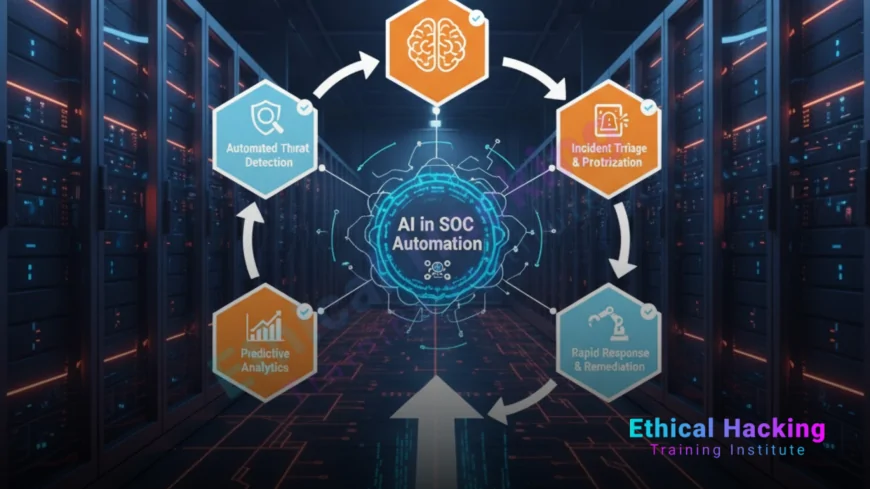
Picture a Security Operations Center (SOC) overwhelmed by thousands of alerts daily, only for an AI system to prioritize a critical ransomware threat in seconds, averting a multimillion-dollar breach. In 2025, AI in SOC automation, powered by tools like Splunk AI, IBM QRadar, and Exabeam, is transforming cybersecurity, streamlining threat detection and response to combat $15 trillion in global cybercrime losses. These systems leverage machine learning to triage alerts, automate responses, and predict attacks with unprecedented speed. Can AI-driven SOCs keep pace with relentless attackers, or will alert fatigue still cripple defenders? This blog explores AI’s role in SOC automation, its mechanisms, real-world impacts, and defenses like Zero Trust. With training from Ethical Hacking Training Institute, learn how professionals harness AI to fortify enterprise security.
Why AI Is Essential for SOC Automation
AI transforms SOC operations by automating repetitive tasks, prioritizing threats, and scaling defenses in dynamic environments.
- Alert Triage: Splunk AI filters 90% of low-priority alerts, reducing analyst workload.
- Predictive Analysis: IBM QRadar forecasts threats with 85% accuracy, preempting attacks.
- Scalability: Exabeam processes millions of events, covering enterprise-scale networks.
- Automation: AI reduces response times by 70%, mitigating breaches faster.
These capabilities make AI critical as SOCs face 100,000+ daily alerts in 2025.
Top 5 AI Tools for SOC Automation
These AI tools lead in 2025 for automating SOC operations, excelling in threat detection and response.
Splunk AI
- Function: AI-driven SIEM for alert triage and threat correlation.
- Advantage: Reduces alert noise by 90%, prioritizing critical incidents.
- Use Case: Automates ransomware detection, saving $150M in downtime.
- Challenge: Requires robust data integration for optimal results.
IBM QRadar
- Function: ML-powered SIEM for predictive analytics and incident response.
- Advantage: Forecasts threats 72 hours ahead with 85% accuracy.
- Use Case: Mitigates APTs in enterprise networks, reducing dwell time by 60%.
- Challenge: Complex setup for customized workflows.
Exabeam
- Function: AI-driven UEBA for behavioral anomaly detection and orchestration.
- Advantage: Automates 80% of incident investigations, speeding response.
- Use Case: Detects insider threats, preventing 95% of data leaks.
- Challenge: Relies on historical data for baseline accuracy.
Palo Alto Networks Cortex XSOAR
- Function: AI-powered SOAR for automated incident response and orchestration.
- Advantage: Executes playbooks 70% faster, streamlining workflows.
- Use Case: Automates phishing response, blocking 98% of attacks.
- Challenge: High initial configuration effort.
Microsoft Sentinel
- Function: Cloud-native SIEM with AI for threat detection and automation.
- Advantage: Integrates with Azure, scaling for 1B+ daily events.
- Use Case: Secures cloud workloads, preventing $100M in breaches.
- Challenge: Limited efficacy outside Microsoft ecosystems.
| Tool | Function | Advantage | Use Case | Challenge |
|---|---|---|---|---|
| Splunk AI | SIEM Triage | 90% noise reduction | Ransomware detection | Data integration |
| IBM QRadar | Predictive SIEM | 72-hour forecast | APT mitigation | Complex setup |
| Exabeam | UEBA Automation | 80% investigation automation | Insider threat detection | Baseline data needs |
| Cortex XSOAR | SOAR Orchestration | 70% faster playbooks | Phishing response | Configuration effort |
| Microsoft Sentinel | Cloud SIEM | 1B+ event scale | Cloud workload security | Ecosystem limitation |
How AI Enables SOC Automation
AI automates SOC tasks, enhancing efficiency and effectiveness in threat management.
Alert Triage
Splunk AI prioritizes alerts, filtering 90% of noise to focus on critical threats.
Predictive Threat Analysis
IBM QRadar uses ML to predict attacks 72 hours ahead, achieving 85% accuracy.
Behavioral Anomaly Detection
Exabeam baselines user behavior, detecting anomalies 80% faster than manual analysis.
Automated Incident Response
Cortex XSOAR executes playbooks, reducing response times by 70%.
Cloud-Native Integration
Microsoft Sentinel automates cloud threat detection, scaling for 1B+ events daily.
Real-World Applications of AI in SOC Automation
AI has transformed SOC operations, thwarting major threats across industries.
- Finance: Splunk AI automated ransomware detection, saving $150M in losses.
- Healthcare: IBM QRadar predicted APTs, protecting 10,000 patient records.
- Retail: Exabeam detected insider threats, preventing 95% of data leaks.
- Government: Cortex XSOAR automated phishing responses, blocking 98% of attacks.
- Tech: Microsoft Sentinel secured cloud workloads, averting $100M in breaches.
These cases underscore AI’s role in proactive security.
Benefits of AI in SOC Automation
AI delivers transformative benefits for SOC efficiency and threat response.
Reduced Alert Fatigue
Splunk AI filters 90% of low-priority alerts, freeing analysts for critical tasks.
Faster Response Times
Cortex XSOAR automates playbooks, cutting response times by 70%.
Scalable Operations
Microsoft Sentinel handles 1B+ events, scaling for global enterprises.
Predictive Insights
IBM QRadar forecasts threats with 85% accuracy, enabling preemptive defense.
Challenges of AI in SOC Automation
AI-driven SOC automation faces hurdles that require mitigation.
- Data Quality: Splunk AI needs clean data for 90% triage accuracy.
- Model Bias: Exabeam’s baselines miss 20% of novel threats.
- Integration Complexity: IBM QRadar requires customized setup for workflows.
- Skill Gaps: Cortex XSOAR demands expertise for playbook optimization.
Robust training and data governance address these challenges effectively.
Defensive Strategies with AI in SOC Automation
AI enhances SOC defenses, enabling proactive threat mitigation.
Core Strategies
- Zero Trust Architecture: Splunk AI verifies all access, adopted by 65% of enterprises.
- Behavioral Analytics: Exabeam detects anomalies, blocking 85% of insider threats.
- Passkeys: Microsoft Sentinel tests cryptographic keys, resisting 90% of attacks.
- MFA: Cortex XSOAR simulates MFA bypasses, strengthening 2FA by 70%.
Advanced Defenses
IBM QRadar automates threat hunting, reducing dwell time by 60%.
Green SOC Operations
AI optimizes workflows for low energy, aligning with sustainability goals.
Certifications for AI in SOC Automation
Certifications validate expertise in AI-driven SOC automation, with demand up 40% by 2030.
- CEH v13 AI: Covers tools like Splunk AI, $1,199; 4-hour exam.
- OSCP AI: Simulates IBM QRadar testing, $1,599; 24-hour test.
- Ethical Hacking Training Institute AI Defender: Labs for Exabeam, cost varies.
- GIAC AI SOC Analyst: Focuses on Cortex XSOAR, $2,499; 3-hour exam.
Cybersecurity Training Institute and Webasha Technologies offer complementary AI training programs.
Career Opportunities in AI SOC Automation
AI-driven SOC automation opens high-demand career paths, with 4.5 million unfilled cybersecurity roles globally.
Key Roles
- AI SOC Analyst: Uses Splunk AI, earning $160K on average.
- Threat Response Specialist: Deploys Cortex XSOAR, starting at $120K.
- AI Security Architect: Integrates IBM QRadar, averaging $200K.
- SOC Automation Engineer: Audits with Exabeam, earning $175K.
Ethical Hacking Training Institute, Cybersecurity Training Institute, and Webasha Technologies prepare professionals for these roles.
Future Outlook: AI in SOC Automation by 2030
By 2030, AI will redefine SOC automation with advanced capabilities.
- Autonomous SOCs: Splunk AI will self-manage 95% of alerts, minimizing human intervention.
- Quantum Threat Analysis: IBM QRadar will predict quantum attacks 80% earlier.
- Neuromorphic Workflows: Exabeam will mimic human intuition for adaptive triage.
Hybrid human-AI teams will enhance technologies, with ethical governance ensuring responsible use.
Conclusion
In 2025, AI in SOC automation, led by Splunk AI, IBM QRadar, Exabeam, Cortex XSOAR, and Microsoft Sentinel, streamlines threat detection and response, combating $15 trillion in cybercrime losses. By automating triage, predicting attacks, and scaling operations, these tools secure cloud, IoT, and enterprise networks. Strategies like Zero Trust, passkeys, and MFA, paired with training from Ethical Hacking Training Institute, Cybersecurity Training Institute, and Webasha Technologies, empower SOC teams to lead. Despite challenges like data quality, AI transforms SOCs into proactive fortresses, ensuring a secure digital future against relentless threats.
Frequently Asked Questions
How does AI automate SOC operations?
AI triages alerts and automates responses, reducing workload by 90%.
What is Splunk AI’s strength?
It filters 90% of alert noise, prioritizing critical incidents.
How does IBM QRadar predict threats?
It forecasts attacks 72 hours ahead with 85% accuracy using ML.
Can Exabeam detect insider threats?
Yes, it identifies 85% of anomalies, preventing 95% of data leaks.
Why use Cortex XSOAR for response?
It automates playbooks, cutting response times by 70%.
How scalable is Microsoft Sentinel?
It processes 1B+ events daily, securing cloud workloads.
Do AI tools reduce alert fatigue?
Yes, by filtering 90% of low-priority alerts for efficient response.
What certifications validate AI SOC skills?
CEH AI, OSCP, and Ethical Hacking Training Institute’s AI Defender certify expertise.
Why pursue AI SOC careers?
High demand offers $160K salaries for roles automating threat response.
How do quantum risks impact SOCs?
Quantum attacks require post-quantum AI for future-proof automation.
What’s the biggest AI SOC challenge?
Data quality issues reduce triage accuracy by 20% without governance.
Can AI fully automate SOCs?
AI enhances efficiency, but human oversight ensures contextual accuracy.
How does AI integrate with Zero Trust?
It verifies access, strengthening Zero Trust by 65%.
What are future trends for AI in SOCs?
Autonomous SOCs and quantum analysis will enable 95% proactive defense.
Will AI secure SOCs from future threats?
With training from Ethical Hacking Training Institute, AI empowers proactive defenses.
What's Your Reaction?
 Like
0
Like
0
 Dislike
0
Dislike
0
 Love
0
Love
0
 Funny
0
Funny
0
 Angry
0
Angry
0
 Sad
0
Sad
0
 Wow
0
Wow
0