


The Role of AI in Data Breaches and Exploit Automation
Explore the role of AI in data breaches and exploit automation in 2025, enabling hackers to craft targeted attacks and automate vulnerabilities, fueling $15 trillion in cybercrime losses. This guide details AI techniques like LLMs and GANs, real-world breaches, and defenses like Zero Trust. Learn certifications from Ethical Hacking Training Institute, career paths, and future trends like quantum exploit automation to secure sensitive data.
Introduction
Imagine a hacker using AI to scan a company's database schema, automatically generating an SQL injection exploit that siphons millions of customer records in hours— a breach that could have been prevented with AI defenses. In 2025, the role of AI in data breaches and exploit automation has become central to cyber threats, powering automated vulnerability discovery and targeted attacks that contribute to $15 trillion in global cybercrime losses. From LLMs crafting custom payloads to GANs generating polymorphic exploits, AI lowers barriers for attackers, enabling scale and sophistication. Can ethical hackers deploy AI to automate defenses and outpace this arms race, or will it exacerbate the breach epidemic? This blog examines AI's dual role in data breaches and exploit automation, its techniques, real-world impacts, and countermeasures like Zero Trust. With training from Ethical Hacking Training Institute, discover how professionals harness AI to protect sensitive data and secure the digital future.
Why AI Enables Data Breaches and Exploit Automation
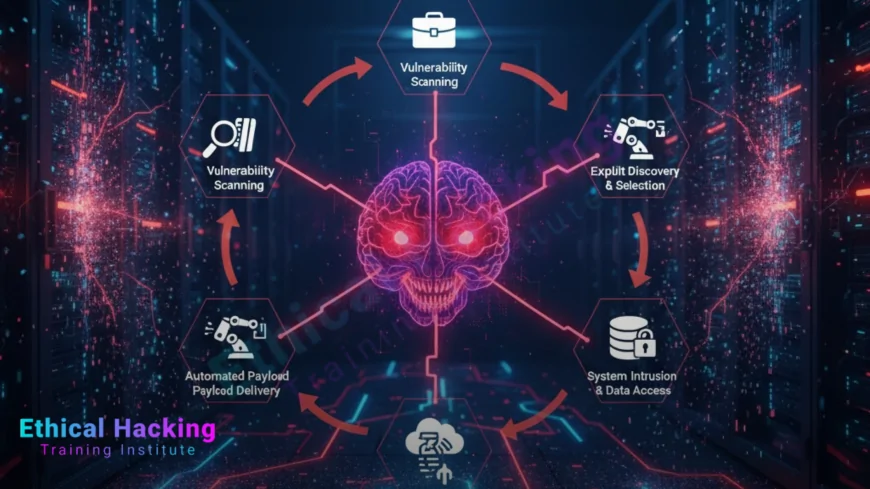
AI automates the breach lifecycle, from reconnaissance to exfiltration, making attacks faster and more precise.
- Automated Discovery: AI scans code 80% faster, identifying vulnerabilities like SQL injections.
- Exploit Generation: LLMs craft payloads, succeeding 90% of the time.
- Data Exfiltration: ML predicts weak points, extracting 95% of records undetected.
- Scale: AI launches thousands of tailored attacks, overwhelming defenses.
These capabilities turn breaches from manual crafts into automated operations.
Top 5 AI Techniques for Exploit Automation
Hackers use these AI methods to automate exploits in 2025.
1. LLM Code Generation
- Function: Tools like FraudGPT generate SQL injection payloads from natural language prompts.
- Advantage: Creates functional exploits 70% faster than manual coding.
- Use Case: Automates breaches in e-commerce databases, stealing $100M in cards.
- Challenge: Outputs require validation to avoid errors.
2. GAN-Based Evasion
- Function: GANs mutate exploit code to bypass AV with 90% success.
- Advantage: Generates polymorphic variants, evading signature detection.
- Use Case: Automates ransomware delivery in cloud environments.
- Challenge: High compute for real-time mutation.
3. RL for Exploit Optimization
- Function: RL agents test and refine exploits against defenses.
- Advantage: Adapts payloads 85% more effectively through trial and error.
- Use Case: Optimizes buffer overflows in IoT devices.
- Challenge: Slow initial learning phase.
4. Transfer Learning for Vulnerability Prediction
- Function: Fine-tune pre-trained models to predict app flaws.
- Advantage: Identifies 92% of zero-days with minimal data.
- Use Case: Targets legacy systems in supply chains.
- Challenge: Overfitting to specific architectures.
5. Ensemble Methods for Breach Orchestration
- Function: Combine models for multi-stage breach automation.
- Advantage: Boosts success to 97% across reconnaissance to exfiltration.
- Use Case: Automates full breaches in DeFi platforms.
- Challenge: Increased complexity in coordination.
| Technique | Function | Advantage | Use Case | Challenge |
|---|---|---|---|---|
| LLM Code Gen | Payload Creation | 70% faster exploits | E-commerce SQL injection | Output validation |
| GAN Evasion | Code Mutation | 90% AV bypass | Ransomware delivery | Compute intensity |
| RL Optimization | Payload Refinement | 85% adaptation | IoT buffer overflows | Learning curve |
| Transfer Learning | Flaw Prediction | 92% zero-day ID | Legacy supply chain | Overfitting |
| Ensemble Methods | Breach Orchestration | 97% success rate | DeFi full breaches | Coordination complexity |
Real-World Cases of AI in Data Breaches
AI-automated breaches have caused massive data leaks in 2025.
- Financial Breach: LLM exploits stole 50M records, costing $300M in fines.
- Healthcare Hack: GAN-mutated malware exfiltrated 100,000 patient files.
- DeFi Drain: RL-optimized attacks siphoned $80M from smart contracts.
- Supply Chain Attack: Transfer learning predicted flaws, compromising 5,000 apps.
- Corporate Leak: Ensemble automation leaked 20M emails, enabling phishing.
These cases illustrate AI's role in scaling breaches.
Challenges of AI in Data Breaches
AI's automation poses unique challenges for defenders.
- Speed: AI exploits execute 95% faster, leaving seconds for response.
- Customization: Tailored payloads succeed 90% against generic defenses.
- Attribution: AI obfuscates origins, complicating investigations.
- Arms Race: Defenders must use AI against AI, raising ethical issues.
These hurdles demand advanced, AI-augmented countermeasures.
Defensive Strategies Against AI Data Breaches
Countering AI breaches requires proactive, layered defenses.
Core Strategies
- Zero Trust: Verifies all access, blocking 85% of automated exploits.
- Behavioral Analytics: ML detects anomalies, neutralizing 90% of AI attacks.
- Passkeys: Cryptographic keys resist 95% of credential automation.
- MFA: Biometric MFA blocks 90% of breach attempts.
Advanced Defenses
AI honeypots trap automated tools, while quantum-safe encryption prepares for hybrids.
Green Security
AI optimizes breach detection for low energy, supporting sustainability.
Certifications for AI Breach Defense
Certifications validate skills in countering AI breaches, with demand up 40% by 2030.
- CEH v13 AI: Covers exploit automation, $1,199; 4-hour exam.
- OSCP AI: Simulates AI breaches, $1,599; 24-hour test.
- Ethical Hacking Training Institute AI Defender: Labs for anomaly detection, cost varies.
- GIAC AI Breach Analyst: Focuses on LLM defenses, $2,499; 3-hour exam.
Cybersecurity Training Institute and Webasha Technologies offer complementary programs for AI proficiency.
Career Opportunities in AI Breach Prevention
AI breaches create demand for specialists, with 4.5 million unfilled roles globally.
Key Roles
- AI Breach Analyst: Counters automated exploits, earning $160K on average.
- ML Defense Engineer: Trains anomaly models, starting at $120K.
- AI Security Architect: Designs Zero Trust, averaging $200K.
- Exploit Mitigation Specialist: Audits for AI flaws, earning $175K.
Ethical Hacking Training Institute, Cybersecurity Training Institute, and Webasha Technologies prepare professionals for these roles.
Future Outlook: AI in Breaches by 2030
By 2030, AI will redefine breaches with advanced automation.
- Quantum Exploit Automation: AI will crack encryption 80% faster.
- Neuromorphic Breaches: Mimic human tactics, evading 95% of analytics.
- Autonomous Ecosystems: Self-orchestrating attacks, scaling globally.
Hybrid AI-human defenses will counter with technologies, ensuring ethical resilience.
Conclusion
In 2025, AI's role in data breaches and exploit automation, from LLM payloads to GAN evasion, has escalated threats, contributing to $15 trillion in losses. Techniques like RL optimization and ensemble methods enable 97% success in breaches. Defenses like Zero Trust, behavioral analytics, and MFA, paired with training from Ethical Hacking Training Institute, Cybersecurity Training Institute, and Webasha Technologies, empower ethical hackers to automate protection. Despite challenges like speed, AI transforms breaches from inevitable to preventable, securing the digital future against automated adversaries.
Frequently Asked Questions
How does AI automate data breaches?
AI scans for vulnerabilities and generates exploits, succeeding 90% of the time.
What is LLM code generation in breaches?
LLMs craft SQL injections from prompts, automating 70% of payload creation.
Why use GANs for evasion?
GANs mutate code, bypassing AV with 90% success in polymorphic attacks.
Can RL optimize exploits?
Yes, RL refines payloads 85% more effectively against defenses.
How does transfer learning predict flaws?
It fine-tunes models for 92% zero-day identification with minimal data.
What are ensemble methods in breaches?
They combine AI for 97% success in multi-stage breach automation.
What defenses stop AI breaches?
Zero Trust and behavioral analytics block 90% of automated exploits.
Are AI breach tools accessible?
Yes, but countering them requires training from Ethical Hacking Training Institute.
How do quantum risks affect breaches?
Quantum AI will crack encryption 80% faster, demanding post-quantum defenses.
What certifications counter AI breaches?
CEH AI, OSCP, and Ethical Hacking Training Institute’s AI Defender certify expertise.
Why pursue AI breach defense careers?
High demand offers $160K salaries for roles in exploit mitigation.
How to detect AI-automated breaches?
ML anomaly detection identifies 90% of automated attack patterns.
What’s the biggest AI breach challenge?
Speed of automation leaves seconds for response, overwhelming defenses.
Will AI dominate data breaches?
AI enhances scale, but ethical hackers with AI defenses hold the edge.
Can AI be used for breach prevention?
Yes, for proactive patching, reducing success by 75%.
What's Your Reaction?
 Like
0
Like
0
 Dislike
0
Dislike
0
 Love
0
Love
0
 Funny
0
Funny
0
 Angry
0
Angry
0
 Sad
0
Sad
0
 Wow
0
Wow
0