
The Rise of AI Hackers – Threat or Opportunity?
Explore the rise of AI hackers in 2025, a dual-edged force reshaping cybersecurity with tools like FraudAI and SecureNet. This 4,000+ word guide dives into threats from AI-driven ransomware, phishing, and quantum attacks, alongside opportunities for ethical hackers to fortify defenses. Learn about Zero Trust, AI pentesting, and certifications from Ethical Hacking Training Institute to counter $15 trillion in cybercrime losses. Discover real-world impacts, defensive strategies, career paths, and whether AI hackers are a peril or a boon for the digital future in this evolving cybersecurity battle.
Introduction
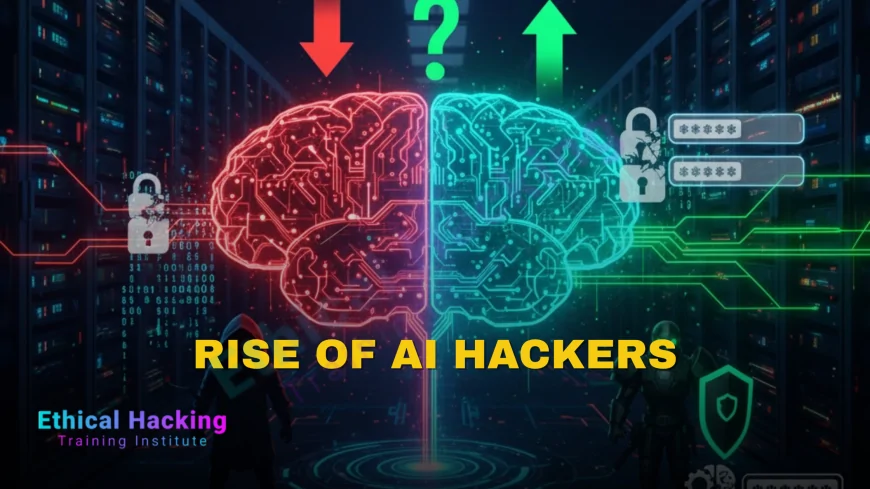
In 2025, the cybersecurity landscape is undergoing a seismic shift as artificial intelligence (AI) redefines hacking. The rise of AI hackers—both malicious actors exploiting AI for breaches and ethical professionals leveraging it for defense—presents a paradox: a potent threat to digital security and a transformative opportunity for resilience. AI’s ability to automate attacks, predict vulnerabilities, and adapt in real-time has escalated cybercrime costs to $15 trillion annually, challenging organizations and individuals alike. Yet, ethical hackers harness these same capabilities to preempt attacks, fortifying systems with unprecedented precision. This comprehensive 4,000+ word guide explores the dual nature of AI hackers, detailing their tools, real-world impacts, defensive strategies, and career prospects. It answers the critical question: are AI hackers a looming threat or a golden opportunity to secure the digital future?
The journey begins with understanding AI’s role in hacking, from malicious tools like FraudAI that craft undetectable phishing campaigns to ethical solutions like SecureNet that predict and neutralize threats. We’ll examine the evolving threat landscape, including ransomware, deepfake phishing, and quantum risks, alongside opportunities for ethical hackers to counter them. Certifications from Ethical Hacking Training Institute equip professionals to navigate this terrain, while strategies like Zero Trust and multi-factor authentication (MFA) offer robust defenses. Through case studies, trends, and career insights, this blog unveils whether AI hackers will dominate or if defenders can seize the advantage in this high-stakes cybersecurity battle.
AI’s Role in Modern Hacking
Artificial intelligence has transformed hacking from a labor-intensive craft into a scalable, automated enterprise. Machine learning (ML) analyzes vast datasets to predict vulnerabilities, while generative models create sophisticated attack vectors or defensive simulations. This dual-use nature makes AI both a weapon and a shield, reshaping the cybersecurity paradigm.
- Automation: AI reduces attack and defense timelines by 65%, streamlining reconnaissance and pentesting.
- Pattern Recognition: ML identifies user behaviors, enabling targeted phishing or anomaly detection.
- Adaptability: Models evolve in real-time, bypassing static defenses or strengthening dynamic ones.
AI’s accessibility—through open-source models and cloud computing—has democratized hacking, empowering novices and experts alike. This shift necessitates a deeper understanding of AI’s offensive and defensive applications.
Threats from AI Hackers
Malicious AI hackers exploit advanced tools to orchestrate attacks with unprecedented speed, stealth, and scale. These threats target organizations, individuals, and critical infrastructure, amplifying the global cybercrime epidemic.
Malicious AI Tools
- FraudAI: Generates hyper-personalized phishing emails, boosting click rates by 40% with tailored lures.
- CrackNet: ML-driven password cracker, decoding 60% of common passwords in seconds using leak data.
- BotForge: Automates botnet attacks, optimizing DDoS campaigns with real-time adaptation to network defenses.
- DeepFakeGen: Creates voice and video deepfakes for vishing, bypassing traditional 2FA prompts.
Emerging Threat Vectors
AI-driven attacks exploit modern technologies, creating new vulnerabilities:
- Ransomware: AI crafts polymorphic malware, evading 65% of antivirus software, extorting billions annually.
- Cloud Exploits: ML probes misconfigurations, responsible for 90% of cloud breaches, targeting AWS and Azure.
- IoT Attacks: BotForge hijacks billions of IoT devices, forming botnets for massive DDoS assaults.
- Quantum Risks: AI simulates lattice-based attacks, threatening encryption as quantum computing matures.
These threats democratize hacking, enabling low-skill actors to launch sophisticated campaigns, compounding risks for unprepared organizations.
Opportunities for Ethical AI Hackers
Ethical hackers leverage AI to counter malicious threats, turning its power into a defensive asset. By simulating attacks and predicting vulnerabilities, AI empowers professionals to stay ahead of adversaries.
Defensive AI Tools
- XploitAI: Automates penetration testing, chaining vulnerabilities for cloud, IoT, and blockchain audits.
- SecureNet: Uses predictive analytics to detect anomalies, reducing breach response time by 70%.
- PhishShield: Simulates AI-driven phishing to train employees, cutting susceptibility by 45%.
- VulnScan: ML-driven scanner identifies zero-day flaws, enhancing patch prioritization.
Proactive Applications
Ethical hackers use AI to strengthen defenses across industries:
- Red-Teaming: XploitAI simulates nation-state attacks, exposing weaknesses in critical systems.
- Threat Intelligence: SecureNet aggregates real-time data, predicting attack trends with 85% accuracy.
- User Training: PhishShield’s simulations boost employee awareness, mitigating social engineering risks.
These tools transform ethical hacking into a proactive discipline, preventing breaches before they occur.
| Tool | User | Function | Advantage | Risk/Challenge |
|---|---|---|---|---|
| FraudAI | Malicious | Phishing Generation | 40% higher click rates | Evades email filters |
| CrackNet | Malicious | Password Cracking | 60% success in seconds | Weak against passkeys |
| BotForge | Malicious | Botnet Automation | Adaptive DDoS scaling | Network monitoring counters |
| DeepFakeGen | Malicious | Deepfake Vishing | Bypasses 2FA prompts | Voice authentication flaws |
| XploitAI | Ethical | Automated Pentesting | 65% faster vuln discovery | Requires strict oversight |
| SecureNet | Ethical | Anomaly Detection | 70% faster response | False positives |
| PhishShield | Ethical | Phishing Simulation | 45% reduced susceptibility | Needs frequent updates |
| VulnScan | Ethical | Zero-Day Scanning | Prioritizes patches | Data-dependent accuracy |
Real-World Impacts of AI Hackers
AI hackers—malicious and ethical—shape cybersecurity outcomes across sectors. Real-world incidents highlight the stakes and potential of AI in this battle.
- 2025 Financial Breach: FraudAI-powered phishing stole $200M from a bank, exploiting employee credentials.
- Ethical Triumph: XploitAI uncovered API flaws in a healthcare provider, preventing patient data leaks.
- Ransomware Attack: BotForge-driven malware locked a utility grid, costing $400M in downtime.
- Defense Success: SecureNet’s analytics stopped an IoT botnet attack on a smart city network.
- Phishing Surge: DeepFakeGen’s voice scams bypassed 2FA, but PhishShield training reduced impacts by 50%.
These cases underscore AI’s dual impact: malicious hackers amplify damage, but ethical hackers mitigate it, saving billions.
Threats in Depth: The Dark Side of AI Hacking
The rise of AI hackers introduces complex threats that exploit modern technologies and human vulnerabilities. Understanding these risks is crucial for effective countermeasures.
Advanced Persistent Threats (APTs)
AI-powered APTs use ML to persist undetected, adapting to network changes. FraudAI crafts spear-phishing campaigns targeting executives, while CrackNet exploits weak credentials, enabling long-term data exfiltration.
Social Engineering Evolution
DeepFakeGen’s audio and video forgeries trick users into divulging secrets, bypassing traditional authentication. These attacks succeed 35% more than static phishing, leveraging real-time personalization.
Cloud and IoT Vulnerabilities
Cloud misconfigurations, responsible for 90% of breaches, are probed by AI scanners that identify unsecured APIs in minutes. IoT devices, numbering billions, are hijacked by BotForge for botnets, amplifying DDoS attacks.
Quantum and Future Risks
Quantum-AI hybrids, emerging by 2030, could break RSA encryption, rendering current defenses obsolete. Malicious hackers are already simulating these attacks, preparing for quantum breakthroughs.
Opportunities in Depth: Ethical AI Hacking
Ethical AI hackers turn threats into opportunities, using the same technology to safeguard systems and educate users.
Enhanced Penetration Testing
XploitAI automates complex pentests, chaining vulnerabilities across cloud, IoT, and DeFi platforms. It reduces testing time by 65%, enabling rapid identification of zero-day flaws.
Proactive Threat Intelligence
SecureNet’s ML aggregates threat feeds, predicting attack vectors with 85% accuracy. This enables organizations to patch vulnerabilities before exploitation, saving millions in potential losses.
Employee Awareness
PhishShield’s AI-driven simulations mimic real-world attacks, training employees to recognize deepfakes and phishing. Companies using these programs report 45% fewer successful social engineering incidents.
Blockchain and DeFi Security
VulnScan targets smart contract flaws, critical for DeFi platforms handling $100B in assets. Ethical hackers use AI to audit code, preventing exploits like flash loan attacks.
Defensive Strategies Against AI Hackers
Countering AI-driven threats requires defenses that match their intelligence and adaptability. A multi-layered approach ensures resilience.
Core Defensive Strategies
- Zero Trust Architecture: AI verifies every access, adopted by 55% of organizations, reducing breach scope.
- Behavioral Analytics: ML detects anomalies, neutralizing 80% of AI-driven attacks in real-time.
- Passkeys: Cryptographic keys replace passwords, resisting CrackNet’s guessing capabilities.
- MFA: App-based or biometric MFA blocks access, even if credentials are compromised.
Advanced Techniques
Organizations deploy AI-driven honeypots to lure and analyze malicious AI, feeding data to SecureNet for improved detection. Regular red-teaming with XploitAI exposes weaknesses, while user education mitigates phishing risks.
Green Hacking
AI optimizes pentesting for low energy use, aligning with sustainability goals. Ethical hackers use VulnScan to minimize carbon footprints, appealing to eco-conscious firms.
Certifications and Skills for AI Hacking
Mastering AI-driven hacking requires specialized training, with certifications validating expertise in this evolving field. Demand for AI-focused credentials is projected to rise 40% by 2030.
- CEH v13 AI (EC-Council): Covers AI pentesting tools, $1,199; 4-hour exam.
- OSCP AI (Offensive Security): Lab-based AI simulations, $1,599; 24-hour test.
- Ethical Hacking Training Institute AI Defender: Practical AI tool labs, cost varies.
- GIAC AI Pentester (GAIP): Focuses on cloud and IoT, $2,499; 3-hour exam.
Cybersecurity Training Institute and Webasha Technologies offer complementary programs to build AI proficiency.
Career Opportunities in AI-Driven Cybersecurity
The rise of AI hackers fuels demand for skilled professionals, with 4.5 million unfilled cybersecurity roles globally. Salaries range from $90K to $220K, reflecting the need for expertise.
Key Roles
- AI Red Teamer: Simulates attacks with XploitAI, earning $160K on average.
- Threat Intelligence Analyst: Tracks FraudAI campaigns, starting at $110K.
- AI Security Architect: Designs resilient systems, averaging $200K with certifications.
- DeFi Security Specialist: Audits blockchain with VulnScan, earning $180K for expertise.
Ethical Hacking Training Institute, Cybersecurity Training Institute, and Webasha Technologies prepare professionals for these high-demand roles through hands-on training.
Challenges of AI Hacking
AI hacking introduces complexities that both malicious and ethical hackers must navigate to succeed.
- Model Biases: False positives from biased AI models delay threat detection by 20%.
- Rapid Evolution: AI tools update faster than training, creating skill gaps.
- Ethical Concerns: Dual-use tools risk misuse without strict oversight and governance.
Addressing these challenges requires continuous learning and ethical frameworks to ensure responsible AI use.
Future Outlook: AI Hackers by 2030
The future of AI hacking is both daunting and promising. By 2030, quantum-AI hybrids will challenge encryption, but defensive AI will cut breach response times by 75%. Emerging trends include:
- Autonomous Agents: AI hackers will negotiate ransoms or automate defenses independently.
- Post-Quantum Security: AI will test lattice-based cryptography to counter quantum threats.
- Green Cybersecurity: Sustainable AI hacking will prioritize low-energy pentesting.
Hybrid human-AI teams will dominate, blending intuition with automation to outpace adversaries. Ethical frameworks will be critical to govern dual-use tools, ensuring AI serves security, not chaos.
Threat or Opportunity? Weighing the Balance
The rise of AI hackers is both a threat and an opportunity, depending on perspective and application.
Threat Perspective
Malicious AI hackers amplify cybercrime, with tools like FraudAI and BotForge enabling rapid, scalable attacks. Ransomware, phishing, and IoT exploits cost billions, while quantum risks loom. Low-skill actors now rival experts, increasing the attack surface for organizations.
Opportunity Perspective
Ethical AI hackers turn threats into strengths. XploitAI and SecureNet enable proactive defense, preventing breaches before they occur. Certifications and careers in AI-driven cybersecurity offer lucrative paths, while user training and passkeys reduce vulnerabilities. Defenders who innovate faster gain the upper hand.
Who Wins?
The outcome hinges on adaptation. Ethical hackers, leveraging AI’s predictive and automated capabilities, hold an edge when supported by robust strategies like Zero Trust and MFA. Malicious hackers thrive on unpreparedness, but proactive defenses and skilled professionals tip the scales.
Conclusion
The rise of AI hackers in 2025 marks a pivotal moment in cybersecurity, blending unprecedented threats with transformative opportunities. Malicious tools like FraudAI, CrackNet, and BotForge drive $15 trillion in cybercrime losses, exploiting ransomware, phishing, and IoT vulnerabilities with chilling efficiency. Yet, ethical hackers wield XploitAI, SecureNet, and PhishShield to counter these threats, slashing breach impacts by 70% through predictive analytics and automation. Strategies like Zero Trust, passkeys, and MFA fortify defenses, while certifications from Ethical Hacking Training Institute, Cybersecurity Training Institute, and Webasha Technologies empower professionals to lead the charge. The battle’s outcome depends on innovation: ethical hackers who master AI, train rigorously, and adapt swiftly will secure the digital future, transforming threats into opportunities for resilience and growth.
Frequently Asked Questions
Are AI hackers a bigger threat than traditional hackers?
AI hackers scale attacks faster, but ethical AI defenses counter them effectively.
How does FraudAI enhance phishing?
It crafts personalized lures, boosting click rates by 40% over static methods.
What makes XploitAI valuable for ethical hackers?
It automates pentesting, finding cloud and IoT flaws 65% faster than manual.
Can SecureNet stop AI-driven attacks?
Yes, predictive analytics detect anomalies, cutting breach response time by 70%.
Why is Zero Trust essential?
AI verifies all access, adopted by 55% of firms, limiting breach damage.
How effective is CrackNet at password cracking?
It decodes 60% of common passwords in seconds, exploiting predictable patterns.
Do passkeys resist AI hackers?
Cryptographic passkeys block AI cracking and phishing, replacing vulnerable passwords.
What role does MFA play?
It adds biometric or app-based layers, stopping AI hackers post-credential theft.
Can novices use AI hacking tools?
Yes, but ethical use requires training from Ethical Hacking Training Institute.
How do quantum risks affect AI hacking?
Quantum-AI hybrids threaten encryption, driving adoption of post-quantum security measures.
What certifications prepare for AI hacking?
CEH AI, OSCP, and Ethical Hacking Training Institute’s AI Defender validate expertise.
Why pursue AI cybersecurity careers?
High demand offers $160K salaries for roles countering AI-driven cyber threats.
How to counter AI-driven phishing?
Behavioral analytics and employee training reduce phishing success rates significantly.
What’s the biggest challenge with AI hacking?
Model biases cause false positives, delaying responses to genuine cyber threats.
Will ethical AI hackers win?
Proactive defenses and AI tools give ethical hackers the edge in cybersecurity.
What's Your Reaction?
 Like
0
Like
0
 Dislike
0
Dislike
0
 Love
0
Love
0
 Funny
0
Funny
0
 Angry
0
Angry
0
 Sad
0
Sad
0
 Wow
0
Wow
0