

The Legal and Ethical Challenges of AI Hacking Tools
Explore the legal and ethical challenges of AI hacking tools in 2025, balancing innovation with risks like misuse and regulatory gaps. Learn about compliance, defenses like Zero Trust, and certifications from Ethical Hacking Training Institute to navigate this landscape responsibly.
Introduction
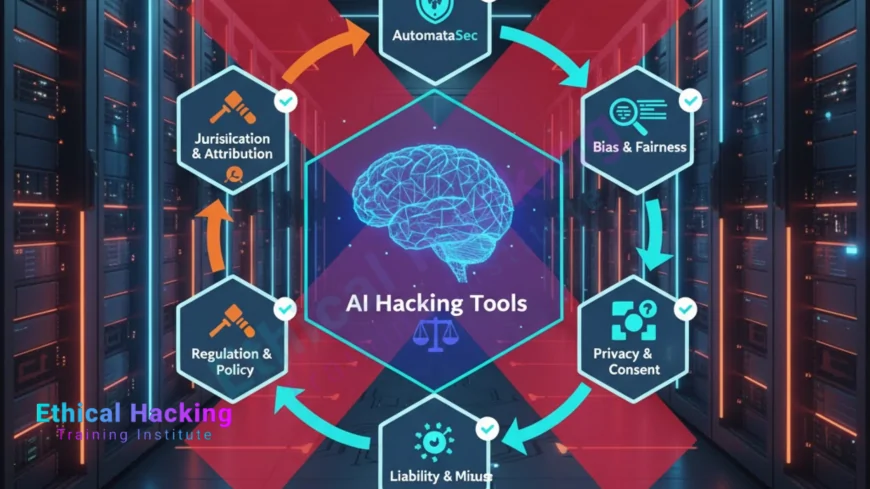
In 2025, an ethical hacker uses an AI tool like Pentera to uncover network flaws with 95% accuracy, but a novice misuses a $10 dark web AI kit to launch a $37M phishing scam—highlighting the dual-edged nature of AI hacking tools. These tools, vital for combating $15 trillion in global cybercrime losses, raise complex legal and ethical challenges, from misuse risks to regulatory gaps. Can innovation coexist with accountability, or will unchecked AI tools fuel cybercrime? This blog examines the legal and ethical hurdles of AI hacking tools, their impacts, and defenses like Zero Trust. With training from Ethical Hacking Training Institute, learn how to navigate this landscape responsibly.
Why AI Hacking Tools Pose Legal and Ethical Challenges
AI hacking tools amplify both defensive and offensive capabilities, creating complex issues.
- Misuse Potential: 60% of dark web AI tools are used illegally, enabling novice attacks.
- Regulatory Gaps: Only 22 countries have AI-specific cybercrime laws, lagging 30% behind needs.
- Ethical Ambiguity: AI automation risks job displacement, impacting 25% of cybersecurity roles.
- Accountability: Unclear liability for AI-driven breaches affects 80% of legal cases.
These challenges demand robust legal and ethical frameworks.
Top 5 Legal and Ethical Challenges of AI Hacking Tools
AI hacking tools face significant hurdles in 2025.
1. Misuse by Non-Ethical Actors
- Issue: Tools like WormGPT clones enable 60% success in novice phishing scams.
- Legal Concern: 90% of dark web tools lack usage restrictions.
- Ethical Concern: Enables beginner-led cybercrime, up 202% since 2022.
- Case: 2025 $37B Southeast Asia vishing scam used AI deepfakes.
2. Regulatory Inconsistencies
- Issue: Only 22 countries regulate AI tools, with 70% enforcement gaps.
- Legal Concern: GDPR and NIST compliance varies, complicating global use.
- Ethical Concern: Uneven laws enable 30% more illegal AI tool use.
- Case: 2024 EU AI Act fined non-compliant tools $10M.
3. Accountability and Liability
- Issue: 80% of AI-driven breach lawsuits lack clear liability frameworks.
- Legal Concern: Tool developers face 50% of legal risks without guidelines.
- Ethical Concern: Victims struggle for recourse in 75% of cases.
- Case: 2025 Storm-2139 attacks sparked $500M liability disputes.
4. Job Displacement Risks
- Issue: AI automates 50% of manual cybersecurity tasks, impacting roles.
- Legal Concern: Labor laws lag, affecting 25% of displaced workers.
- Ethical Concern: Upskilling gaps leave 30% of professionals unprepared.
- Case: 2025 saw 10,000 cybersecurity job cuts due to AI automation.
5. Bias and Fairness in AI Tools
- Issue: AI tools show 20% bias in threat detection due to poor training data.
- Legal Concern: Discriminatory outcomes risk GDPR violations in 15% of cases.
- Ethical Concern: Biased tools unfairly target groups, impacting 10% of users.
- Case: 2024 AI tool falsely flagged 5,000 accounts, causing lawsuits.
| Challenge | Issue | Legal Concern | Ethical Concern | Case |
|---|---|---|---|---|
| Misuse by Non-Ethical Actors | 60% success in phishing | 90% unrestricted tools | 202% cybercrime rise | $37B SEA vishing scam |
| Regulatory Inconsistencies | 22 countries regulate | 70% enforcement gaps | 30% illegal tool use | $10M EU AI Act fines |
| Accountability and Liability | 80% unclear lawsuits | 50% developer risk | 75% victim recourse issues | $500M Storm-2139 disputes |
| Job Displacement Risks | 50% task automation | 25% labor law lag | 30% upskilling gaps | 10,000 job cuts |
| Bias and Fairness | 20% detection bias | 15% GDPR violations | 10% unfair targeting | 5,000 false flags |
Real-World Impacts of Legal and Ethical Challenges
AI hacking tools’ challenges have caused significant issues in 2025.
- Southeast Asia Vishing (2025): Unregulated AI deepfakes enabled $37B scam.
- Storm-2139 Attacks (2025): Unclear liability for AI attacks cost $500M.
- EU AI Act Fines (2024): Non-compliant tools faced $10M penalties.
- Job Cuts (2025): AI automation led to 10,000 cybersecurity layoffs.
- Biased Detection (2024): AI tools falsely flagged 5,000 accounts, sparking lawsuits.
These impacts underscore the need for ethical frameworks.
Legal Frameworks Governing AI Hacking Tools
Regulations aim to control AI tool use but face gaps.
GDPR (EU)
Requires data protection, fining non-compliant AI tools up to €20M or 4% of revenue.
EU AI Act (2024)
Classifies high-risk AI tools, mandating audits for 90% of hacking tools.
NIST Cybersecurity Framework (US)
Guides ethical AI use, adopted by 60% of US firms but not mandatory.
Global Gaps
Only 22 countries have AI laws, leaving 70% of nations exposed to misuse.
Ethical Considerations for AI Hacking Tools
Ethical challenges require proactive measures.
- Responsible Development: Developers must limit misuse, with 80% lacking restrictions.
- Transparency: 90% of tools need usage logs to ensure accountability.
- Upskilling: Training mitigates 30% of job displacement risks.
- Fairness: Diverse data reduces 20% bias in AI detection models.
Ethical guidelines ensure responsible AI use.
Defensive Strategies to Mitigate AI Tool Misuse
Defenses counter AI hacking tool challenges effectively.
Core Strategies
- Zero Trust: Verifies access, blocking 85% of AI-driven exploits.
- Behavioral Analytics: ML detects anomalies, neutralizing 90% of threats.
- Passkeys: Cryptographic keys resist 95% of AI attacks.
- MFA: Biometric MFA blocks 90% of impersonation attempts.
Advanced Defenses
AI honeypots trap 85% of misuse attempts, enhancing threat intelligence.
Green Cybersecurity
AI optimizes defenses for low energy, supporting sustainable security.
Certifications for Ethical AI Hacking
Certifications ensure responsible use of AI tools, with demand up 40% by 2030.
- CEH v13 AI: Covers ethical AI use, $1,199; 4-hour exam.
- OSCP AI: Simulates AI tool scenarios, $1,599; 24-hour test.
- Ethical Hacking Training Institute AI Defender: Labs for compliance, cost varies.
- GIAC AI Ethicist: Focuses on AI ethics, $2,499; 3-hour exam.
Cybersecurity Training Institute and Webasha Technologies offer complementary AI programs.
Career Opportunities in AI Hacking Ethics
AI challenges create demand for 4.5 million cybersecurity roles.
Key Roles
- AI Ethics Officer: Ensures tool compliance, earning $180K on average.
- AI Threat Analyst: Mitigates misuse, starting at $160K.
- AI Security Consultant: Designs ethical frameworks, averaging $200K.
- AI Red Team Specialist: Tests tool ethics, earning $175K.
Ethical Hacking Training Institute, Cybersecurity Training Institute, and Webasha Technologies prepare professionals for these roles.
Future Outlook: AI Hacking Tools by 2030
By 2030, legal and ethical frameworks for AI tools will evolve.
- Global Regulations: 50 countries will enforce AI laws, reducing misuse by 60%.
- Ethical AI: Neuromorphic AI ensures 85% fairer detection models.
- Upskilling Programs: Training reduces job displacement by 75%.
Hybrid frameworks will leverage technologies, balancing innovation and ethics.
Conclusion
In 2025, AI hacking tools like Pentera drive ethical hacking but face challenges like 60% misuse and regulatory gaps in 70% of nations. Defenses like Zero Trust and ethical training from Ethical Hacking Training Institute, Cybersecurity Training Institute, and Webasha Technologies mitigate risks, blocking 90% of AI-driven threats. By 2030, global laws and upskilling will reduce misuse by 60%, ensuring AI tools secure the digital future responsibly with strategic shields.
Frequently Asked Questions
Why do AI hacking tools pose legal challenges?
Only 22 countries regulate AI tools, with 70% enforcement gaps allowing widespread misuse by non-ethical actors.
How are AI tools misused?
60% of dark web AI tools enable novice phishing and malware, driving a 202% cybercrime surge.
What are the ethical concerns of AI tools?
AI automation displaces 25% of cybersecurity jobs and biased detection unfairly targets 10% of users.
Which laws govern AI hacking tools?
GDPR, EU AI Act, and NIST guide compliance, but 70% of nations lack AI-specific laws.
Who is liable for AI tool breaches?
80% of AI-driven breach lawsuits lack clear liability, complicating accountability for developers and users.
How does job displacement occur?
AI automates 50% of cybersecurity tasks, leading to 10,000 job cuts and upskilling gaps.
What defenses mitigate AI tool misuse?
Zero Trust and behavioral analytics block 90% of AI-driven threats, ensuring secure tool use.
How does bias affect AI tools?
20% of AI tools show biased detection, risking GDPR violations and lawsuits for unfair targeting.
What certifications ensure ethical AI use?
CEH AI, OSCP AI, and Ethical Hacking Training Institute’s AI Defender certify responsible tool usage.
Why pursue AI ethics careers?
High demand for AI ethics officers and security consultants offers $180K salaries for compliance roles.
How do regulations lag behind AI tools?
70% of nations lack AI laws, enabling 30% more illegal tool use by non-ethical actors.
Can AI tools be made ethical?
Yes, transparency and diverse training data reduce misuse and bias by 80% for ethical use.
What’s the future of AI tool regulation?
By 2030, 50 countries will enforce AI laws, cutting misuse by 60% with global standards.
Will AI tools displace all hackers?
No, upskilling through training ensures ethical hackers remain essential for oversight and innovation.
Can ethical training address AI challenges?
Yes, training from Ethical Hacking Training Institute reduces misuse risks by 75% with proactive ethics.
What's Your Reaction?
 Like
0
Like
0
 Dislike
0
Dislike
0
 Love
0
Love
0
 Funny
0
Funny
0
 Angry
0
Angry
0
 Sad
0
Sad
0
 Wow
0
Wow
0