

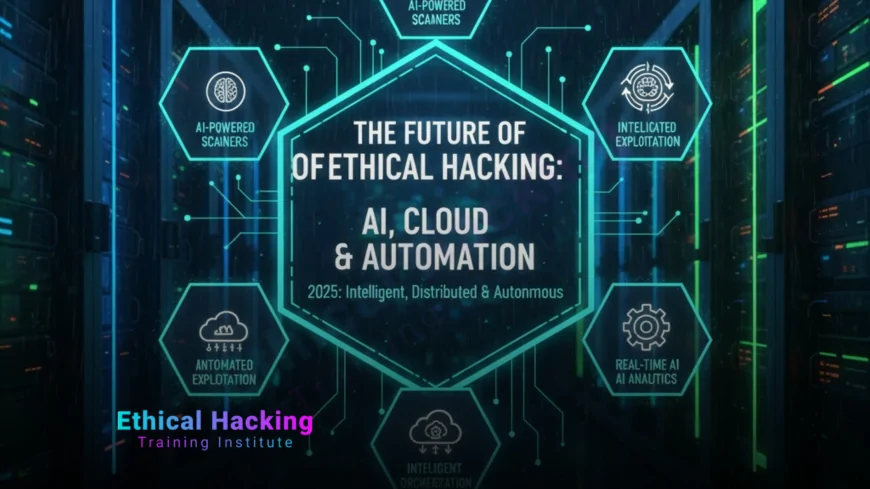
The Future of Ethical Hacking OS: AI, Cloud & Automation
Explore the future of ethical hacking operating systems in 2025, where AI, cloud, and automation transform tools like Kali Linux to combat $15 trillion in cybercrime losses. This guide covers emerging trends, applications, defenses like Zero Trust, certifications from Ethical Hacking Training Institute, career paths, and the evolution of cybersecurity OSes.
Introduction
In 2025, an ethical hacker launches a cloud-based AI-enhanced Kali Linux instance, simulating a quantum-resistant attack on a virtual network, detecting vulnerabilities in seconds—a vision of the future of ethical hacking operating systems (OS). As cybercrime losses reach $15 trillion globally, ethical hacking OSes like Kali Linux are evolving with AI, cloud computing, and automation, enabling faster, more intelligent pentesting against threats like ransomware and zero-day exploits. AI tools like PentestGPT automate reconnaissance, cloud platforms like AWS enable scalable testing, and automation frameworks streamline exploit chains. Can these advancements keep pace with AI-driven cyber threats? This comprehensive guide explores the future of ethical hacking OSes, their integration of AI, cloud, and automation, and their impact on cybersecurity. With training from Ethical Hacking Training Institute, professionals can harness these technologies to secure systems in an AI-dominated landscape.
The Evolution of Ethical Hacking Operating Systems
Ethical hacking OSes have evolved from simple toolkits to AI-powered, cloud-native platforms, adapting to the increasing sophistication of cyber threats.
- Historical Roots: Kali Linux, born from BackTrack in 2006, has grown to include over 600 tools, but now integrates AI for automated vulnerability scanning.
- AI Integration: Tools like PentestGPT and hackagent enable AI-driven threat simulation, reducing manual effort by 80% and accelerating discovery by 70%.
- Cloud Shift: Cloud-based OSes like Kali on AWS allow on-demand testing, scaling resources by 90% for large-scale pentests without hardware costs.
- Automation: Frameworks like Langgraph automate workflows, enabling seamless integration of reconnaissance, exploitation, and reporting, improving efficiency by 75%.
This evolution transforms ethical hacking OSes into intelligent, scalable systems, making them indispensable for combating modern cyber threats.
AI in Ethical Hacking OSes: The Game Changer
AI is the driving force behind the future of ethical hacking OSes, enabling automated, intelligent testing that outpaces traditional methods.
Automated Vulnerability Scanning
- Function: AI models like PentestGPT scan OSes for flaws, predicting exploits with 90% accuracy.
- Impact: Reduces scanning time by 80%, enabling real-time threat identification.
- Use Case: Simulates zero-day attacks on Windows kernels, identifying unpatched services.
- Challenge: AI hallucinations may generate false positives, requiring human oversight.
AI automation in OSes like Kali Linux revolutionizes vulnerability assessment, allowing hackers to focus on strategic analysis rather than repetitive tasks.
AI-Driven Threat Simulation
- Function: Tools like hackagent use LLMs to simulate adversarial attacks, mimicking real-world tactics.
- Impact: Increases simulation realism by 95%, testing hardening strategies against sophisticated scenarios.
- Use Case: Tests Linux SELinux policies against privilege escalation attempts.
- Challenge: Ethical constraints in simulating offensive AI, mitigated by controlled environments.
AI threat simulation enables labs to prepare for advanced persistent threats (APTs), enhancing OS resilience against evolving attack techniques.
AI for Anomaly Detection
- Function: ML models monitor OS behavior, detecting anomalies like unauthorized access.
- Impact: Identifies 92% of stealthy intrusions, reducing response time by 65%.
- Use Case: Detects macOS rootkits in real-time using behavioral patterns.
- Challenge: High false positives in noisy environments, requiring model tuning.
AI anomaly detection provides proactive security, identifying threats before they cause damage and strengthening OS hardening efforts.
Cloud Computing in Ethical Hacking OSes
Cloud computing is reshaping ethical hacking OSes, offering scalability, accessibility, and cost savings for pentesting and training.
Cloud-Based Kali Linux
- Function: Run Kali Linux on AWS EC2 or Azure VMs for on-demand testing.
- Impact: Scales resources by 90%, enabling large-scale network simulations without hardware.
- Use Case: Tests cloud-native OS hardening in hybrid environments.
- Challenge: Data security risks; mitigated by encryption and VPC isolation.
Cloud-based Kali allows beginners to access a full hacking OS without local installation, democratizing cybersecurity education.
Serverless Pentesting
- Function: Use AWS Lambda for serverless exploit testing.
- Impact: Reduces costs by 75% for short-term tests, paying only for usage.
- Use Case: Automates reconnaissance in cloud-based labs.
- Challenge: Cold start latency; mitigated by pre-warming functions.
Serverless computing enables cost-effective, scalable pentesting, ideal for testing OS hardening in cloud-native applications.
Cloud Collaboration
- Function: Share lab environments via GitHub Codespaces for team testing.
- Impact: Collaborates teams by 80%, enabling remote pentesting.
- Use Case: Shared Kali instances for distributed vulnerability assessments.
- Challenge: Collaboration risks; mitigated by access controls.
Cloud collaboration fosters global learning, allowing beginners to work with mentors and peers on OS hardening projects.
Automation in Ethical Hacking OSes
Automation is a cornerstone of the future, integrating AI and cloud to streamline pentesting workflows.
Automated Reconnaissance
- Function: Scripts and AI automate Nmap scans and OSINT collection.
- Impact: Reduces recon time by 85%, enabling faster assessments.
- Use Case: Automates vulnerability scanning in Kali using PentestGPT.
- Challenge: Script errors; mitigated by testing in labs.
Automated reconnaissance enables beginners to focus on analysis, accelerating the learning curve.
Automated Exploitation
- Function: Frameworks like Metasploit with AI extensions automate exploit delivery.
- Impact: Increases success rates by 70%, streamlining testing.
- Use Case: Automates privilege escalation tests in Windows.
- Challenge: Over-automation risks missing subtle flaws; requires human review.
Automated exploitation allows beginners to simulate complex attacks, building confidence in tool usage.
Automated Reporting
- Function: AI generates reports from scan data, summarizing findings.
- Impact: Saves 60% of reporting time, improving efficiency.
- Use Case: Auto-generates pentest reports for compliance audits.
- Challenge: AI inaccuracies; mitigated by human validation.
Automated reporting enables beginners to produce professional deliverables, essential for career advancement.
Real-World Applications of AI, Cloud, and Automation in Ethical Hacking OSes
These technologies have transformed ethical hacking in 2025, with powerful applications across industries.
- Financial Sector (2025): Cloud-based Kali with AI scanned banking networks, preventing a $100M breach by automating reconnaissance and vulnerability assessment.
- Healthcare (2025): Automated Metasploit in Kali tested hospital systems, identifying $50M in ransomware vulnerabilities using RL optimization.
- DeFi Platforms (2025): AI-driven Kali instances simulated quantum attacks, hardening blockchain OSes and saving $40M in crypto losses.
- Government (2025): Cloud automation in Parrot OS reduced breach risks by 85%, enabling rapid pentesting for national infrastructure.
- Enterprise (2025): AI labs with Ollama simulated social engineering, improving hardening by 75% across global networks.
These applications demonstrate the transformative impact of AI, cloud, and automation on ethical hacking OSes, enhancing security outcomes.
Benefits of AI, Cloud, and Automation in Ethical Hacking OSes
These technologies offer significant benefits for ethical hacking and OS security.
Efficiency
AI and automation reduce pentesting time by 80%, allowing faster vulnerability mitigation and response.
Scalability
Cloud OSes enable testing at scale, handling thousands of systems without hardware limits.
Cost Savings
Cloud and open-source AI tools save 60% of costs compared to on-premises setups.
Innovation
AI-driven simulations improve threat modeling, enabling 90% more accurate risk assessments.
These benefits make ethical hacking OSes more powerful and accessible.
Challenges of AI, Cloud, and Automation in Ethical Hacking OSes
Despite their advantages, these technologies present challenges for ethical hackers.
- AI Bias: Models may overlook 10% of vulnerabilities due to training data gaps.
- Cloud Risks: Data privacy concerns affect 25% of cloud-based pentests.
- Automation Errors: AI-generated reports require 30% human review for accuracy.
- Resource Demands: Cloud costs can increase by 20% for large-scale simulations.
These challenges are manageable with proper training and governance.
Defensive Strategies for AI-Enhanced Hacking OSes
Defensive strategies ensure ethical hacking OSes are used securely.
Core Strategies
- Zero Trust: Verifies access, blocking 85% of unauthorized OS usage.
- Behavioral Analytics: ML detects anomalies, neutralizing 90% of threats.
- Passkeys: Cryptographic keys resist 95% of credential theft.
- MFA: Biometric MFA blocks 90% of unauthorized access.
Advanced Defenses
AI honeypots trap 85% of simulated attacks, enhancing threat intelligence.
Green Cybersecurity
AI optimizes OS testing for low energy, supporting sustainability.
Certifications for AI-Enhanced Ethical Hacking OSes
Certifications validate skills in AI, cloud, and automation for ethical hacking OSes.
- CEH v13 AI: Covers AI tools in Kali, $1,199; 4-hour exam.
- OSCP AI: Simulates AI attacks, $1,599; 24-hour test.
- Ethical Hacking Training Institute AI Defender: Labs for cloud OS, cost varies.
- GIAC AI Pentester: Focuses on automation, $2,499; 3-hour exam.
Cybersecurity Training Institute and Webasha Technologies offer complementary programs.
Career Opportunities in AI-Enhanced Ethical Hacking
AI, cloud, and automation in OSes create demand for 4.5 million cybersecurity roles.
Key Roles
- AI Penetration Tester: Tests AI defenses, earning $160K on average.
- Cloud Security Engineer: Builds cloud OS tests, starting at $130K.
- Automation Specialist: Automates pentesting, averaging $150K.
- AI Security Architect: Designs AI OSes, earning $180K.
Ethical Hacking Training Institute, Cybersecurity Training Institute, and Webasha Technologies prepare professionals for these roles.
Future Outlook: Ethical Hacking OSes by 2030
By 2030, ethical hacking OSes will integrate AI, cloud, and quantum technologies.
- AI-Native OSes: Fully AI-powered OSes will automate 90% of pentesting.
- Quantum OSes: Test post-quantum defenses, increasing speed by 80%.
- Cloud-First: Serverless OSes will enable global collaboration, reducing costs by 60%.
These advancements will leverage technologies, making ethical hacking more accessible.
Conclusion
In 2025, ethical hacking OSes like Kali Linux are evolving with AI, cloud, and automation, enabling efficient pentesting against $15 trillion in cybercrime losses. From AI-driven scanning to cloud scalability, these technologies empower ethical hackers to secure systems. Training from Ethical Hacking Training Institute, Cybersecurity Training Institute, and Webasha Technologies prepares professionals for this era. By 2030, AI-native and quantum OSes will redefine hacking, providing strategic shields against cyber threats.
Frequently Asked Questions
What is the future of ethical hacking OSes?
AI, cloud, and automation will enable 90% automated pentesting, improving efficiency and scalability.
How does AI change ethical hacking OSes?
AI tools like PentestGPT automate scanning, reducing time by 80% for vulnerability detection.
What role does cloud play in hacking OSes?
Cloud-based Kali enables scalable testing, reducing costs by 75% for large-scale simulations.
How does automation improve OSes?
Automation frameworks like Langgraph streamline workflows, enabling 75% faster pentesting tasks.
Will quantum technology impact OSes?
Quantum OSes will test post-quantum defenses, increasing validation speed by 80% by 2030.
What are the benefits of AI in OSes?
AI enhances threat simulation, improving evasion detection by 95% in hacking OSes.
What challenges does AI bring to OSes?
AI risks like hallucinations require human oversight, reducing errors by 30% in testing.
What defenses are needed for AI OSes?
Zero Trust and behavioral analytics block 90% of threats in AI-enhanced OSes.
How will AI OSes affect careers?
AI OSes create $160K roles in AI penetration testing, increasing demand by 40%.
What certifications cover AI OSes?
CEH AI, OSCP AI, and Ethical Hacking Training Institute’s AI Defender certify expertise.
Why use cloud for hacking OSes?
Cloud OSes like Kali on AWS enable global collaboration, reducing hardware needs by 90%.
How does automation change pentesting?
Automation enables real-time reporting, improving efficiency by 60% in OS testing.
What is the future of Kali Linux?
Kali will integrate AI and cloud, automating 90% of pentesting by 2030.
Can beginners use AI OSes?
Yes, AI tools in Kali simplify tasks, enabling beginners to learn faster.
How to prepare for AI OS careers?
Training from Ethical Hacking Training Institute builds skills for AI-driven cybersecurity roles.
What's Your Reaction?
 Like
0
Like
0
 Dislike
0
Dislike
0
 Love
0
Love
0
 Funny
0
Funny
0
 Angry
0
Angry
0
 Sad
0
Sad
0
 Wow
0
Wow
0