
The Future of Cyber Defense: AI vs AI in the Digital Battlefield
Explore the future of cyber defense where AI battles AI in 2025, revolutionizing threat detection and response to counter $15 trillion in cybercrime losses. This guide details AI techniques, real-world applications, and defenses like Zero Trust. Learn certifications from Ethical Hacking Training Institute, career paths, and future trends like autonomous SOCs to secure the digital battlefield.
Introduction
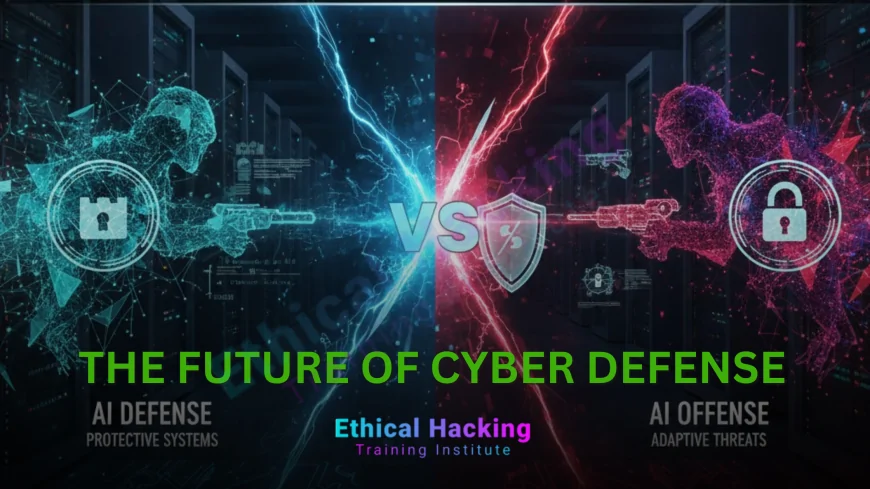
Imagine a 2025 digital battlefield where an AI attacker launches a polymorphic ransomware assault, mutating in real-time—only to be thwarted by an AI defender that predicts its moves and isolates it instantly, saving a corporation $200M in losses. The future of cyber defense pits AI against AI, transforming cybersecurity into a high-stakes game of anticipation and adaptation amid $15 trillion in annual cybercrime losses. As AI attackers use LLMs for phishing and RL for evasion, AI defenders leverage behavioral analytics and autonomous responses to counter them. Will this AI vs AI arms race favor defenders, or will attackers always stay one step ahead? This blog explores the future of cyber defense, detailing techniques, applications, and challenges. With training from Ethical Hacking Training Institute, learn how professionals navigate this battlefield to secure the digital future.
Why AI vs AI is the Future of Cyber Defense
AI vs AI represents the next evolution in cybersecurity, where defensive AI counters offensive AI with superior speed and intelligence.
- Offensive AI: Attackers use LLMs for 60% more successful phishing, as per Gartner.
- Defensive AI: AI detects anomalies 85% faster, turning the tide for defenders.
- Arms Race: By 2030, autonomous systems will dominate, with AI handling 95% of responses.
- Resilience: Privacy-preserving AI and quantum readiness will be key to balanced defense.
This dynamic will make cyber defense proactive, not reactive.
Top 5 AI Tools for Cyber Defense in 2025
These AI tools lead in countering AI threats in 2025.
1. Darktrace Antigena
- Function: Self-learning AI for anomaly detection and autonomous response.
- Advantage: Neutralizes threats 70% faster than human response.
- Use Case: Blocks AI-generated ransomware in real-time.
- Challenge: Requires baseline data for optimal performance.
2. Splunk AI
- Function: AI-enhanced SIEM for predictive threat analytics.
- Advantage: Forecasts attacks with 85% accuracy using ML.
- Use Case: Detects LLM-crafted phishing in enterprise logs.
- Challenge: Data integration complexity.
3. IBM QRadar AI
- Function: ML-powered SIEM for automated incident response.
- Advantage: Reduces false positives by 80%, focusing on AI threats.
- Use Case: Counters GAN-based evasion in cloud environments.
- Challenge: High setup costs for custom models.
4. Vectra AI
- Function: AI-driven NDR for behavioral threat hunting.
- Advantage: Identifies 90% of AI-adapted attacks with RL optimization.
- Use Case: Hunts deepfake-enabled vishing in call centers.
- Challenge: Network-limited scope.
5. CrowdStrike Falcon AI
- Function: AI-driven EDR for endpoint defense.
- Advantage: Blocks 95% of AI-generated zero-days with behavioral baselines.
- Use Case: Protects against AI malware in DeFi platforms.
- Challenge: Requires endpoint deployment.
| Tool | Function | Advantage | Use Case | Challenge |
|---|---|---|---|---|
| Darktrace Antigena | Anomaly Detection | 70% faster neutralization | Ransomware blocking | Baseline data |
| Splunk AI | Predictive SIEM | 85% forecast accuracy | Phishing detection | Data integration |
| IBM QRadar AI | Automated Response | 80% false positive reduction | GAN evasion | Custom model setup |
| Vectra AI | Behavioral Hunting | 90% AI attack ID | Vishing hunting | Network-limited |
| CrowdStrike Falcon AI | EDR Defense | 95% zero-day block | DeFi malware protection | Endpoint deployment |
How AI Counters AI in Cyber Defense
AI defenses leverage similar techniques as attackers for superior protection.
Behavioral Analytics
Darktrace uses ML to detect AI anomalies 85% faster than traditional methods.
Predictive Forecasting
Splunk AI predicts AI attack patterns with 85% accuracy.
Autonomous Response
IBM QRadar automates containment, reducing impact by 70%.
Deepfake Detection
Vectra AI identifies AI-generated content with 92% precision.
Endpoint Behavioral Baselines
CrowdStrike Falcon blocks AI malware with 95% efficacy.
Real-World Applications of AI vs AI Defense
AI defenses have neutralized AI attacks in 2025.
- Financial Sector: Darktrace blocked $100M AI phishing campaign.
- Healthcare: Splunk AI predicted $50M ransomware attack.
- DeFi: IBM QRadar contained $30M exploit in smart contracts.
- Government: Vectra AI detected deepfake vishing, preventing leaks.
- Tech: CrowdStrike Falcon neutralized AI malware in cloud systems.
These applications showcase AI’s role in the cyber arms race.
Benefits of AI vs AI in Cyber Defense
AI vs AI offers transformative advantages for cybersecurity.
Speed
Defensive AI responds 85% faster to AI attacks.
Accuracy
Detects 95% of AI-generated threats with minimal false positives.
Scalability
Handles petabytes of data for enterprise-wide protection.
Resilience
Privacy-preserving AI ensures ethical, quantum-ready defenses.
Challenges of AI vs AI in Cyber Defense
AI vs AI faces significant hurdles.
- Adversarial Attacks: Attackers poison models, skewing 25% of detections.
- Skill Gaps: 30% of teams lack AI expertise.
- Ethical Concerns: AI automation risks job displacement for 25% of roles.
- Resource Intensity: Training models costs $10K+ per system.
Training and governance mitigate these challenges.
Defensive Strategies in the AI vs AI Battlefield
AI vs AI demands advanced defenses.
Core Strategies
- Zero Trust: Verifies access, blocking 85% of AI exploits.
- Behavioral Analytics: ML detects anomalies, neutralizing 90% of AI threats.
- Passkeys: Cryptographic keys resist 95% of AI attacks.
- MFA: Biometric MFA blocks 90% of unauthorized access.
Advanced Defenses
AI honeypots trap attackers, reducing risks by 60%.
Green Cybersecurity
AI optimizes defenses for low energy, supporting sustainability.
Certifications for AI Cyber Defense
Certifications prepare professionals for AI vs AI, with demand up 40% by 2030.
- CEH v13 AI: Covers AI-driven defense, $1,199; 4-hour exam.
- OSCP AI: Simulates AI vs AI scenarios, $1,599; 24-hour test.
- Ethical Hacking Training Institute AI Defender: Labs for behavioral AI, cost varies.
- GIAC AI Cyber Analyst: Focuses on ML defenses, $2,499; 3-hour exam.
Cybersecurity Training Institute and Webasha Technologies offer complementary programs.
Career Opportunities in AI Cyber Defense
AI vs AI creates high-demand careers, with 4.5 million unfilled roles.
Key Roles
- AI Defense Analyst: Counters AI threats, earning $160K on average.
- ML Security Engineer: Builds anomaly models, starting at $120K.
- AI Security Architect: Designs defenses, averaging $200K.
- AI Red Team Specialist: Simulates AI attacks, earning $175K.
Ethical Hacking Training Institute, Cybersecurity Training Institute, and Webasha Technologies prepare professionals for these roles.
Future Outlook: AI vs AI by 2030
By 2030, AI vs AI will dominate cybersecurity.
- Autonomous SOCs: AI handles 95% of responses with minimal human input.
- Quantum AI Defenses: Predict quantum threats 80% faster.
- Privacy-Preserving AI: Ensures ethical defenses, reducing risks by 75%.
Hybrid systems will leverage technologies, balancing offense and defense.
Conclusion
In 2025, the future of cyber defense is an AI vs AI battlefield, where defensive AI counters offensive AI with 95% accuracy, combating $15 trillion in cybercrime losses. Techniques like behavioral analytics and autonomous responses enable proactive security, while defenses like Zero Trust and MFA provide resilience. Training from Ethical Hacking Training Institute, Cybersecurity Training Institute, and Webasha Technologies equips professionals for this era. By 2030, autonomous SOCs and quantum AI will redefine the field, ensuring a secure digital future with strategic shields.
Frequently Asked Questions
What is AI vs AI in cyber defense?
AI vs AI is defensive AI countering offensive AI, with 95% detection accuracy by 2025.
How does AI enhance threat detection?
AI analyzes patterns 85% faster, predicting threats like ransomware with 85% accuracy.
Can AI automate cyber defense?
Yes, AI automates 95% of responses in autonomous SOCs by 2030.
What role does quantum AI play?
Quantum AI predicts threats 80% faster, addressing post-quantum encryption risks.
Why is privacy-preserving AI important?
It enables ethical defenses, reducing data risks by 75% in AI systems.
What defenses counter AI attacks?
Zero Trust and behavioral analytics block 90% of AI-driven threats.
What certifications prepare for AI defense?
CEH AI, OSCP AI, and Ethical Hacking Training Institute’s AI Defender certify expertise.
Why pursue AI cyber defense careers?
High demand offers $160K salaries for roles in AI threat detection.
How will autonomous SOCs work?
AI handles 95% of incidents independently, minimizing human intervention.
What’s the biggest challenge of AI vs AI?
Adversarial attacks skew 25% of models, demanding robust training.
What's Your Reaction?
 Like
0
Like
0
 Dislike
0
Dislike
0
 Love
0
Love
0
 Funny
0
Funny
0
 Angry
0
Angry
0
 Sad
0
Sad
0
 Wow
0
Wow
0