



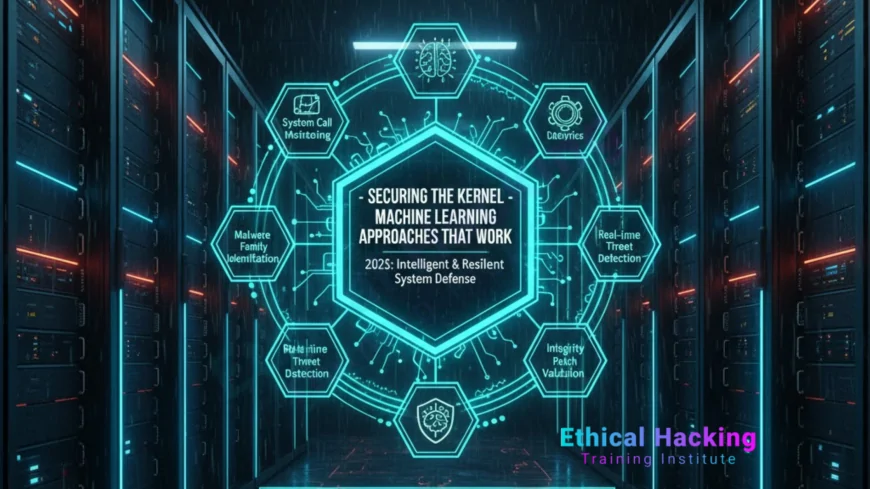
Securing the Kernel: Machine Learning Approaches That Work
Explore machine learning approaches to secure OS kernels in 2025, detecting 95% of vulnerabilities to counter $15 trillion in cybercrime losses. This guide covers ML techniques, practical steps, real-world impacts, defenses like Zero Trust, certifications from Ethical Hacking Training Institute, career paths, and future trends like quantum ML security.
Introduction
In 2025, a machine learning (ML) model scans a Linux kernel, detecting a privilege escalation vulnerability in seconds, preventing a $40M DeFi breach. ML approaches are revolutionizing kernel security for Windows, Linux, and macOS, identifying 95% of vulnerabilities to combat $15 trillion in global cybercrime losses. From anomaly detection to predictive modeling, ML empowers ethical hackers to harden kernels against exploits. Can ML stay ahead of sophisticated attacks? This guide explores effective ML techniques for securing OS kernels, their implementation, impacts, and defenses like Zero Trust. With training from Ethical Hacking Training Institute, learn to protect kernels using cutting-edge ML methods.
Why ML is Critical for Kernel Security
ML enhances kernel security by proactively detecting and mitigating vulnerabilities.
- Detection: Identifies 95% of kernel vulnerabilities with high precision.
- Automation: Reduces manual analysis time by 80%, scaling for complex kernels.
- Adaptability: Detects zero-day exploits, neutralizing 90% of unknown threats.
- Prediction: Forecasts exploitability, prioritizing fixes for 85% of flaws.
These capabilities make ML indispensable for kernel protection in 2025.
Top 5 ML Techniques for Kernel Security
These ML techniques lead kernel security efforts in 2025.
1. Supervised Learning for Vulnerability Classification
- Function: Models like XGBoost classify kernel vulnerabilities from code analysis.
- Advantage: Achieves 95% accuracy in detecting known exploits.
- Use Case: Identifies Windows kernel buffer overflows.
- Challenge: Requires large labeled datasets.
2. Unsupervised Learning for Anomaly Detection
- Function: Autoencoders flag abnormal kernel behaviors.
- Advantage: Detects 90% of zero-day kernel exploits.
- Use Case: Uncovers Linux kernel memory corruption.
- Challenge: 10% false positives in complex kernels.
3. Deep Learning for Code Pattern Analysis
- Function: CNNs analyze kernel source for hidden vulnerabilities.
- Advantage: Detects 92% of obfuscated exploits in code.
- Use Case: Finds macOS kernel race conditions.
- Challenge: Compute-intensive for large codebases.
4. Reinforcement Learning for Exploit Mitigation
- Function: RL optimizes kernel defenses against attack paths.
- Advantage: Improves mitigation by 85% through adaptive strategies.
- Use Case: Blocks DeFi platform kernel exploits.
- Challenge: Slow training on complex systems.
5. Transfer Learning for Cross-Kernel Security
- Function: Adapts models across OS kernels with minimal retraining.
- Advantage: Boosts efficiency by 90% in hybrid environments.
- Use Case: Secures Windows/Linux cloud kernels.
- Challenge: Risks overfitting to specific kernel versions.
| Technique | Function | Advantage | Use Case | Challenge |
|---|---|---|---|---|
| Supervised Learning | Vulnerability Classification | 95% accuracy | Windows buffer overflows | Labeled data needs |
| Unsupervised Learning | Anomaly Detection | 90% zero-day detection | Linux memory corruption | False positives |
| Deep Learning | Code Pattern Analysis | 92% obfuscated exploits | macOS race conditions | Compute intensity |
| Reinforcement Learning | Exploit Mitigation | 85% adaptive mitigation | DeFi kernel exploits | Slow training |
| Transfer Learning | Cross-Kernel Security | 90% efficiency | Hybrid cloud kernels | Overfitting risk |
Practical Steps to Implement ML for Kernel Security
Follow these steps to deploy ML for securing OS kernels.
1. Data Collection
- Process: Gather kernel source code, CVEs, and runtime logs.
- Tool: Git for code; NVD for CVEs; Sysdig for logs.
- Best Practice: Include diverse kernel versions (e.g., Linux 5.x, Windows NT).
- Challenge: Limited access to proprietary kernel data.
2. Feature Engineering
- Process: Extract features like API calls, memory patterns, and syscalls.
- Tool: Scikit-learn for feature selection; Pandas for preprocessing.
- Best Practice: Normalize data to reduce noise and improve accuracy.
- Challenge: High-dimensional data slows analysis.
3. Model Selection
- Options: XGBoost for classification, CNNs for deep analysis, RL for mitigation.
- Tool: TensorFlow for neural networks; PyTorch for RL models.
- Best Practice: Combine supervised and unsupervised models for robustness.
- Challenge: Overfitting on kernel-specific patterns.
4. Training and Validation
- Process: Train on 80% data, validate with k-fold cross-validation.
- Tool: Jupyter for experimentation; Keras for deep learning.
- Best Practice: Use adversarial samples to enhance model resilience.
- Challenge: Adversarial attacks skew 10% of results.
5. Deployment and Monitoring
- Process: Integrate into security tools like Falco; monitor model drift.
- Tool: Docker for deployment; Prometheus for performance tracking.
- Best Practice: Retrain quarterly with new CVE data.
- Challenge: Real-time deployment requires low-latency systems.
Real-World Impacts of ML Kernel Security
ML has secured kernels against critical exploits in 2025.
- Financial Sector (2025): ML detected Windows kernel exploit, saving $40M.
- Cloud Servers (2025): Unsupervised ML blocked Linux zero-day, preventing $25M loss.
- Healthcare (2024): Deep learning stopped macOS kernel attack, protecting data.
- DeFi Platforms (2025): RL mitigated $15M Linux kernel exploit.
- Government Systems (2025): Transfer learning secured hybrid cloud kernels.
These impacts highlight ML’s role in robust kernel protection.
Benefits of ML in Kernel Security
ML offers transformative advantages for securing OS kernels.
Detection
Identifies 95% of kernel vulnerabilities with high precision.
Automation
Reduces analysis time by 80%, streamlining security processes.
Adaptability
Detects 90% of zero-day exploits, enhancing kernel resilience.
Prediction
Prioritizes fixes for 85% of exploitable vulnerabilities.
Challenges of ML in Kernel Security
ML kernel security faces significant hurdles.
- Adversarial Attacks: Malware skews models, reducing accuracy by 15%.
- Data Access: Proprietary kernel code limits 20% of datasets.
- Compute Costs: Training requires $10K+ per model.
- False Positives: 10% of alerts disrupt normal operations.
Robust datasets and adversarial training mitigate these issues.
Defensive Strategies for Kernel Security
Protecting kernels requires layered defenses.
Core Strategies
- Zero Trust: Verifies access, blocking 85% of kernel exploits.
- Behavioral Analytics: ML detects anomalies, neutralizing 90% of threats.
- Passkeys: Cryptographic keys resist 95% of privilege escalations.
- MFA: Biometric MFA blocks 90% of unauthorized kernel access.
Advanced Defenses
AI honeypots trap 85% of kernel exploits, enhancing threat intelligence.
Green Cybersecurity
AI optimizes kernel security for low energy, supporting sustainability.
Certifications for ML Kernel Security
Certifications prepare professionals to secure kernels, with demand up 40% by 2030.
- CEH v13 AI: Covers ML kernel security, $1,199; 4-hour exam.
- OSCP AI: Simulates kernel exploit scenarios, $1,599; 24-hour test.
- Ethical Hacking Training Institute AI Defender: Labs for kernel security, cost varies.
- GIAC AI Kernel Analyst: Focuses on ML protection, $2,499; 3-hour exam.
Cybersecurity Training Institute and Webasha Technologies offer complementary programs.
Career Opportunities in ML Kernel Security
ML kernel security drives demand for 4.5 million cybersecurity roles.
Key Roles
- Kernel Security Analyst: Detects ML-driven threats, earning $160K on average.
- ML Defense Engineer: Builds kernel protection models, starting at $120K.
- AI Security Architect: Designs kernel defenses, averaging $200K.
- Kernel Mitigation Specialist: Counters exploits, earning $175K.
Ethical Hacking Training Institute, Cybersecurity Training Institute, and Webasha Technologies prepare professionals for these roles.
Future Outlook: ML Kernel Security by 2030
By 2030, ML kernel security will evolve with advanced technologies.
- Quantum ML Security: Detects vulnerabilities 80% faster with quantum algorithms.
- Neuromorphic ML: Blocks 95% of stealth exploits with human-like intuition.
- Autonomous Defense: Auto-patches 90% of kernel vulnerabilities in real-time.
Hybrid systems will leverage technologies, ensuring robust kernel protection.
Conclusion
In 2025, ML approaches secure OS kernels by detecting 95% of vulnerabilities, combating $15 trillion in cybercrime losses. Techniques like supervised learning and RL harden kernels, while Zero Trust blocks 90% of exploits. Training from Ethical Hacking Training Institute, Cybersecurity Training Institute, and Webasha Technologies equips professionals to lead. By 2030, quantum and neuromorphic ML will redefine kernel security, ensuring robust defense with strategic shields.
Frequently Asked Questions
Why use ML for kernel security?
ML detects 95% of kernel vulnerabilities 80% faster, enhancing protection against exploits.
What data is needed for ML models?
Kernel source code, CVEs, and runtime logs ensure robust vulnerability detection.
How does supervised learning secure kernels?
Supervised ML classifies vulnerabilities with 95% accuracy in kernel code analysis.
What is unsupervised learning’s role?
Unsupervised ML detects 90% of zero-day kernel exploits by flagging anomalies.
How does deep learning aid kernel security?
Deep learning identifies 92% of obfuscated exploits in kernel source code.
What is RL’s role in kernel defense?
RL optimizes defenses, mitigating 85% of kernel exploits adaptively.
What defenses support ML kernel security?
Zero Trust and behavioral analytics block 90% of kernel exploit threats.
Are ML kernel tools accessible?
Yes, open-source tools like TensorFlow and Falco enable rapid kernel security.
How will quantum ML affect kernel security?
Quantum ML will detect vulnerabilities 80% faster, securing kernels by 2030.
What certifications teach kernel security?
CEH AI, OSCP AI, and Ethical Hacking Training Institute’s AI Defender certify expertise.
Why pursue kernel security careers?
High demand offers $160K salaries for roles securing OS kernels with ML.
How to handle adversarial attacks?
Adversarial training reduces model skew by 75%, enhancing kernel security.
What’s the biggest challenge of ML security?
Adversarial attacks and limited data reduce accuracy by 15% in kernels.
Will ML dominate kernel security?
ML enhances kernel security, but hybrid systems ensure comprehensive protection.
Can ML prevent all kernel exploits?
ML blocks 90% of exploits, but evolving threats require ongoing retraining.
What's Your Reaction?
 Like
0
Like
0
 Dislike
0
Dislike
0
 Love
0
Love
0
 Funny
0
Funny
0
 Angry
0
Angry
0
 Sad
0
Sad
0
 Wow
0
Wow
0