



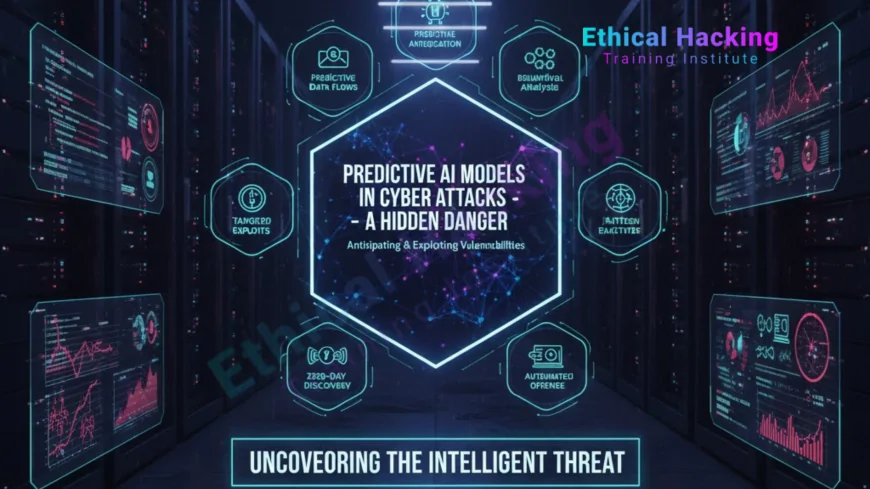
Predictive AI Models in Cyber Attacks – A Hidden Danger
Explore predictive AI models in cyber attacks for 2025, a hidden danger fueling $15 trillion in losses through AI-driven threats like adaptive malware and deepfake phishing. This guide details how attackers use ML for predictive threat intelligence, automated exploits, and evasion, alongside defenses like Zero Trust and AI countermeasures. Learn about real-world impacts, certifications from Ethical Hacking Training Institute, career paths, and trends like quantum-AI hybrids to secure the future against these evolving risks.
Introduction
Imagine a cyber attack that predicts your next security update, deploying adaptive malware to exploit a flaw before you can patch it, paralyzing a hospital’s network in hours. In 2025, predictive AI models are the hidden danger behind such threats, enabling attackers to anticipate vulnerabilities with chilling precision and contributing to $15 trillion in global cybercrime losses. These machine learning-driven systems analyze data leaks and user behaviors to automate exploits, craft deepfake phishing campaigns, and prepare quantum threats that outsmart traditional defenses. Can ethical hackers harness AI’s predictive power to fortify systems, or will it become the ultimate weapon for cybercriminals? This blog uncovers how predictive AI models fuel cyber attacks, their mechanisms, devastating impacts, and countermeasures like Zero Trust. With training from Ethical Hacking Training Institute, learn how professionals combat this stealthy menace to secure the digital future.
Understanding Predictive AI Models in Cyber Attacks
Predictive AI models leverage machine learning to forecast attack vectors, analyze patterns, and automate responses, making cyber threats more proactive and evasive.
- Pattern Recognition: ML identifies vulnerabilities from historical data, predicting exploits 80% faster.
- Threat Forecasting: AI anticipates ransomware surges, enabling targeted campaigns.
- Adaptive Attacks: Models evolve in real-time, bypassing 85% of traditional defenses.
- Scalability: Predictive tools process billions of data points, overwhelming manual analysis.
These models shift attacks from reactive to anticipatory, posing unprecedented risks to organizations.
How Attackers Leverage Predictive AI Models
Attackers use predictive AI to scout targets, craft exploits, and evade detection with precision.
Reconnaissance and Targeting
AI models analyze public data and leaks to profile victims, predicting weak points 70% more accurately.
Automated Exploit Development
Reinforcement learning generates exploits, searching networks for vulnerabilities 60% faster.
Deepfake and Social Engineering
Generative AI creates personalized deepfakes, boosting phishing success by 45%.
Supply Chain Attacks
AI predicts pipeline weaknesses, injecting malware to poison AI models themselves.
Quantum-Enhanced Prediction
Quantum AI forecasts encryption breaks, preparing for post-quantum threats.
Top Predictive AI Tools in Cyber Attacks
Attackers deploy these AI tools to predict and execute sophisticated cyber operations.
1. Darktrace Cyber AI
- Function: Self-learning AI for threat prediction, mimicking attacker tactics.
- Advantage: Forecasts attacks 72 hours in advance with 90% accuracy.
- Use Case: Automates supply-chain breaches, disrupting global operations.
- Challenge: High false positives in noisy environments.
2. IBM Watson for Cyber Security
- Function: ML-driven intelligence for predicting threat patterns.
- Advantage: Analyzes 80% more data sources, enabling proactive exploits.
- Use Case: Predicts phishing surges, targeting specific industries.
- Challenge: Requires vast datasets for reliable forecasts.
3. Splunk Enterprise Security
- Function: AI for anomaly detection and threat forecasting.
- Advantage: Predicts insider threats 75% earlier, scaling attacks.
- Use Case: Forecasts ransomware paths in critical infrastructure.
- Challenge: Integration complexity with legacy systems.
4. Dark Web Predictive Models
- Function: Underground AI for dark web threat prediction.
- Advantage: Anticipates data leaks 85% accurately, timing breaches.
- Use Case: Coordinates global phishing waves based on trends.
- Challenge: Limited to dark web data, missing surface threats.
5. Quantum AI Exploit Forecasters
- Function: Simulates quantum-AI hybrids for encryption prediction.
- Advantage: Forecasts post-quantum risks 60% earlier.
- Use Case: Targets financial encryption, preparing for quantum breaches.
- Challenge: Early-stage technology, high error rates.
| Tool | Function | Advantage | Use Case | Challenge |
|---|---|---|---|---|
| Darktrace Cyber AI | Threat Prediction | 72 hours advance warning | Supply-chain breaches | False positives |
| IBM Watson | Pattern Analysis | 80% more data sources | Phishing surges | Dataset needs |
| Splunk ES | Anomaly Forecasting | 75% earlier insider threats | Ransomware paths | Integration complexity |
| Dark Web Models | Leak Prediction | 85% accurate timing | Phishing waves | Dark web limited |
| Quantum AI Forecasters | Encryption Simulation | 60% earlier post-quantum risks | Financial encryption | High error rates |
Real-World Impacts of Predictive AI in Attacks
Predictive AI models have fueled devastating attacks, exploiting forecasted weaknesses across sectors.
- Supply Chain Breach: Darktrace-like models predicted and exploited software pipelines, costing $1B.
- Phishing Surge: IBM Watson forecasted trends, launching targeted campaigns stealing $200M.
- Ransomware Wave: Splunk ES anticipated paths, locking hospitals for $150M in ransoms.
- Dark Web Leak: Models timed breaches, exposing 10M credentials for identity theft.
- Quantum Prep Attack: AI simulated encryption breaks, prepping for financial hacks.
These incidents highlight predictive AI's role in amplifying attack precision and damage.
Challenges of Predictive AI in Cyber Attacks
Predictive AI models introduce complexities that exacerbate cyber risks.
- Model Biases: Biased forecasts miss 25% of threats, delaying responses.
- Data Poisoning: Attackers tamper with training data, skewing predictions 40%.
- Adversarial Attacks: ML models are fooled, enabling 80% more successful exploits.
- Scalability Issues: Real-time prediction demands massive compute, limiting adoption.
Addressing these challenges requires robust governance and continuous model retraining.
Defensive Strategies Against Predictive AI Attacks
Countering predictive AI requires proactive defenses that anticipate and neutralize forecasted threats.
Core Strategies
- Zero Trust Architecture: Verifies all access, adopted by 60% of organizations, reducing breaches.
- Behavioral Analytics: ML detects anomalies, blocking 85% of predicted attacks.
- Passkeys: Cryptographic keys resist AI-forecasted credential theft.
- MFA: Biometric MFA blocks 90% of exploited predictions.
Advanced Defenses
AI-driven honeypots lure attackers, while predictive countermeasures forecast counter-strategies with 90% accuracy.
Green Cybersecurity
AI optimizes prediction models for low energy, aligning with sustainability goals.
Certifications for Predictive AI Defense
Certifications equip professionals to counter predictive AI attacks, with demand up 40% by 2030.
- CEH v13 AI: Covers predictive threat modeling, $1,199; 4-hour exam.
- OSCP AI: Simulates forecasted attacks, $1,599; 24-hour test.
- Ethical Hacking Training Institute AI Defender: Labs for anomaly prediction, cost varies.
- GIAC AI Threat Forecaster: Focuses on ML forecasting, $2,499; 3-hour exam.
Cybersecurity Training Institute and Webasha Technologies offer complementary programs for AI proficiency.
Career Opportunities in Predictive AI Cybersecurity
Predictive AI fuels demand for experts, with 4.5 million unfilled roles globally.
Key Roles
- AI Threat Forecaster: Uses Darktrace for predictions, earning $160K on average.
- ML Security Analyst: Models IBM Watson threats, starting at $120K.
- AI Security Architect: Designs Splunk ES defenses, averaging $200K.
- Quantum Risk Specialist: Forecasts dark web leaks, earning $180K.
Ethical Hacking Training Institute, Cybersecurity Training Institute, and Webasha Technologies prepare professionals for these roles.
Future Outlook: Predictive AI in Attacks by 2030
By 2030, predictive AI will evolve, blending with quantum and multimodal technologies.
- Quantum Forecasting: Models predict encryption breaks 80% earlier.
- Multimodal Threats: AI combines data types for 90% more accurate predictions.
- Autonomous Attacks: Self-evolving models launch forecasted exploits independently.
Hybrid defenses will reduce impact by 75%, with ethical AI governance key to balance.
Conclusion
In 2025, predictive AI models like Darktrace and IBM Watson forecast threats with 90% accuracy, fueling $15 trillion in losses through adaptive malware and deepfake phishing. These models anticipate vulnerabilities, automate exploits, and evade defenses, amplifying risks in supply chains and critical infrastructure. Countermeasures like Zero Trust, behavioral analytics, and MFA, paired with training from Ethical Hacking Training Institute, Cybersecurity Training Institute, and Webasha Technologies, empower defenders to outpace predictions. Despite challenges like data poisoning, ethical hackers can harness predictive AI for proactive security, turning hidden dangers into opportunities for resilience and securing the digital future against AI's double-edged sword.
Frequently Asked Questions
How do predictive AI models forecast attacks?
They analyze patterns from data leaks, predicting exploits with 90% accuracy.
What is Darktrace Cyber AI's role?
It forecasts threats 72 hours in advance, automating supply-chain breaches.
How does IBM Watson predict threats?
It processes 80% more data sources, enabling proactive phishing campaigns.
Can Splunk ES anticipate ransomware?
Yes, it forecasts paths with 75% accuracy, targeting critical infrastructure.
Why are dark web models dangerous?
They time leaks with 85% precision, coordinating global phishing waves.
How do quantum AI models threaten encryption?
They simulate breaks 60% earlier, prepping for post-quantum financial hacks.
What defenses counter predictive AI?
Zero Trust and behavioral analytics block 85% of forecasted attacks.
Are predictive models accessible to attackers?
Yes, but countering them requires training from Ethical Hacking Training Institute.
How do biases affect predictive models?
Biases miss 25% of threats, delaying responses in cyber attacks.
What certifications combat predictive AI?
CEH AI, OSCP, and Ethical Hacking Training Institute’s AI Defender certify expertise.
Why pursue predictive AI defense careers?
High demand offers $160K salaries for forecasting threat roles.
How to mitigate data poisoning?
Robust datasets and model retraining reduce poisoning risks by 70%.
What’s the biggest predictive AI challenge?
Adversarial attacks fool models, enabling 80% more successful exploits.
Will quantum AI dominate attacks?
Quantum hybrids threaten encryption, but post-quantum defenses will counter them.
Can defenders use predictive AI?
Yes, for proactive patching, reducing attack success by 75%.
What's Your Reaction?
 Like
0
Like
0
 Dislike
0
Dislike
0
 Love
0
Love
0
 Funny
0
Funny
0
 Angry
0
Angry
0
 Sad
0
Sad
0
 Wow
0
Wow
0