
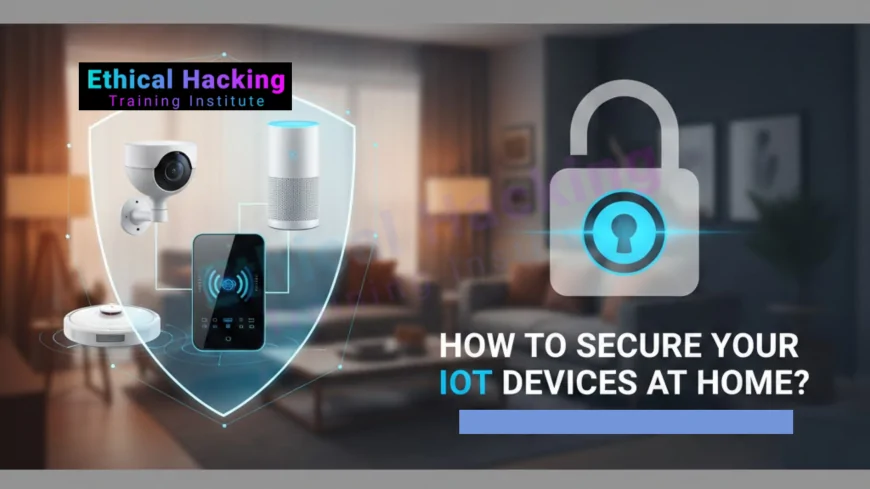
How to Secure Your IoT Devices at Home?
Complete 2025 guide to protect your smart cameras, TVs, bulbs, routers, and Alexa/Google devices from hackers. Learn real Indian IoT attacks, best practices, and how Ethical Hacking Training Institute & Webasha Technologies teach IoT pentesting and security to thousands of students every year.
Introduction
India now has over 300 million active IoT devices — smart TVs, CCTV cameras, bulbs, Alexa, Google Nest, and Wi-Fi routers. CERT-In reported a 600% rise in IoT attacks in 2024–2025. Hackers are watching babies through compromised cameras, listening via smart speakers, and using unsecured devices to enter corporate networks. At Ethical Hacking Training Institute and Webasha Technologies, we show students exactly how these attacks happen — and how to stop them permanently.
Real IoT Attacks That Happened in India (2024–2025)
Real cases we recreate in our labs: Delhi family’s baby monitor hacked and threats issued, Mumbai society CCTV cameras streaming on dark web, Bangalore engineer’s smart bulb used to mine crypto, Hyderabad company’s network breached via employee’s unsecured Xiaomi camera, and thousands of D-Link/Tenda routers with default “admin/admin” passwords added to Mirai botnets. These are not hypotheticals — they are daily incidents.
We demonstrate every one of these attacks live in our dedicated IoT hacking lab at Ethical Hacking Training Institute & Webasha Technologies.
15-Step Home IoT Security Checklist (Follow This Today)
Immediate actions every Indian home must take in 2025:
- Change default router password (admin/admin → 20+ character unique)
- Disable remote management/WPS/UPnP on router
- Create separate 2.4 GHz & 5 GHz guest networks for IoT
- Update firmware on ALL devices the day you buy them
- Disable cloud access & microphone on cameras when not needed
- Use strong unique passwords (never reuse banking passwords)
- Enable two-factor authentication wherever available
- Block internet access for devices that only need local control
- Cover or disable camera lenses physically when not in use
- Regularly check for unknown devices on your Wi-Fi
Best Tools & Practices Taught to Our Students
Tools we make every student master for IoT security: Shodan & Censys (find exposed devices), RouterSploit & IoT Inspector, Binwalk & Firmware-mod-kit (extract & analyse firmware), Wireshark + MITMProxy (sniff unencrypted traffic), Nmap IoT scripts, and our custom IoT vulnerable testbed with real TP-Link, Xiaomi, Realme cameras, and smart plugs. Students perform full compromise → patch → secure cycle in lab.
Join Asia’s most advanced IoT security module in our CEH + IoT Pentesting course at Webasha Technologies.
How to Secure Specific Devices (Real Brands Indians Use)
Practical settings for popular devices: TP-Link Tapo / Xiaomi / Realme / CP Plus cameras → disable RTSP & cloud, use local SD card only; Mi Home / Tuya / Wipro smart bulbs → disable cloud control after setup; Amazon Echo & Google Nest → mute mic when not in use, review voice history weekly; D-Link / Tenda / iBall routers → change default 192.168.0.1 credentials immediately; Chromecast & Fire TV → restrict to local network only.
Advanced Protection: Network Segmentation VLANs
Professional technique we teach in class: create a separate VLAN or guest network for all IoT devices so even if a camera is hacked, attacker cannot reach your laptop or phone. We show students how to configure this on consumer routers (TP-Link Archer, Asus, Netgear) and enterprise-grade pfSense/OPNsense setups used by companies.
Master network segmentation and IoT exploitation in our advanced bootcamp at Ethical Hacking Training Institute.
Conclusion: Don’t Let Your Smart Home Become a Hacker’s Backdoor
A single compromised ₹2,000 CCTV camera can give attackers full access to your Wi-Fi, banking apps, and corporate VPN. Ten minutes of proper configuration today saves lakhs of rupees tomorrow. Join Ethical Hacking Training Institute and Webasha Technologies — India’s leading IoT security and ethical hacking training provider — and learn to protect your home and build a high-paying career. Classroom (Pune) online live batches start every Monday.
Frequently Asked Questions
Can hackers really watch me through my smart camera?
Yes — thousands of Indian cameras are publicly streaming due to default passwords. We show live compromised feeds in class.
Should I put tape on my laptop webcam?
Yes, and on smart TVs too. Our students learn both physical and digital protection methods.
Is it safe to buy cheap Chinese IoT devices?
Only if you immediately change defaults, disable cloud, and segment network — exactly what we teach in lab.
Which institute teaches real IoT hacking in India?
Ethical Hacking Training Institute & Webasha Technologies — with physical IoT lab containing 50+ real devices.
Can IoT devices be used to hack my phone?
Yes, via same Wi-Fi attacks. We demonstrate live phone compromise via smart bulb in advanced classes.
Do smart bulbs need internet after setup?
No — disable cloud access after pairing for maximum security.
When is the next IoT security batch starting?
New batches every Monday (classroom + online). Limited seats — register today!
What's Your Reaction?
 Like
0
Like
0
 Dislike
0
Dislike
0
 Love
0
Love
0
 Funny
0
Funny
0
 Angry
0
Angry
0
 Sad
0
Sad
0
 Wow
0
Wow
0