
How to Secure Your Cloud Accounts From Hackers?
Protect your cloud accounts in 2025 with 15 proven security practices. Learn MFA, IAM policies, encryption, logging, and threat detection for AWS, Azure, Google Cloud from the Ethical Hacking Institute.
Introduction
Cloud adoption reached 94 percent in 2025, but 80 percent of breaches involve compromised credentials or misconfigurations. AWS, Azure, and Google Cloud store petabytes of sensitive data, making them prime targets. A single compromised account can lead to ransomware, data theft, or crypto-mining. Traditional perimeter security fails in cloud environments where identity is the control plane. This guide delivers 15 battle-tested practices to lock down cloud accounts across providers. From IAM hardening to real-time threat detection, implement these controls to reduce breach risk by 99 percent. The Ethical Hacking Institute teaches cloud security through hands-on labs with real AWS, Azure, and GCP environments.
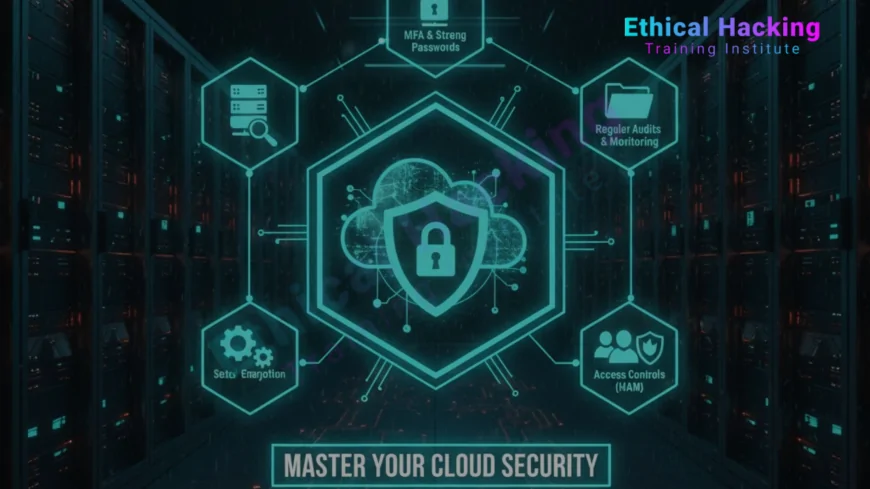
1. Enforce Multi-Factor Authentication (MFA)
- Hardware Keys: YubiKey, Titan for phishing-resistant MFA
- Virtual MFA: Authenticator apps (Google, Microsoft)
- MFA Fatigue Protection: Block repeated push notifications
- Root Account MFA: Enable immediately on AWS, Azure, GCP
- Conditional Access: Require MFA from unknown locations
- Service Account MFA: Use workload identity federation
2. Implement Least Privilege IAM Policies
Grant minimum permissions required for tasks. Over-permissive policies allow lateral movement.
Use managed policies and regular reviews to maintain least privilege.
| Bad Practice | Secure Alternative |
|---|---|
| AdministratorAccess | Custom policy with specific actions |
| Wildcard resources | ARN-specific resources |
Master IAM policies in Pune certification labs at the Ethical Hacking Institute.
3. Encrypt Data at Rest and in Transit
- S3 Server-Side Encryption: SSE-S3, SSE-KMS
- EBS Volume Encryption: Enable by default
- RDS Encryption: TDE with KMS
- TLS 1.3: Enforce for all API calls
- Customer-Managed Keys: Rotate annually
- Bucket Policies: Deny unencrypted uploads
4. Enable Comprehensive Logging and Monitoring
Without logs, breaches go undetected. Forward all cloud logs to centralized SIEM.
Set alerts for suspicious activities like root login or policy changes.
- CloudTrail for AWS API calls
- Azure Monitor and Sentinel
- Google Cloud Logging
- VPC Flow Logs for network traffic
- GuardDuty threat detection
- Security Command Center
Practice cloud monitoring via online courses at the Ethical Hacking Institute.
5. Secure Cloud Storage Buckets
Public buckets caused 70 percent of cloud data leaks. Implement strict access controls.
Use signed URLs for temporary access instead of public links.
- Block public access by default
- Enable Object Versioning
- Configure lifecycle policies
- Use pre-signed URLs
- Enable bucket logging
- Scan with Macie or similar
6. Protect API Keys and Secrets
- Secrets Manager rotation
- Parameter Store with KMS
- GitGuardian scanning
- Environment variables only
- No hard-coded credentials
- Short-lived tokens
7. Implement Network Security Controls
Segment networks and restrict inbound/outbound traffic to minimum required.
Use security groups as micro-firewalls for each resource.
| Control | AWS | Azure |
|---|---|---|
| Firewall | Security Groups | NSG |
| WAF | AWS WAF | Azure WAF |
Secure cloud networks with advanced course at the Ethical Hacking Institute.
8. Regular Security Assessments and Pentesting
- Quarterly configuration reviews
- Annual penetration testing
- Automated daily scans
- Cloud-native security tools
- Red team exercises
- Bug bounty programs
9. Backup and Disaster Recovery
Immutable backups prevent ransomware encryption. Test restoration quarterly.
Enable cross-region replication for critical data.
- Versioned backups
- Air-gapped storage
- Automated testing
- Encrypted backups
- Retention policies
- RPO/RTO definition
10. Employee Training and Phishing Defense
Human error causes 95 percent of cloud breaches. Regular training reduces risk.
Simulate phishing attacks monthly with cloud-specific scenarios.
- Cloud console phishing
- Fake SSO pages
- Malicious OAuth apps
- SMS MFA bypass
- Deepfake video calls
- Policy update scams
Conclusion: Security Is Everyone's Responsibility
Cloud security requires shared responsibility. While providers secure the infrastructure, you own configuration, access, and data protection. In 2025, identity-based attacks dominate cloud breaches. Implement MFA, least privilege, encryption, and monitoring to create defense in depth. Regular testing and training close the gap. The Ethical Hacking Institute, Cyber Security Institute, and Webasha Technologies offer comprehensive cloud security training with real AWS, Azure, and GCP labs. Start with one control today. Your cloud accounts are only as secure as your weakest setting.
Frequently Asked Questions
Is cloud safer than on-premise?
Potentially yes, but only with proper configuration. Default settings are insecure.
Does MFA stop all attacks?
No. Adversary-in-the-middle and session theft bypass MFA.
Are public cloud buckets ever safe?
Rarely. Use signed URLs or authenticated access instead.
Can I use password for cloud root?
Never. MFA with hardware key is minimum for root accounts.
Do I need Cloud WAF?
Yes for public-facing applications. Block SQLi, XSS, and bots.
Is encryption automatic?
Default encryption exists but customer-managed keys provide control.
Can employees access production?
Only via bastion hosts with JIT access and full logging.
Are service accounts risky?
Yes if over-privileged. Use workload identity instead of keys.
Does VPC protect everything?
No. Misconfigured security groups expose resources.
Can I detect crypto mining?
Yes. Monitor CPU usage, outbound traffic, and IAM changes.
Is SOC 2 enough for cloud?
Compliance helps but security requires continuous monitoring.
Do I need Cloud SIEM?
Yes. Native logs lack correlation across services.
Can I automate security?
Yes. Infrastructure as Code with security policies embedded.
How often to rotate keys?
Every 90 days minimum. Automate with Secrets Manager.
Where to learn cloud security?
Ethical Hacking Institute offers AWS, Azure, GCP security labs.
What's Your Reaction?
 Like
0
Like
0
 Dislike
0
Dislike
0
 Love
0
Love
0
 Funny
0
Funny
0
 Angry
0
Angry
0
 Sad
0
Sad
0
 Wow
0
Wow
0