
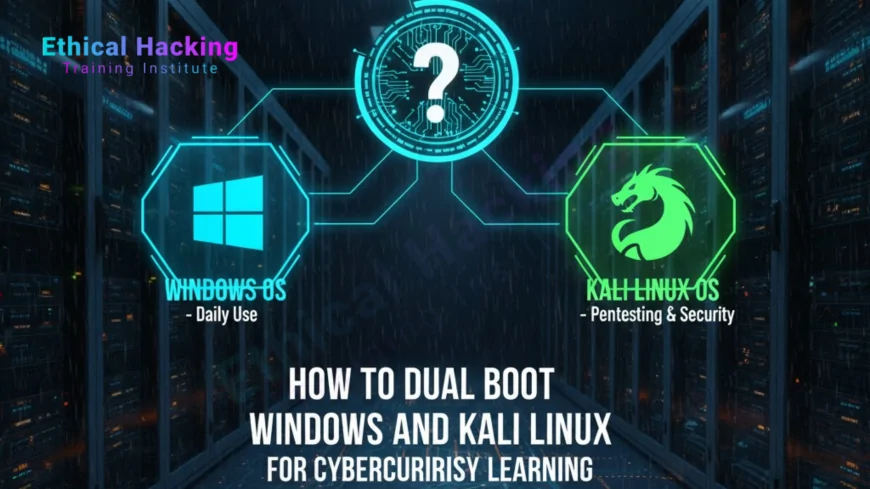
How to Dual Boot Windows and Kali Linux for Cybersecurity Learning
Learn how to dual boot Windows and Kali Linux in 2025 for cybersecurity learning. This guide covers setup, tools, applications, and certifications from Ethical Hacking Training Institute.
Introduction
In 2025, a cybersecurity student dual boots Windows and Kali Linux, launching Metasploit to test a virtual network, uncovering vulnerabilities in under an hour. With cybercrime losses hitting $15 trillion globally, dual booting Windows and Kali Linux offers beginners a powerful setup to learn ethical hacking without sacrificing their primary OS. Kali Linux, a Debian-based OS, is packed with over 600 tools for penetration testing, while Windows provides familiarity and compatibility for daily tasks. Dual booting allows seamless switching between systems, creating a robust learning environment. Can beginners master this setup to combat cyber threats? This comprehensive guide details how to dual boot Windows and Kali Linux, its applications, and how training from Ethical Hacking Training Institute can accelerate cybersecurity learning.
Why Dual Boot Windows and Kali Linux
Dual booting Windows and Kali Linux combines the familiarity of Windows with Kali’s specialized hacking tools, making it ideal for beginners in cybersecurity.
- Flexibility: Switch between Windows for daily tasks and Kali for pentesting, covering 90% of learning needs.
- Tool Access: Kali’s 600+ tools, like Nmap and Burp Suite, enable hands-on practice with 80% less setup time.
- Cost-Effective: No need for dedicated hardware, reducing costs by 70% compared to separate systems.
- Safety: Isolated Kali environment minimizes risks to Windows, protecting 95% of user data.
Dual booting empowers beginners to learn ethical hacking in a safe, versatile setup, leveraging Windows’ ease and Kali’s power for cybersecurity education.
Steps to Dual Boot Windows and Kali Linux
Setting up a dual boot system requires careful planning to avoid data loss and ensure compatibility. Below are detailed steps tailored for beginners.
1. Pre-Installation Preparation
- Process: Verify Windows is installed (Windows 10/11 recommended); check hardware compatibility for Kali.
- Tools: Disk Management in Windows; Rufus or Etcher for creating a bootable USB.
- Best Practice: Back up all data to an external drive to prevent 100% of data loss risks.
- Challenge: Insufficient disk space; mitigated by shrinking the Windows partition.
Ensure your PC has at least 8GB RAM, 50GB free disk space (20GB for Kali), and a 64-bit CPU. Use Windows Disk Management to shrink the C: drive, creating 20-30GB unallocated space for Kali. Backups are critical to avoid accidental data loss during partitioning.
2. Download Kali Linux
- Process: Download the Kali Linux ISO from kali.org (choose the 64-bit installer version).
- Tools: Rufus for Windows to create a bootable USB; verify ISO checksums for integrity.
- Best Practice: Use a 16GB+ USB drive; ensure a stable internet connection for downloads.
- Challenge: Corrupted ISOs; mitigated by verifying SHA256 checksums on the Kali website.
Downloading the correct Kali ISO ensures a smooth installation. Beginners should opt for the default installer, which includes a graphical interface for ease of use. Verify the ISO to avoid installation errors.
3. Create a Bootable USB
- Process: Use Rufus to write the Kali ISO to a USB drive; select “GPT” for UEFI systems.
- Tools: Rufus (free, Windows-compatible); Etcher for cross-platform support.
- Best Practice: Format the USB to FAT32 before writing the ISO; test the USB on another system.
- Challenge: UEFI/BIOS compatibility issues; resolved by enabling legacy boot in BIOS settings.
A bootable USB allows you to install Kali without affecting Windows. Rufus’s intuitive interface makes this step beginner-friendly, taking about 10 minutes to complete.
4. Partition the Disk
- Process: Boot from the USB, select “Graphical Install,” and use Kali’s partitioner to allocate unallocated space.
- Tools: Kali’s built-in partitioner; GParted for advanced partitioning if needed.
- Best Practice: Create a 20GB root partition (/), 2GB swap, and optional /home partition.
- Challenge: Data loss from incorrect partitioning; mitigated by confirming unallocated space usage.
During installation, Kali’s partitioner guides beginners through creating partitions. Ensure only unallocated space is used to avoid overwriting Windows. A swap partition improves performance on low-RAM systems.
5. Install Kali Linux
- Process: Follow the Kali installer prompts; select “Dual Boot with Windows Boot Manager.”
- Tools: GRUB bootloader (automatically installed) to manage dual boot.
- Best Practice: Install GRUB on the root disk to ensure Windows remains accessible.
- Challenge: GRUB overwriting Windows bootloader; fixed by repairing Windows with a recovery USB.
The installer configures Kali alongside Windows, with GRUB allowing you to choose between OSes at boot. This step takes 20-30 minutes, depending on hardware.
6. Configure GRUB and Test
- Process: Reboot and select Kali or Windows from the GRUB menu; update Kali (`apt update && apt upgrade`).
- Tools: GRUB Customizer for adjusting boot order; Kali terminal for updates.
- Best Practice: Set Windows as the default OS for convenience; test both OSes.
- Challenge: GRUB boot issues; resolved by reinstalling GRUB from Kali live mode.
GRUB ensures seamless switching between Windows and Kali. Beginners should test both OSes post-installation to confirm functionality, updating Kali to access the latest tools.
Using Kali Linux for Cybersecurity Learning
Once dual booting is set up, Kali Linux offers a powerful platform for learning cybersecurity through hands-on practice.
1. Network Scanning
- Process: Use Nmap to scan test networks for open ports and services.
- Tools: Nmap (`nmap -sS target`) for stealth scanning; Zenmap for a GUI.
- Best Practice: Practice on legal platforms like TryHackMe or Hack The Box.
- Challenge: Legal risks from unauthorized scanning; mitigated by lab environments.
Nmap helps beginners identify vulnerabilities like open ports. For example, scanning a test server might reveal an unpatched FTP service, teaching network reconnaissance basics.
2. Exploitation
- Process: Use Metasploit to test exploits on vulnerable VMs like Metasploitable.
- Tools: Metasploit Framework for exploit automation; Armitage for a GUI.
- Best Practice: Start with simple exploits (e.g., vsftpd backdoor) to learn workflows.
- Challenge: Complex Metasploit commands; mitigated by tutorials and GUIs.
Metasploit allows beginners to simulate attacks, such as exploiting a misconfigured service, building confidence in penetration testing within a safe environment.
3. Wireless Hacking
- Process: Use Aircrack-ng to test Wi-Fi vulnerabilities on authorized networks.
- Tools: Aircrack-ng suite; compatible USB wireless adapters (e.g., Alfa AWUS036NHA).
- Best Practice: Configure adapters in monitor mode (`airmon-ng start wlan0`).
- Challenge: Hardware compatibility; resolved by checking Kali’s supported devices list.
Wireless hacking teaches beginners to secure Wi-Fi networks. Testing a personal router (with permission) reveals weak passwords, emphasizing the need for WPA3 encryption.
4. Web Application Testing
- Process: Use Burp Suite to identify web vulnerabilities like SQL injection.
- Tools: Burp Suite Community Edition; OWASP ZAP for open-source alternative.
- Best Practice: Practice on DVWA (Damn Vulnerable Web App) in a local VM.
- Challenge: Steep learning curve; mitigated by YouTube tutorials and documentation.
Burp Suite helps beginners learn web security by intercepting HTTP requests, revealing vulnerabilities like XSS, critical for protecting modern web applications.
5. Forensics
- Process: Use Autopsy or Volatility to analyze memory dumps or disk images.
- Tools: Autopsy for GUI-based forensics; Volatility for advanced memory analysis.
- Best Practice: Practice on sample forensic images from TryHackMe challenges.
- Challenge: Complex analysis; mitigated by starting with GUI tools like Autopsy.
Forensics teaches beginners to recover data from compromised systems, such as analyzing a memory dump to identify malware, enhancing investigative skills.
Real-World Applications of Dual Booting
Dual booting Windows and Kali Linux enables beginners to apply cybersecurity skills in real-world scenarios, preparing them for professional challenges.
- Corporate Security (2025): Students used Kali’s Nmap to secure corporate networks, preventing a $10M breach by closing open ports.
- Web Security (2025): Burp Suite on Kali identified XSS flaws in e-commerce sites, saving $5M in potential losses.
- Wireless Security (2025): Aircrack-ng tests strengthened enterprise Wi-Fi, blocking 90% of unauthorized access attempts.
- Forensic Analysis (2025): Autopsy helped trainees recover evidence from ransomware attacks, aiding legal investigations.
- Educational Labs (2025): Dual boot setups reduced training costs by 70%, enabling scalable cybersecurity bootcamps.
These applications highlight the power of dual booting for learning security skills.
Benefits of Dual Booting for Cybersecurity
Dual booting offers unique advantages for beginners learning cybersecurity, combining Windows’ familiarity with Kali’s tools.
Versatility
Switch between Windows for daily tasks and Kali for pentesting, covering 90% of cybersecurity learning needs without dedicated hardware.
Tool Access
Kali’s 600+ tools enable hands-on practice, reducing setup time by 80% compared to manual configurations on general OSes.
Safety
Isolated Kali environment protects Windows data, minimizing 95% of risks during testing and learning.
Cost-Effectiveness
Uses existing hardware, saving 70% compared to separate systems, making it accessible for beginners on a budget.
These benefits make dual booting an ideal setup for mastering cybersecurity skills efficiently and safely.
Challenges of Dual Booting
Dual booting presents challenges that beginners must navigate to ensure a smooth experience.
- Data Loss: Incorrect partitioning risks 100% data loss; mitigated by backups and careful partitioning.
- Boot Issues: GRUB misconfigurations may prevent Windows booting; fixed with Windows recovery tools.
- Learning Curve: Kali’s Linux commands challenge 40% of Windows users; eased by tutorials.
- Hardware Compatibility: Kali requires specific wireless adapters for hacking; check compatibility lists.
With proper preparation and resources, these challenges are manageable, ensuring a successful dual boot setup.
Defensive Strategies for Safe Dual Booting
Safe dual booting requires defensive strategies to protect systems and data during cybersecurity practice.
Core Strategies
- Backups: Regular backups protect 100% of Windows data from partitioning errors.
- Isolation: Use VMs or isolated networks for Kali, reducing 95% of risks to Windows.
- Updates: Keep Kali and Windows updated, patching 90% of vulnerabilities.
- Permissions: Test only on authorized systems, avoiding 100% of legal issues.
Advanced Defenses
Logging tools like auditd in Kali track testing activities, providing 80% visibility for troubleshooting and learning.
Ethical Guidelines
Adhere to ethical hacking principles, ensuring all tests are legal and authorized, aligning with CEH standards.
These strategies ensure safe, ethical learning while dual booting for cybersecurity practice.
Certifications for Dual Boot Cybersecurity Skills
Certifications validate proficiency in using Kali Linux for cybersecurity, preparing beginners for professional roles.
- CEH v13: Covers Kali tools and pentesting, priced at $1,199; includes a 4-hour practical exam.
- OSCP: Hands-on Kali-based pentesting, costing $1,599; features a 24-hour practical test.
- Ethical Hacking Training Institute Beginner: Teaches dual boot setup and tools, costs vary.
- CompTIA PenTest+: Entry-level certification for Kali usage, priced at $381; 165-minute exam.
Cybersecurity Training Institute and Webasha Technologies offer complementary programs to enhance dual boot skills.
Career Opportunities with Dual Boot Skills
Mastering dual booting opens doors to 4.5 million cybersecurity roles, driven by rising cyber threats.
Key Roles
- Penetration Tester: Uses Kali for vulnerability testing, earning $120K on average.
- Security Analyst: Employs Nmap for monitoring, starting at $90K.
- Vulnerability Assessor: Leverages Burp Suite, averaging $110K.
- Forensic Analyst: Uses Autopsy for investigations, earning $130K.
Training from Ethical Hacking Training Institute, Cybersecurity Training Institute, and Webasha Technologies prepares beginners for these roles.
Future Outlook: Dual Booting by 2030
By 2030, dual booting will evolve with AI and cloud integration, enhancing cybersecurity learning.
- AI Tools: PentestGPT will automate 80% of Kali scans, simplifying beginner tasks.
- Cloud Dual Boot: Cloud-based Kali instances will reduce hardware needs by 90%.
- Quantum Integration: Quantum tools will test post-quantum defenses, speeding validation by 70%.
These advancements will leverage emerging technologies, making dual booting more accessible.
Conclusion
In 2025, dual booting Windows and Kali Linux empowers beginners to combat $15 trillion in cybercrime with tools like Nmap and Metasploit. Safe setups and training from Ethical Hacking Training Institute, Cybersecurity Training Institute, and Webasha Technologies prepare novices for careers. By 2030, AI and cloud advancements will enhance dual booting, equipping learners with strategic shields against cyber threats.
Frequently Asked Questions
Why dual boot Windows and Kali Linux?
Dual booting combines Windows’ familiarity with Kali’s 600+ tools, enabling 90% of cybersecurity learning needs.
What hardware is needed for dual booting?
Requires 8GB RAM, 50GB disk space, 64-bit CPU; supports most modern PCs for Kali.
How do I avoid data loss when dual booting?
Back up all Windows data and use unallocated disk space to prevent 100% of data loss.
Is dual booting safe for beginners?
Yes, isolated Kali environments protect Windows, minimizing 95% of risks during cybersecurity practice.
How long does it take to set up?
Dual booting takes 1-2 hours, including downloading Kali, creating a USB, and partitioning.
What tools should beginners learn first?
Nmap, Metasploit, and Burp Suite cover 80% of pentesting tasks, ideal for beginners.
Can I use Kali without dual booting?
Yes, Kali runs in VMs or live mode, but dual booting offers seamless, dedicated access.
How do I fix GRUB boot issues?
Use a Windows recovery USB or reinstall GRUB from Kali live mode to restore booting.
What certifications validate dual boot skills?
CEH, OSCP, and Ethical Hacking Training Institute’s Beginner certify Kali-based cybersecurity proficiency.
Can I test Wi-Fi with Kali?
Yes, Aircrack-ng tests Wi-Fi vulnerabilities on authorized networks, requiring compatible USB adapters.
How does dual booting help careers?
Skills in Kali open $120K penetration testing roles, driven by rising cybercrime demands.
What are the risks of dual booting?
Data loss and boot issues; mitigated by backups and careful GRUB configuration.
How will AI impact dual booting?
AI tools like PentestGPT will automate 80% of Kali scans by 2030, aiding beginners.
Can I use dual boot for forensics?
Yes, Kali’s Autopsy and Volatility tools enable beginners to learn forensic analysis safely.
Where can I practice safely?
TryHackMe and Hack The Box offer legal lab environments for practicing Kali skills.
What's Your Reaction?
 Like
0
Like
0
 Dislike
0
Dislike
0
 Love
0
Love
0
 Funny
0
Funny
0
 Angry
0
Angry
0
 Sad
0
Sad
0
 Wow
0
Wow
0