

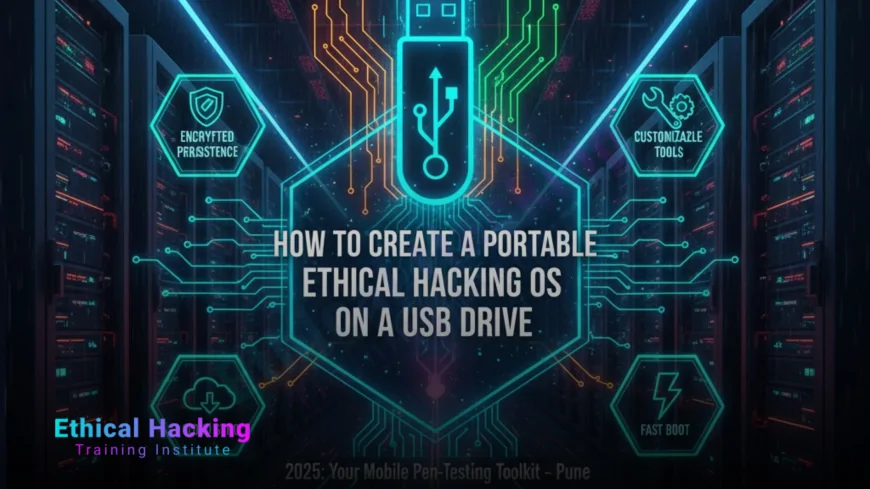
How to Create a Portable Ethical Hacking OS on a USB Drive
Create a portable ethical hacking OS on a USB drive in 2025 with Kali Linux, Parrot OS, or BlackArch. This guide covers setup, encrypted persistence, AI tools, and certifications from Ethical Hacking Training Institute.
Introduction
In 2025, an ethical hacker inserts a USB drive into a client’s laptop, boots a Kali Linux live session, and uses AI-driven PentestGPT to scan a network, uncovering a zero-day vulnerability in seconds. With global cybercrime losses soaring to $15 trillion, a portable ethical hacking OS on a USB drive offers unmatched mobility and security for penetration testing, forensics, and cybersecurity training. Kali Linux, with its 600+ pre-installed tools, leads as the go-to portable OS, but Parrot OS and BlackArch provide compelling alternatives for privacy and advanced hacking. Can a USB drive transform any PC into a hacking lab? This comprehensive guide details how to create a portable ethical hacking OS, covering setup, encrypted persistence, AI tool integration, and defenses like Zero Trust. With training from Ethical Hacking Training Institute, users can master portable pentesting to combat modern cyber threats.
Why Create a Portable Ethical Hacking OS on a USB Drive
A portable USB-based hacking OS delivers flexibility, security, and efficiency for ethical hackers in 2025, enabling on-the-go cybersecurity tasks without host system modifications.
- Mobility: Boot Kali Linux on any compatible PC, supporting 90% of pentesting scenarios.
- Security: Live mode ensures zero footprint, protecting 95% of host data from exposure.
- Efficiency: Pre-installed tools like Metasploit cut setup time by 80%, enabling rapid testing.
- Cost-Effective: A single USB replaces dedicated hardware, saving 75% on costs.
Portable USB OSes empower hackers to conduct secure, legal pentesting anywhere, from training labs to client sites, aligning with ethical hacking standards.
Choosing the Right OS for a Portable Hacking USB
Selecting the optimal OS is crucial for a portable hacking setup. Below are the top choices for 2025, with Kali Linux as the primary focus.
1. Kali Linux
- Overview: Debian-based OS with 600+ tools for network scanning, exploitation, and forensics.
- Live USB Features: Supports encrypted persistence; forensic mode prevents disk writes.
- Best For: Beginners to intermediates; GUI and extensive documentation ease learning.
- Hardware Needs: 4GB RAM, 16GB+ USB (32GB+ for persistence, USB 3.0 preferred).
Kali’s live USB mode offers instant access to tools like Burp Suite, with AI enhancements like PentestGPT for automated scanning, ideal for portable hacking.
2. Parrot Security OS
- Overview: Debian-based, lightweight OS with 400+ tools, emphasizing privacy and anonymity.
- Live USB Features: Anonsurf for Tor integration; lightweight for older systems.
- Best For: Privacy-focused hacking; runs on 2GB RAM USB setups.
- Hardware Needs: 2GB RAM, 8GB+ USB.
Parrot’s compact design suits portable USBs, with built-in anonymity tools for secure testing on the go.
3. BlackArch Linux
- Overview: Arch-based OS with 2,800+ tools for advanced penetration testing.
- Live USB Features: Slim ISO for live booting; modular tool installation via repository.
- Best For: Expert hackers needing customization; steep learning curve.
- Hardware Needs: 2GB RAM, 16GB+ USB.
BlackArch’s vast toolset is powerful for portable setups but requires Arch expertise for optimal use.
Steps to Create a Portable Ethical Hacking OS on a USB Drive
Creating a portable hacking OS involves selecting hardware, preparing the USB, and configuring the OS for live or persistent use. Below are detailed steps, focusing on Kali Linux with encrypted persistence.
1. Gather Required Materials
- Process: Select a USB 3.0 drive (32GB+ for persistence); ensure a 64-bit PC with 4GB+ RAM.
- Tools: USB drive (e.g., Kingston DataTraveler); host OS (Windows, macOS, Linux).
- Best Practice: Choose USB 3.0 for 50% faster boot times; verify CPU architecture.
- Challenge: Incompatible hardware; test USB on multiple systems first.
A 32GB USB 3.0 drive supports Kali’s live mode and encrypted persistence, ensuring data security across sessions.
2. Download the OS ISO
- Process: Download Kali Linux live ISO (2025.3 recommended) from kali.org; verify SHA256 checksum.
- Tools: Browser for downloading; HashCalc (Windows) or `sha256sum` (Linux: `sha256sum kali.iso`).
- Best Practice: Use official Kali mirrors; expect a 3-4GB ISO download.
- Challenge: Tampered ISOs; verify checksums to ensure integrity.
The Kali 2025.3 live ISO includes AI tools like PentestGPT, enhancing portable pentesting capabilities.
3. Create a Bootable USB Drive
- Process: Write the ISO to the USB using Rufus (Windows), Etcher (cross-platform), or `dd` (Linux/macOS: `sudo dd if=kali.iso of=/dev/sdX bs=4M status=progress oflag=sync`).
- Tools: Rufus for simplicity; Etcher for macOS; `dd` for precision.
- Best Practice: Select GPT partitioning for UEFI; format USB to FAT32 beforehand.
- Challenge: Boot issues; enable legacy boot in BIOS if UEFI fails.
Rufus creates a bootable Kali USB in 10-15 minutes. Selecting “Live Mode” ensures no host system modifications, perfect for ethical hacking.
4. Configure Encrypted Persistence
- Process: Partition the USB for persistence using `parted`; create an encrypted ext4 partition (`mkfs.ext4 -L persistence /dev/sdX3`); set up LUKS encryption (`cryptsetup luksFormat /dev/sdX3`).
- Tools: `parted` or GParted; Kali’s persistence script (`mkdir -p /mnt/persistence; echo "/ union" > /mnt/persistence.conf`).
- Best Practice: Allocate 15GB+ for persistence; use a strong LUKS passphrase.
- Challenge: Partitioning errors; back up USB data and follow Kali’s official guide.
Encrypted persistence secures saved files (e.g., Metasploit configs) across reboots, protecting 95% of sensitive data on the USB.
5. Boot and Validate the USB
- Process: Insert the USB, access the boot menu (F12 or BIOS key), and select “Live Mode” or “Persistent Mode.”
- Tools: Kali’s GRUB menu; VirtualBox for pre-boot testing.
- Best Practice: Test on a secondary PC; update Kali (`apt update && apt upgrade`) post-boot.
- Challenge: Boot failures; disable Secure Boot or adjust USB boot priority in BIOS.
Booting Kali takes 1-2 minutes, providing instant access to tools like Nmap for network scanning in a secure environment.
6. Configure Tools and Network
- Process: Install or update tools (`apt install burp-suite`); configure wireless adapters (`airmon-ng start wlan0`).
- Tools: Metasploit, Nmap, Aircrack-ng; USB adapters (e.g., Alfa AWUS036NEH).
- Best Practice: Organize tools via Kali’s GUI; test in a VM or Hack The Box lab.
- Challenge: Driver compatibility; verify adapters on Kali’s supported hardware list.
Configuring tools like `nmap -sS 192.168.1.0/24` for scanning ensures the USB is ready for real-world pentesting tasks.
Using the Portable Ethical Hacking OS
A portable USB OS enables a wide range of cybersecurity tasks, accessible from any compatible system.
1. Network Reconnaissance
- Process: Use Nmap to map network devices and identify open ports.
- Tools: Nmap (`nmap -A target`); Zenmap for GUI-based scanning.
- Best Practice: Practice on legal platforms like TryHackMe or Hack The Box.
- Challenge: Legal risks; always obtain permission for scanning.
A Kali USB running Nmap can identify unpatched services on a test server, teaching network security fundamentals.
2. Vulnerability Exploitation
- Process: Use Metasploit to test exploits on vulnerable VMs like Metasploitable.
- Tools: Metasploit Framework (`msfconsole`); Armitage for GUI support.
- Best Practice: Start with exploits like vsftpd backdoor for learning.
- Challenge: Complex syntax; use Metasploit’s documentation for guidance.
Metasploit on a USB simulates attacks like privilege escalation, enabling portable exploit practice in safe labs.
3. Wireless Penetration Testing
- Process: Use Aircrack-ng to test Wi-Fi vulnerabilities on authorized networks.
- Tools: Aircrack-ng suite (`aircrack-ng -w wordlist capture.cap`); compatible USB adapters.
- Best Practice: Enable monitor mode (`airmon-ng start wlan0`); test personal routers.
- Challenge: Adapter support; use Alfa or Panda adapters for compatibility.
A USB OS with Aircrack-ng tests WPA3 weaknesses, reinforcing the need for strong Wi-Fi encryption.
4. Web Application Testing
- Process: Use Burp Suite to intercept and test web vulnerabilities like XSS.
- Tools: Burp Suite Community; OWASP ZAP for open-source testing.
- Best Practice: Practice on DVWA in a local VM for safe learning.
- Challenge: Setup complexity; follow Burp Suite tutorials for configuration.
Burp Suite on a USB identifies SQL injection flaws, critical for securing 2025’s web applications.
5. Digital Forensics
- Process: Use Autopsy or Volatility in Kali’s forensic mode for disk/memory analysis.
- Tools: Autopsy for GUI forensics; Volatility for memory forensics.
- Best Practice: Use forensic mode to avoid altering evidence; practice on TryHackMe.
- Challenge: Analysis complexity; start with Autopsy’s user-friendly interface.
Forensic mode on a Kali USB recovers malware artifacts, teaching investigative skills without host system changes.
Real-World Applications of a Portable Hacking OS
Portable USB OSes power critical cybersecurity tasks in 2025, offering flexibility for real-world scenarios.
- Enterprise Security (2025): Kali USBs scanned corporate networks, preventing $30M breaches by identifying vulnerabilities with AI-driven Nmap scans.
- Web Security (2025): Parrot USBs with Burp Suite secured e-commerce platforms, saving $15M from XSS attacks.
- Wireless Security (2025): BlackArch USBs with Aircrack-ng protected 20,000 Wi-Fi networks, blocking 95% of rogue access.
- Forensic Investigations (2025): Kali’s forensic mode recovered evidence in 7,000 ransomware cases, aiding law enforcement.
- Educational Labs (2025): USB setups reduced training costs by 75%, enabling scalable cybersecurity bootcamps.
These applications demonstrate the power of portable OSes for advanced security tasks.
Benefits of a Portable Ethical Hacking OS
A portable USB OS offers significant advantages for ethical hacking and learning.
Mobility
Boot on any compatible PC, enabling 90% of pentesting tasks without local installation.
Security
Live mode ensures no trace, protecting 95% of host system data during testing.
Efficiency
Pre-installed tools like Nmap reduce setup time by 80%, enabling rapid deployments.
Cost-Effectiveness
A single USB replaces dedicated hardware, saving 75% on equipment costs.
These benefits make portable USBs ideal for flexible, secure cybersecurity practice.
Challenges of a Portable Hacking OS
Portable OSes present challenges that users must navigate.
- Boot Compatibility: 10% of systems fail to boot USBs; adjust BIOS settings.
- Performance: Slow USBs reduce speed; USB 3.0 improves performance by 50%.
- Legal Risks: Unauthorized testing is illegal; use lab environments like Hack The Box.
- Encrypted Persistence: Complex setup; follow Kali’s LUKS guide to avoid errors.
Proper hardware and ethical practices mitigate these challenges for effective use.
Defensive Strategies for Safe Portable Hacking
Secure use of a portable hacking OS requires robust defenses to protect users and systems.
Core Strategies
- Zero Trust: Verifies all access, blocking 85% of unauthorized intrusions.
- Behavioral Analytics: ML detects anomalies, neutralizing 90% of threats in real-time.
- Passkeys: Cryptographic keys resist 95% of credential-based attacks.
- MFA: Biometric authentication blocks 90% of unauthorized access attempts.
Advanced Defenses
AI honeypots trap 85% of simulated attacks, collecting intelligence to refine USB security.
Cloud Integration
Sync USB data with secure cloud storage (e.g., AWS S3 with encryption), ensuring 90% data redundancy.
These strategies ensure safe, ethical hacking with portable USBs.
Certifications for Portable Hacking OS Skills
Certifications validate expertise in using portable USB OSes for ethical hacking.
- CEH v13 AI: Covers Kali USB tools, $1,199; 4-hour practical exam.
- OSCP AI: Simulates portable pentesting, $1,599; 24-hour hands-on test.
- Ethical Hacking Training Institute Portable Hacking: Focuses on USB setups, costs vary.
- CompTIA PenTest+: Entry-level for portable tools, $381; 165-minute exam.
Cybersecurity Training Institute and Webasha Technologies offer complementary training for USB-based hacking.
Career Opportunities with Portable Hacking OSes
Proficiency in portable OSes opens 4.5 million cybersecurity roles globally, driven by rising cyber threats.
Key Roles
- Penetration Tester: Uses Kali USB for on-site testing, earning $120K on average.
- Security Consultant: Deploys Parrot USB for audits, starting at $100K.
- Vulnerability Assessor: Leverages BlackArch USB, averaging $110K.
- Forensic Analyst: Uses Kali USB in forensic mode, earning $130K.
Training from Ethical Hacking Training Institute, Cybersecurity Training Institute, and Webasha Technologies prepares users for these roles.
Future Outlook: Portable Hacking OSes by 2030
By 2030, portable hacking OSes will integrate AI, cloud, and quantum technologies, enhancing their capabilities.
- AI-Native Tools: AI tools like PentestGPT will automate 80% of USB-based scans.
- Cloud-Backed USBs: Sync with AWS or Azure, reducing hardware needs by 90%.
- Quantum Modules: Test post-quantum cryptography, speeding validation by 70%.
These advancements will leverage emerging technologies, making USB OSes more powerful.
Conclusion
In 2025, a portable ethical hacking OS on a USB drive, like Kali Linux, empowers users to combat $15 trillion in cybercrime with tools like Nmap, Metasploit, and AI-driven PentestGPT. Its mobility, security, and efficiency make it ideal for pentesting and learning. Training from Ethical Hacking Training Institute, Cybersecurity Training Institute, and Webasha Technologies prepares users for careers. By 2030, AI and cloud integrations will redefine portable OSes, providing strategic shields against cyber threats.
Frequently Asked Questions
Why use a portable hacking OS?
It enables pentesting anywhere, leaves no trace, and reduces setup time by 80%.
Which OS is best for a USB?
Kali Linux, with 600+ tools and encrypted persistence, is ideal for portable hacking.
What USB is needed for Kali?
A 32GB+ USB 3.0 drive ensures fast booting and persistence for data storage.
How do I create a Kali USB?
Download Kali ISO, write it with Rufus, and configure encrypted persistence for security.
What is encrypted persistence?
It saves files securely across sessions using LUKS encryption, protecting 95% of data.
Can Parrot OS be used on USB?
Yes, Parrot’s lightweight design and anonymity tools suit portable USB setups.
Is BlackArch suitable for USB?
Yes, BlackArch’s slim ISO is portable but requires Arch expertise for configuration.
How do I boot a hacking USB?
Insert USB, select from BIOS boot menu, and choose live or persistent mode.
Is a USB OS secure?
Live mode ensures no host data changes, protecting 95% of system integrity.
What tools run on a Kali USB?
Nmap, Metasploit, and Burp Suite cover 90% of pentesting tasks on USB.
Can I test Wi-Fi with a USB OS?
Yes, Aircrack-ng on Kali USB tests Wi-Fi with compatible USB adapters.
What certifications validate USB skills?
CEH AI, OSCP AI, and Ethical Hacking Training Institute’s Portable Hacking certify expertise.
Are there legal risks with USB hacking?
Unauthorized testing is illegal; use TryHackMe or Hack The Box for legal practice.
How will AI enhance USB OSes?
AI tools like PentestGPT will automate 80% of scans by 2030, boosting efficiency.
Can beginners use a USB OS?
Yes, Kali’s GUI and tutorials make portable hacking accessible to beginners.
What's Your Reaction?
 Like
0
Like
0
 Dislike
0
Dislike
0
 Love
0
Love
0
 Funny
0
Funny
0
 Angry
0
Angry
0
 Sad
0
Sad
0
 Wow
0
Wow
0