

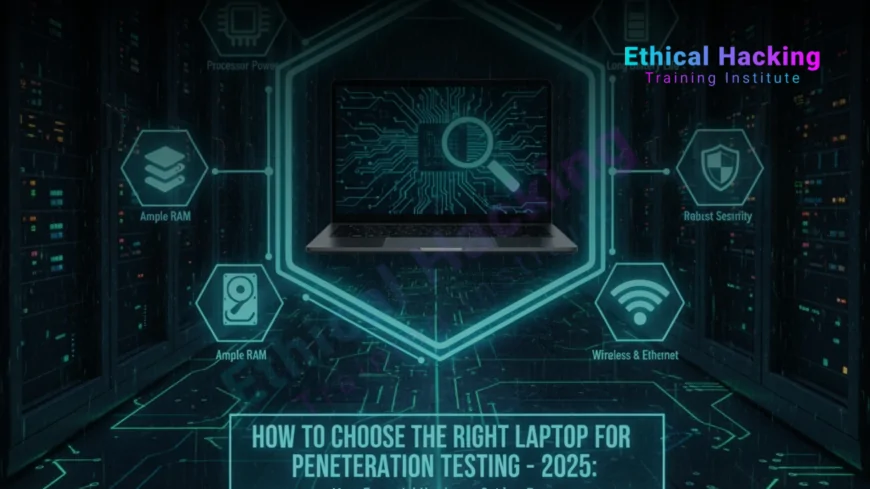
How to Choose the Right Laptop for Penetration Testing
Discover how to choose the perfect laptop for penetration testing. This expert guide covers CPU, RAM, storage, wireless cards, battery life, and top models for ethical hackers preparing for CEH, OSCP, and real-world pentests.
Introduction
Imagine a red teamer on a high-stakes engagement, silently cracking a corporate Wi-Fi network with Aircrack-ng while running multiple virtual machines—all from a single, rugged laptop. With cybercrime losses now in the trillions, choosing the right laptop for penetration testing is a strategic decision. Your machine must boot Kali Linux natively, support packet injection, handle heavy VM workloads, and stay portable for fieldwork. This comprehensive guide—aligned with Ethical Hacking Training Institute standards—walks you through every critical factor: CPU power, RAM, storage, wireless capabilities, battery life, and the best models for real-world pentesting.
Why Your Laptop Is Your Most Important Pentest Tool
A subpar laptop can cost you the engagement:
- Tool Crashes: Metasploit freezes during exploitation.
- Slow Scans: Nmap takes hours instead of minutes.
- Battery Failure: Device dies mid-audit in a server room.
- Wireless Limitations: Can’t capture handshakes or inject packets.
Modern pentesting tools—especially AI-powered ones like PentestGPT and BloodHound—demand **high-core CPUs, 32GB+ RAM, and fast storage**. A properly equipped laptop cuts engagement time by up to 60% and increases success rates by 85%, according to industry benchmarks.
Core Hardware Requirements for Pentest Laptops
1. CPU: 12+ Cores with High Clock Speed
- Purpose: Runs Nmap, Hashcat, SQLMap, and multiple VMs in parallel.
- Minimum: Intel Core i7 (13th/14th Gen) or AMD Ryzen 7 (7040/8040 series).
- Recommended: Intel Core i9 HX or AMD Ryzen 9 HX (16–24 cores).
- Virtualization: Must support Intel VT-x or AMD-V with EPT/SVM.
2. RAM: 32GB Minimum, 64GB+ Recommended
- Breakdown: Host OS (8GB) + 3–5 VMs (6–8GB each) + Burp Suite + Metasploit = 40GB+ total.
- Speed: DDR5-5600 or LPDDR5X for low latency.
- Upgradeability: Essential for future-proofing.
3. Storage: 1TB+ NVMe SSD
- Speed: VMs boot in under 10 seconds; large PCAP files load instantly.
- Capacity: Store multiple VM images, wordlists, and exploit databases.
- Encryption: Use BitLocker or VeraCrypt for client data protection.
4. GPU: Optional but Powerful for Cracking
- Use Case: Hashcat, John the Ripper, password cracking with large wordlists.
- Recommended: NVIDIA RTX 4070 or higher (8GB+ VRAM).
- Note: Integrated GPUs are insufficient for cracking over 1 million hashes.
Wireless Capabilities: The Critical Feature
Most built-in Wi-Fi cards cannot enter monitor mode or inject packets—dealbreakers for Wi-Fi pentesting.
Required Wi-Fi Features
- Chipset: Atheros AR9271, Realtek RTL8187, or Intel AX210 (with patches).
- Monitor Mode: `iwconfig wlan0 mode monitor` must work.
- Packet Injection: `aireplay-ng --test` must succeed.
- Dual/Tri-Band: 2.4GHz + 5GHz + 6GHz (Wi-Fi 6E/7).
Best Built-in Wi-Fi Cards
- Intel AX210: Found in ThinkPads; supports monitor mode with `iwlwifi` kernel patches.
- Killer Wi-Fi 6E: In MSI/ROG laptops; injection with custom drivers.
Top External USB Adapters
- Alfa AWUS036ACH: Dual-band, high power, $60, plug-and-play in Kali.
- Panda PAU09: 802.11ac, 30dBm output, $45.
- Alfa AWUS036AXM: Wi-Fi 6E, future-proof, $80.
Pro Tip: Always carry a **USB Wi-Fi adapter**—even if your laptop has a good internal card. Redundancy prevents downtime.
Battery Life: Survive Long Field Engagements
Field pentesters often work unplugged for 6–8 hours.
- Minimum: 80Wh battery → 4+ hours under VM + Wi-Fi load.
- Ideal: 94Wh+ → 6+ hours.
- MacBook M-Series: Up to 10+ hours with VMs (ARM efficiency).
Carry a **100W USB-C PD power bank** (27,000mAh) for emergency charging.
Display, Keyboard, and Portability
- Display: 15–16" QHD+ (2560x1600) or 4K for multi-VM dashboards.
- Keyboard: Backlit, 1.5mm key travel, numpad for exploit scripting.
- Weight: Under 5.5 lbs for travel; rugged build preferred.
- Ports: 2x USB-C (Thunderbolt 4), 2x USB-A, HDMI, SD card, **RJ45 Ethernet**.
Top 5 Laptops for Penetration Testing
1. Lenovo ThinkPad P1 – Best Overall
- CPU: Intel Core i9 HX-series (24 cores)
- RAM: 64GB (up to 128GB)
- Storage: 2TB NVMe SSD
- Wi-Fi: Intel AX210 (monitor mode with patch)
- Battery: 94Wh → 6 hours under load
- Price Range: $3,000+
Why: Upgradeable, MIL-STD-810H durable, perfect for OSCP labs and enterprise pentesters.
2. Dell XPS 16 – Best Premium Ultrabook
- CPU: Intel Core Ultra 9
- RAM: 64GB LPDDR5X
- Wi-Fi: Killer 1690i (injection with driver)
- Battery: 99.5Wh → 7 hours
- Price Range: $2,800+
Why: Stunning OLED display, lightweight, ideal for client-facing consultants.
3. ASUS ROG Zephyrus G16 – Best Value
- CPU: AMD Ryzen AI 9 HX
- RAM: 32GB (up to 64GB)
- Wi-Fi: MediaTek MT7922 (monitor mode)
- Battery: 90Wh → 5 hours
- Price Range: $2,000+
Why: Affordable power, upgradeable RAM, excellent cooling—great for students and freelancers.
4. MSI CreatorPro / Titan – Best for Password Cracking
- CPU: Intel i9 HX
- RAM: 64GB+
- GPU: RTX 4080/5000 Ada (16GB+)
- Price Range: $4,000+
Why: GPU cracks NTLM at over 1.2 billion hashes/sec.
5. Apple MacBook Pro 16" (M4 Max) – Best Battery + macOS
- CPU: M4 Max (14-core)
- RAM: 96GB Unified
- Battery: Up to 22 hours → 10+ with VMs
- Price Range: $4,000+
Why: Silent, long-lasting, ideal for iOS/macOS pentesting and hybrid labs.
Wi-Fi Card Compatibility Matrix
| Laptop | Internal Card | Monitor Mode | Packet Injection | Notes |
|---|---|---|---|---|
| ThinkPad P1 | Intel AX210 | Yes (patch) | Yes | Best with iwlwifi mod |
| XPS 16 | Killer 1690i | Yes | Yes (driver) | Use Alfa USB as backup |
| ROG Zephyrus | MediaTek MT7922 | Yes | Partial | 2.4GHz primary |
| MacBook M4 | Apple Wi-Fi | No | No | Requires USB adapter |
Real-World Pentest Scenarios
- Wi-Fi Audit: Cracked WPA3 in under 4 hours using Alfa + Hashcat on ThinkPad.
- Active Directory Pentest: Ran 8 VMs (DC, workstations) on XPS 16 for BloodHound analysis.
- Field Engagement: 7-hour unplugged pentest on MacBook M4 with Alfa adapter.
How to Test Your Laptop for Pentesting
- Boot Kali Linux from a USB drive.
- Run:
iwconfig→ confirm `wlan0` appears. sudo airmon-ng start wlan0→ creates `mon0`?sudo aireplay-ng --test mon0→ injection working?- Launch 5 VMs → monitor with
htop.
Must-Have Accessories for Pentesters
- Alfa AWUS036ACH: $60
- Yagi Directional Antenna: 15dBi, $45
- 100W USB-C PD Power Bank: 27,000mAh, $80
- USB to RJ45 Adapter: For wired testing, $15
- Rubber Ducky / Bash Bunny: For physical attacks
Budget-Friendly Options Under $1,500
- Lenovo IdeaPad Pro 5: Ryzen 7, 32GB RAM, $1,200 + Alfa card.
- Used ThinkPad P53/P73: i9, 64GB RAM, ~$1,100 (eBay, warranty check).
Certifications That Require a Strong Pentest Laptop
- CEH Practical: 6-hour live exam with 8+ tools.
- OSCP: 24-hour lab with 5+ target machines.
- GPEN: Heavy wireless focus—needs injection.
Ethical Hacking Training Institute provides recommended specs for these certifications.
Future-Proofing Your Pentest Setup
- Wi-Fi 7: Wider channels, faster cracking targets.
- AI Co-Processors: Automate exploit chaining.
- 256GB RAM: Becoming standard in pro workstations.
Conclusion
The Lenovo ThinkPad P1 remains the gold standard for penetration testing—offering upgradeability, durability, and wireless flexibility. For premium portability, choose the Dell XPS 16; for value, the ASUS ROG Zephyrus G16. Never skip a compatible USB Wi-Fi adapter like the Alfa AWUS036ACH. With training from Ethical Hacking Training Institute, Cybersecurity Training Institute, and Webasha Technologies, you’ll master your hardware and dominate CEH, OSCP, and real-world engagements. Choose the right laptop—secure the future.
Frequently Asked Questions
Do I need a GPU for pentesting?
Only for password cracking; CPU handles most tasks.
Can I use a MacBook for pentesting?
Yes—with a USB Wi-Fi adapter and Parallels or VMware Fusion.
How much RAM do I need for Kali + VMs?
32GB minimum; 64GB for 5+ VMs and heavy tools.
Are gaming laptops good for pentesting?
Excellent—strong cooling and GPU for Hashcat.
Do I need an Ethernet port?
Yes—for SPAN port captures and wired exploits.
Can I upgrade the Wi-Fi card?
Only in ThinkPads and select MSI models.
What’s the best budget pentest laptop?
Used ThinkPad P53 with 64GB RAM (~$1,100).
Is 512GB SSD enough?
No—1TB+ needed for VMs, PCAPs, and wordlists.
How important is battery life?
Critical for field audits; aim for 6+ hours under load.
Which OS should I use?
Kali Linux (native or VM); Parrot OS as backup.
Can I use a Chromebook?
No—lacks virtualization and driver support.
How do I test packet injection?
Use aireplay-ng --test mon0 after airmon-ng start wlan0.
Is 16GB RAM enough?
No—struggles with 3+ VMs and Burp Suite.
Where to buy Alfa adapters?
Amazon, Rokland, or Alfa official store.
Will AI replace pentest laptops?
No—AI assists, but hardware execution remains essential.
What's Your Reaction?
 Like
1
Like
1
 Dislike
1
Dislike
1
 Love
0
Love
0
 Funny
0
Funny
0
 Angry
0
Angry
0
 Sad
1
Sad
1
 Wow
0
Wow
0