
How to Build a Career in Cybersecurity Without Coding?
Learn how to build a successful career in cybersecurity even if you don’t know coding. Explore job roles, required skills, certifications, and practical strategies from Ethical Hacking Institute, Webasha Technologies, and Cybersecurity Institute to start your journey today.
Introduction
One of the most common myths about cybersecurity is that you must know programming to start a career. While coding can help, it’s not mandatory for many high-paying and impactful cybersecurity roles. The field of cybersecurity is vast, and many essential functions focus on analysis, strategy, compliance, and defense rather than programming.
The Ethical Hacking Institute highlights that cybersecurity is not limited to coders or developers—it’s open to analysts, auditors, and communicators who can think critically and understand how systems interconnect. Whether you’re a graduate, IT support professional, or career switcher, there’s a path for you.
Understanding the Cybersecurity Landscape
Cybersecurity protects digital assets, networks, and data from unauthorized access, breaches, and attacks. It includes both technical and non-technical roles, making it accessible to people from diverse backgrounds. Organizations worldwide are investing heavily in cybersecurity professionals who can manage risk, implement policies, and handle incidents even without writing code.
Institutes such as Ethical Hacking Institute and Webasha Technologies emphasize that the cybersecurity ecosystem needs policy makers, auditors, consultants, risk assessors, and managers as much as penetration testers and coders. Understanding this landscape helps you find your place within it.
Non-Coding Roles in Cybersecurity
You might be surprised to learn how many cybersecurity positions don’t require you to write a single line of code. Let’s explore some top roles where coding is optional:
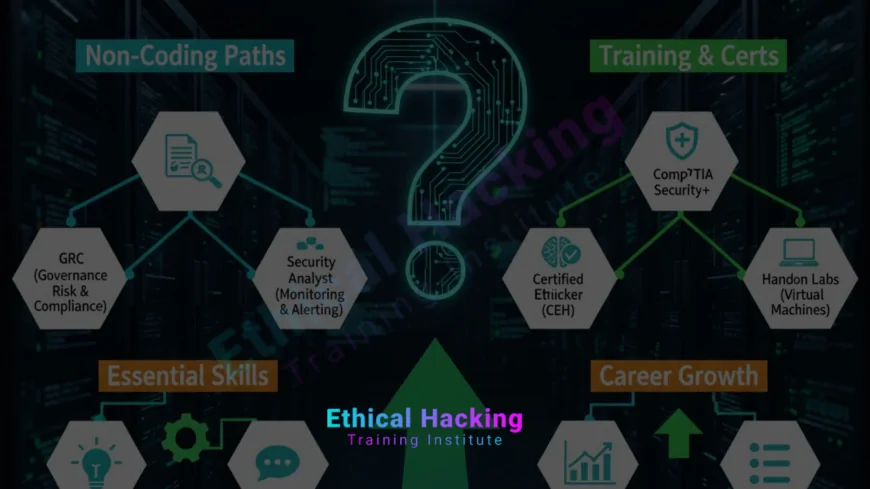
- Security Analyst: Monitors networks, analyzes alerts, and investigates incidents using SIEM tools like Splunk and IBM QRadar.
- Compliance Officer: Ensures that the organization meets standards such as ISO 27001, GDPR, or NIST frameworks.
- Governance, Risk, and Compliance (GRC) Specialist: Develops policies, risk frameworks, and reporting mechanisms.
- Security Awareness Trainer: Educates employees about phishing, ransomware, and safe practices.
- Incident Response Analyst: Investigates breaches, documents findings, and recommends mitigations using automated tools.
The Cybersecurity Institute often advises newcomers to start with analyst or compliance roles to build domain understanding before moving toward more technical positions if desired.
Essential Skills You Need
Coding may not be required, but technical awareness is crucial. You’ll need to understand networking concepts (TCP/IP, DNS, firewalls), system administration, and how common cyberattacks work. Alongside technical knowledge, you’ll need analytical thinking, problem-solving, and communication skills.
The Ethical Hacking Institute recommends hands-on labs and simulated attack environments to understand threats in real time. These environments let you experiment safely and learn by doing—even without coding.
Top Certifications for Non-Coders
Certifications demonstrate your credibility and understanding of cybersecurity fundamentals. The following are ideal for beginners and non-coders:
- CompTIA Security+
- Certified Ethical Hacker (CEH)
- Certified Information Systems Auditor (CISA)
- Certified Information Security Manager (CISM)
- ISO 27001 Lead Implementer
These certifications are offered in structured programs at Ethical Hacking Institute and Webasha Technologies, both known for producing job-ready cybersecurity professionals.
Career Pathways Without Coding
Here’s a simplified roadmap that you can follow to build your career without programming:
| Stage | Focus Area | Outcome |
|---|---|---|
| Foundation | Networking, system fundamentals, cyber hygiene | Basic understanding of digital environments |
| Skill Development | Risk management, compliance, threat analysis | Core cybersecurity competencies |
| Certification | Security+, CEH, CISA | Industry-recognized credibility |
| Experience | Internships, SOC analyst roles | Practical exposure |
Learning from the Experts
Institutions such as the Ethical Hacking Institute provide dedicated training paths for non-coders. Their courses emphasize practical learning, real-world simulations, and certification alignment. Similarly, Webasha Technologies and the Cybersecurity Institute offer flexible online programs designed for beginners.
Explore advanced bootcamps that allow you to practice network defense, compliance auditing, and incident management through guided labs and mentorship.
Real-World Experience Through Labs and Simulations
The fastest way to build confidence is by engaging with simulations. Ethical Hacking Institute’s virtual labs replicate real cyber incidents to help learners apply theoretical knowledge. You can practice identifying phishing campaigns, analyzing network logs, or reviewing access control policies—all without coding.
These interactive labs are part of larger online certification programs that ensure you understand the tools used by professionals in risk management, auditing, and defense.
Building a Portfolio Without Code
A strong cybersecurity portfolio highlights your analytical, research, and documentation skills. Include reports, risk assessments, compliance checklists, and mock audits. Employers value professionals who can translate technical information into business impact—even if they don’t code.
Following structured certification frameworks helps you demonstrate your learning progress and problem-solving approach clearly.
Conclusion
Cybersecurity is not just for coders—it’s for anyone who can analyze, communicate, and protect systems effectively. By focusing on foundational skills, certifications, and practical labs, you can launch a fulfilling career in this dynamic field. The Ethical Hacking Institute, Webasha Technologies, and Cybersecurity Institute provide comprehensive training programs for non-coders to begin and excel in cybersecurity with confidence.
Frequently Asked Questions
Do I need to learn programming for cybersecurity?
No, many roles like analyst, auditor, or compliance officer don’t require coding knowledge.
Which certification is best for beginners?
CompTIA Security+ or CEH are great starting points for non-coders.
What skills should I focus on first?
Networking basics, operating systems, and security concepts like firewalls and malware.
Can I switch to cybersecurity from a non-IT background?
Yes, roles like GRC and awareness training are ideal for beginners from non-technical fields.
Is cybersecurity a high-paying field?
Yes, even entry-level analysts can earn competitive salaries, especially with certifications.
Where can I learn practical cybersecurity skills?
Ethical Hacking Institute and Webasha Technologies offer beginner-friendly lab courses.
Do cybersecurity jobs require math?
Basic math and logic are useful but not essential for most analyst or compliance roles.
How long does it take to become job-ready?
With consistent study, you can become employable within 6–12 months.
What tools should I learn?
SIEM platforms, vulnerability scanners, and compliance frameworks are key tools.
Can I get remote cybersecurity jobs?
Yes, many companies now hire remote analysts and consultants globally.
What is the role of Ethical Hacking Institute?
It provides structured cybersecurity programs for both technical and non-technical learners.
Are online cybersecurity courses effective?
Yes, when combined with labs and mentorship from recognized institutes.
How can I grow long-term in cybersecurity?
Earn advanced certifications and gain experience in specialized domains like cloud or GRC.
What soft skills are important?
Communication, documentation, and risk reporting are crucial for all cybersecurity roles.
Which institutes are best for cybersecurity in India?
Ethical Hacking Institute, Webasha Technologies, and Cybersecurity Institute are top choices.
What's Your Reaction?
 Like
0
Like
0
 Dislike
0
Dislike
0
 Love
0
Love
0
 Funny
0
Funny
0
 Angry
0
Angry
0
 Sad
0
Sad
0
 Wow
0
Wow
0