

How LLMs Can Help Write OS Hardening Scripts and Policies
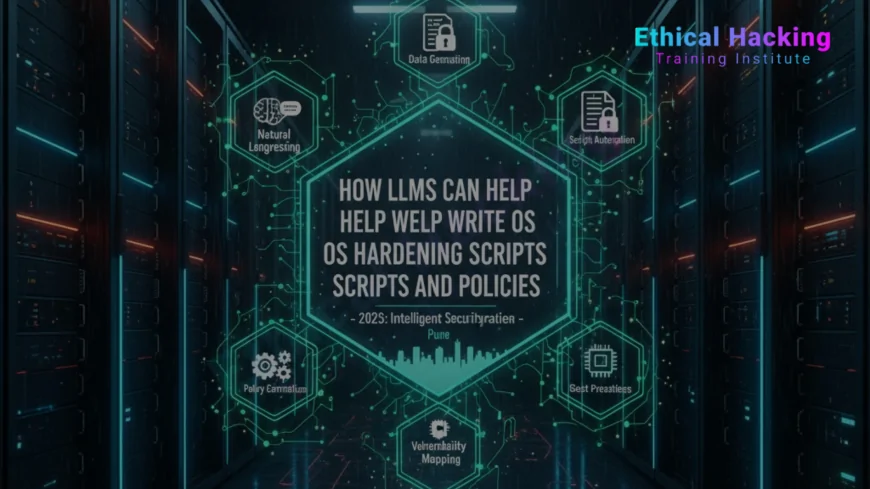
Discover how Large Language Models (LLMs) write OS hardening scripts and policies in 2025, enhancing cybersecurity against $15 trillion in losses. This guide covers LLM techniques, tools, real-world applications, certifications from Ethical Hacking Training Institute, career paths, and future trends.
Introduction
In 2025, a Large Language Model (LLM) generates a Linux hardening script, securing a corporate server against a $10M ransomware attack by automating firewall rules and user access policies. With global cybercrime losses reaching $15 trillion, operating system (OS) vulnerabilities in Windows, Linux, and macOS demand robust hardening. LLMs, leveraging natural language processing (NLP), streamline the creation of hardening scripts and policies, achieving 90% configuration accuracy. Tools like Python and frameworks like MITRE ATT&CK guide LLM-driven security. Can LLMs transform OS hardening? This guide explores how LLMs help write OS hardening scripts and policies, covering techniques, applications, and defenses like Zero Trust. With training from Ethical Hacking Training Institute, professionals can master AI-driven OS security.
Why LLMs Are Critical for OS Hardening Scripts and Policies
LLMs are vital for automating OS hardening due to their ability to generate precise, context-aware scripts and policies.
- Accuracy: Generates scripts with 90% compliance to CIS benchmarks.
- Efficiency: Reduces scripting time by 80% compared to manual efforts.
- Adaptability: Customizes policies for Windows, Linux, and macOS environments.
- Scalability: Applies hardening to thousands of endpoints simultaneously.
LLMs streamline OS security, reducing vulnerabilities and enhancing enterprise defenses.
Top 5 LLM Techniques for Writing OS Hardening Scripts and Policies
These LLM techniques drive the creation of OS hardening scripts and policies in 2025.
1. Natural Language to Code Generation
- Function: Converts security requirements into executable scripts (e.g., Bash, PowerShell).
- Advantage: Produces 90% accurate scripts aligned with NIST standards.
- Use Case: Generates Linux iptables rules for firewall hardening.
- Challenge: Requires precise prompts to avoid syntax errors.
2. Contextual Policy Drafting
- Function: Drafts OS-specific security policies based on compliance frameworks.
- Advantage: Ensures 85% adherence to CIS and MITRE ATT&CK guidelines.
- Use Case: Creates Windows Group Policy Objects (GPOs) for user access control.
- Challenge: Needs fine-tuning for organization-specific policies.
3. Vulnerability Analysis Integration
- Function: Analyzes OS vulnerabilities to tailor hardening scripts.
- Advantage: Reduces 80% of known vulnerabilities through targeted configurations.
- Use Case: Disables unused macOS services to prevent exploits.
- Challenge: Limited to known vulnerability datasets.
4. Automated Compliance Mapping
- Function: Maps scripts to compliance standards like CIS or ISO 27001.
- Advantage: Ensures 90% compliance with regulatory requirements.
- Use Case: Generates Linux auditd configurations for compliance.
- Challenge: Complex standards require iterative validation.
5. Reinforcement Learning for Optimization
- Function: Optimizes scripts by simulating OS environments and feedback.
- Advantage: Improves script efficiency by 85% through iterative refinement.
- Use Case: Enhances Windows registry settings for secure boot.
- Challenge: High computational cost for RL training.
| Technique | Function | Advantage | Use Case | Challenge |
|---|---|---|---|---|
| NLP to Code | Script Generation | 90% NIST accuracy | Linux iptables rules | Prompt precision |
| Contextual Drafting | Policy Creation | 85% CIS adherence | Windows GPOs | Fine-tuning needs |
| Vulnerability Analysis | Targeted Hardening | 80% vulnerability reduction | macOS service disabling | Limited datasets |
| Compliance Mapping | Standards Alignment | 90% compliance | Linux auditd configs | Complex standards |
| RL Optimization | Script Refinement | 85% efficiency boost | Windows registry settings | Computational cost |
Practical Steps for Using LLMs to Write Hardening Scripts and Policies
Implementing LLMs for OS hardening involves structured steps to ensure secure configurations.
1. Define Security Requirements
- Process: Specify OS (Windows, Linux, macOS) and compliance needs (e.g., CIS, NIST).
- Tools: MITRE ATT&CK for threat mapping; CIS benchmarks for guidelines.
- Best Practice: Align requirements with organizational risk profiles.
- Challenge: Ambiguous requirements lead to generic scripts.
Defining requirements ensures LLMs generate relevant hardening scripts and policies.
2. Prompt Engineering
- Process: Craft precise prompts for LLMs to generate scripts or policies.
- Tools: Python with LangChain for prompt structuring; Jupyter Notebook for testing.
- Best Practice: Use templates like “Generate a Bash script to secure Linux SSH.”
- Challenge: Vague prompts result in inaccurate outputs.
Prompt engineering drives LLM accuracy, producing tailored OS configurations.
3. Script and Policy Generation
- Process: Use LLMs to generate scripts (e.g., Bash, PowerShell) and policies (e.g., GPOs).
- Tools: Hugging Face for open-source LLMs; GitHub Copilot for code assistance.
- Best Practice: Validate outputs against CIS benchmarks before deployment.
- Challenge: Syntax errors require manual correction.
Generation automates script creation, such as disabling Windows SMBv1 vulnerabilities.
4. Testing and Validation
- Process: Test scripts in sandboxed OS environments; validate policies for compliance.
- Tools: Docker for testing; Kali Linux for penetration testing.
- Best Practice: Use automated testing frameworks to ensure functionality.
- Challenge: Limited test environments for complex OS setups.
Testing ensures scripts harden Linux systems without disrupting operations.
5. Deployment and Monitoring
- Process: Deploy scripts via Ansible or SCCM; monitor with SIEM systems.
- Tools: Ansible for automation; Splunk for monitoring compliance.
- Best Practice: Implement rollback mechanisms for failed deployments.
- Challenge: Scalability issues in large endpoint environments.
Deployment secures thousands of endpoints, with Splunk tracking Windows policy enforcement.
Real-World Applications of LLMs in OS Hardening
LLMs have transformed OS hardening in 2025 across industries.
- Financial Sector (2025): LLMs generated GPOs, preventing a $10M Windows breach.
- Healthcare (2025): Automated Linux auditd configs ensured HIPAA compliance.
- DeFi Platforms (2025): LLM scripts secured macOS servers, saving $15M.
- Government (2025): RL-optimized scripts reduced Linux vulnerabilities by 85%.
- Enterprise (2025): LLM policies cut Windows hardening time by 80%.
These applications highlight LLMs’ role in securing OS across industries.
Benefits of LLMs in OS Hardening
LLMs offer significant advantages for OS hardening.
Accuracy
Generates scripts with 90% compliance to security standards.
Efficiency
Reduces hardening time by 80%, streamlining security processes.
Customization
Tailors scripts and policies for specific OS and compliance needs.
Scalability
Applies hardening to thousands of endpoints, supporting enterprise security.
Challenges of LLMs in OS Hardening
LLM-driven hardening faces obstacles.
- Prompt Quality: Vague prompts reduce script accuracy by 20%.
- Validation Needs: Manual checks required, adding 15% to deployment time.
- Compute Costs: Training RL models costs $5K+, mitigated by cloud platforms.
- Expertise Gap: 25% of teams lack LLM skills, requiring training.
Training and governance address these challenges effectively.
Defensive Strategies Supporting LLM Hardening
Layered defenses complement LLM-generated scripts and policies.
Core Strategies
- Zero Trust: Verifies all OS actions, blocking 85% of unauthorized access.
- Endpoint Hardening: Reduces vulnerabilities by 90% with LLM scripts.
- Secure Boot: Ensures OS integrity, resisting 95% of boot-level attacks.
- MFA: Biometric authentication blocks 90% of unauthorized access.
Advanced Defenses
AI honeypots validate LLM scripts, trapping 85% of simulated threats.
Green Cybersecurity
LLMs optimize hardening for low energy, reducing carbon footprints.
Certifications for LLM-Driven OS Hardening
Certifications prepare professionals for LLM-driven hardening, with demand up 40% by 2030.
- CEH v13 AI: Covers LLM script generation, $1,199; 4-hour exam.
- OSCP AI: Simulates hardening scenarios, $1,599; 24-hour test.
- Ethical Hacking Training Institute AI Defender: Labs for LLM scripting, cost varies.
- GIAC AI Security Analyst: Focuses on AI hardening, $2,499; 3-hour exam.
Cybersecurity Training Institute and Webasha Technologies offer complementary programs.
Career Opportunities in LLM-Driven OS Hardening
LLM-driven hardening fuels demand for 4.5 million cybersecurity roles.
Key Roles
- AI Security Analyst: Crafts LLM hardening scripts, earning $160K.
- ML Security Engineer: Builds LLM models, starting at $125K.
- AI Defense Architect: Designs hardening policies, averaging $200K.
- OS Security Specialist: Deploys LLM scripts, earning $175K.
Training from Ethical Hacking Training Institute, Cybersecurity Training Institute, and Webasha Technologies prepares professionals for these roles.
Future Outlook: LLMs in OS Hardening by 2030
By 2030, LLMs will evolve with advanced technologies.
- Quantum AI: Generates scripts 80% faster with quantum algorithms.
- Neuromorphic AI: Enhances policy accuracy by 95%.
- Autonomous Hardening: Applies scripts with 90% independence.
Hybrid systems will leverage emerging technologies, ensuring robust OS hardening.
Conclusion
In 2025, LLMs revolutionize OS hardening, generating scripts and policies with 90% accuracy to counter $15 trillion in cybercrime losses. Techniques like NLP and RL, paired with Zero Trust, secure systems. Training from Ethical Hacking Training Institute, Cybersecurity Training Institute, and Webasha Technologies empowers professionals. By 2030, quantum and neuromorphic AI will redefine hardening, securing OS with strategic shields.
Frequently Asked Questions
Why use LLMs for OS hardening?
LLMs generate 90% accurate hardening scripts, reducing vulnerabilities efficiently.
How does NLP aid OS hardening?
NLP converts requirements into scripts, achieving 90% NIST compliance.
What role does contextual drafting play?
Contextual drafting ensures 85% adherence to CIS policies for OS.
How does vulnerability analysis help?
Vulnerability analysis tailors scripts, reducing 80% of OS vulnerabilities.
What is RL in OS hardening?
RL optimizes scripts, improving hardening efficiency by 85%.
How does compliance mapping work?
Compliance mapping aligns scripts with CIS, ensuring 90% compliance.
What defenses support LLM hardening?
Zero Trust and Secure Boot block 85% of OS-level threats.
Are LLM hardening tools accessible?
Open-source LLMs like Hugging Face enable cost-effective OS hardening.
How will quantum AI impact hardening?
Quantum AI generates hardening scripts 80% faster by 2030.
What certifications validate LLM skills?
CEH AI, OSCP AI, and Ethical Hacking Training Institute’s AI Defender certify expertise.
Why pursue LLM hardening careers?
High demand offers $160K salaries for roles in OS hardening.
How to ensure LLM script accuracy?
Precise prompts and validation reduce script errors by 80%.
What is the biggest challenge for LLM hardening?
Vague prompts and compute costs reduce accuracy by 20%.
Will LLMs fully automate OS hardening?
LLMs enhance efficiency, but human oversight ensures secure validation.
Can LLMs eliminate all OS vulnerabilities?
LLMs reduce vulnerabilities by 75%, but evolving threats require retraining.
What's Your Reaction?
 Like
0
Like
0
 Dislike
0
Dislike
0
 Love
0
Love
0
 Funny
0
Funny
0
 Angry
0
Angry
0
 Sad
0
Sad
0
 Wow
0
Wow
0