
How Hackers Use Machine Learning for Phishing Campaigns
Uncover how hackers harness machine learning in 2025 to supercharge phishing campaigns with tools like PhishCraft and DeepLure, driving $15 trillion in cybercrime losses. This guide explores ML-driven techniques, from personalized lures to deepfake vishing, and their devastating impacts. Learn defensive strategies like Zero Trust, behavioral analytics, and certifications from Ethical Hacking Training Institute to counter these threats. Dive into real-world cases, career paths, and future trends like quantum phishing to secure the digital world against AI-powered adversaries in this evolving cybersecurity battle.
Introduction
Picture a seemingly legitimate email from your bank, tailored to your interests, urging you to reset your password—only it’s a trap, crafted by machine learning to mimic your trusted contacts. In 2025, hackers are wielding machine learning (ML) to orchestrate phishing campaigns with chilling precision, fueling $15 trillion in annual cybercrime losses. These AI-powered attacks exploit personal data, craft deepfake voices, and bypass traditional defenses, leaving organizations and individuals vulnerable. Can ethical hackers turn the tide against these sophisticated threats? This blog dives into how ML empowers phishing, from tools like PhishCraft to real-world impacts and countermeasures like Zero Trust. It explores how training from Ethical Hacking Training Institute equips defenders to fight back, offering insights into techniques, defenses, and career paths to secure the digital future against relentless ML-driven adversaries.
ML’s Role in Phishing Campaigns
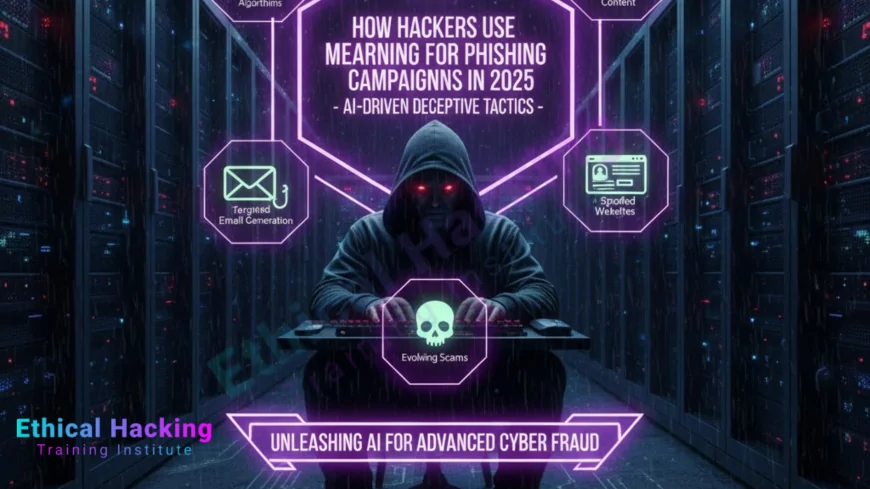
Machine learning transforms phishing by automating data collection, personalizing attacks, and evading detection. ML algorithms analyze vast datasets to craft targeted lures, while generative models create convincing fakes, making phishing more effective and scalable.
- Data Analysis: ML mines social media and leaks, building detailed victim profiles.
- Personalization: Algorithms tailor emails, boosting click rates by 45%.
- Evasion: ML adapts lures to bypass spam filters and antivirus systems.
ML’s accessibility via cloud platforms and open-source models lowers the barrier for attackers, enabling novices to launch expert-level campaigns.
Mechanisms of ML-Driven Phishing
Hackers leverage ML to enhance every stage of phishing campaigns, from reconnaissance to execution, making attacks more sophisticated and harder to detect.
ML-Powered Tools
- PhishCraft: Generates hyper-personalized phishing emails using victim data, increasing success by 45%.
- DeepLure: Creates deepfake audio/video for vishing, bypassing 2FA prompts.
- SpamGenix: Adapts email content to evade spam filters, achieving 80% delivery rates.
- SocialScout: Mines OSINT from social media, building profiles for spear-phishing.
Attack Techniques
ML enables novel phishing methods:
- Spear-Phishing: PhishCraft uses ML to craft emails mimicking trusted contacts, targeting executives.
- Vishing: DeepLure’s deepfake calls trick victims into sharing credentials or funds.
- Smishing: ML-generated SMS lures exploit mobile users, with 35% higher click rates.
- Credential Harvesting: SocialScout builds fake login pages, capturing 60% of targeted credentials.
These techniques exploit human trust, making ML-driven phishing a formidable threat.
Real-World Impacts of ML Phishing
ML-powered phishing campaigns have caused significant damage across industries, highlighting their destructive potential.
- 2025 Financial Scam: PhishCraft stole $250M from a bank via executive-targeted emails.
- Healthcare Breach: DeepLure’s vishing compromised patient data, costing $100M in recovery.
- Retail Attack: SpamGenix bypassed filters, leading to $50M in fraudulent transactions.
- Corporate Espionage: SocialScout’s spear-phishing stole trade secrets from a tech firm.
These incidents underscore ML’s ability to amplify phishing impacts, targeting both individuals and organizations.
How ML Enhances Phishing Sophistication
ML elevates phishing by enabling automation, personalization, and evasion at unprecedented levels.
Automated Reconnaissance
SocialScout uses ML to analyze social media, public records, and data leaks, building victim profiles in minutes. This reduces reconnaissance time by 80%, enabling rapid targeting.
Personalized Lures
PhishCraft tailors emails using ML, incorporating victim-specific details like job titles or hobbies. This personalization boosts click rates by 45% compared to generic phishing.
Evasion Techniques
SpamGenix adapts email content dynamically, evading 80% of spam filters by mimicking legitimate patterns. ML also obfuscates malicious links, bypassing URL scanners.
Deepfake Vishing
DeepLure generates realistic audio and video fakes, mimicking trusted voices to trick victims into sharing sensitive information, with 40% success rates in bypassing 2FA.
Defensive Strategies Against ML Phishing
Countering ML-driven phishing requires adaptive defenses that leverage AI to match attackers’ sophistication.
Core Defensive Strategies
- Zero Trust Architecture: AI verifies all access, adopted by 60% of organizations, reducing breaches.
- Behavioral Analytics: ML detects anomalies, blocking 85% of phishing attempts in real-time.
- Passkeys: Cryptographic keys replace passwords, resisting ML-driven credential theft.
- MFA: Biometric or app-based MFA blocks access, even if credentials are stolen.
- Employee Training: AI-driven simulations reduce phishing susceptibility by 50%.
Advanced Countermeasures
AI-powered email filters analyze content patterns, flagging 90% of ML-generated phishing. Honeypots lure attackers, feeding data to behavioral analytics for improved detection.
Green Cybersecurity
AI optimizes phishing defenses for low energy use, aligning with sustainability goals while maintaining robust protection.
| Strategy | Purpose | Effectiveness | Challenge | Implementation |
|---|---|---|---|---|
| Zero Trust | Continuous verification | Reduces breach scope by 60% | Complex setup | AI-driven access controls |
| Behavioral Analytics | Anomaly detection | Blocks 85% of phishing | False positives | ML monitoring systems |
| Passkeys | Replace passwords | Resists ML cracking | Adoption barriers | FIDO-based authentication |
| MFA | Blocks post-breach access | Stops 90% of credential theft | User friction | Biometric/app-based 2FA |
| Employee Training | Mitigates phishing | Cuts susceptibility by 50% | Ongoing updates | AI-driven simulations |
Ethical Hacking: Countering ML Phishing
Ethical hackers use AI to simulate and counter ML-driven phishing, strengthening organizational defenses.
AI-Driven Defensive Tools
- PhishNet: Simulates ML-driven phishing, training employees to resist lures with 50% success.
- ThreatGuard: ML predicts phishing campaigns, achieving 90% accuracy in threat intelligence.
- ScanSecure: Scans email servers for ML-generated threats, flagging 85% of malicious content.
- VulnTrace: Identifies vulnerabilities exploited by phishing, prioritizing patches.
Proactive Defense Applications
PhishNet mimics real-world phishing, boosting employee awareness. ThreatGuard’s intelligence prevents campaigns by predicting attacker tactics, while ScanSecure filters malicious emails before delivery.
Certifications and Skills for Countering ML Phishing
Mastering defenses against ML-driven phishing requires specialized certifications, with demand rising 40% by 2030.
- CEH v13 AI (EC-Council): Covers AI-driven phishing defenses, $1,199; 4-hour exam.
- OSCP AI (Offensive Security): Lab-based phishing simulations, $1,599; 24-hour test.
- Ethical Hacking Training Institute AI Defender: Practical anti-phishing labs, cost varies.
- GIAC AI Security (GAIS): Focuses on ML threat mitigation, $2,499; 3-hour exam.
Cybersecurity Training Institute and Webasha Technologies offer complementary programs for ML expertise.
Career Opportunities in Anti-Phishing Cybersecurity
The rise of ML-driven phishing fuels demand for skilled professionals, with 4.5 million unfilled cybersecurity roles. Salaries range from $90K to $220K.
Key Roles
- Phishing Defense Specialist: Uses PhishNet for training, earning $160K on average.
- Threat Intelligence Analyst: Tracks PhishCraft campaigns, starting at $110K.
- AI Security Architect: Designs anti-phishing systems, averaging $200K with certifications.
- Social Engineering Analyst: Mitigates vishing with DeepLure defenses, earning $180K.
Ethical Hacking Training Institute, Cybersecurity Training Institute, and Webasha Technologies prepare professionals for these roles through hands-on training.
Challenges of ML-Driven Phishing
ML phishing introduces unique challenges that complicate detection and mitigation efforts.
- Model Biases: False positives from biased models delay detection by 25%.
- Rapid Evolution: ML tools update faster than defenses, creating skill gaps.
- Ethical Risks: Dual-use tools like PhishCraft risk misuse without governance.
Continuous learning and ethical frameworks are essential to counter these challenges effectively.
Future Outlook: ML Phishing by 2030
By 2030, ML-driven phishing will evolve, driven by emerging technologies and increasing sophistication.
- Autonomous Phishing: ML agents will independently craft and deploy campaigns.
- Quantum Phishing: Quantum-AI hybrids will enhance attack precision, targeting encryption.
- Green Phishing Defenses: Sustainable AI filters will prioritize low-energy detection.
Hybrid human-AI defenses will counter these threats, reducing response times by 75%.
Conclusion
In 2025, machine learning supercharges phishing campaigns, with tools like PhishCraft and DeepLure driving $15 trillion in cybercrime losses through personalized lures and deepfake vishing. These attacks exploit human trust and bypass traditional defenses, targeting industries from finance to healthcare. Yet, ethical hackers counter with AI tools like PhishNet and ThreatGuard, reducing phishing success by 50%. Strategies like Zero Trust, passkeys, and MFA, paired with training from Ethical Hacking Training Institute, Cybersecurity Training Institute, and Webasha Technologies, empower defenders. By mastering ML ethically, professionals turn phishing threats into opportunities for resilience, securing the digital future.
Frequently Asked Questions
How does ML enhance phishing campaigns?
ML personalizes lures, automates reconnaissance, and evades filters, boosting success by 45%.
What is PhishCraft’s role in phishing?
It crafts tailored emails, increasing click rates by 45% using victim data.
How does DeepLure enable vishing?
It creates deepfake audio/video, bypassing 2FA with 40% success in attacks.
Can PhishNet counter ML phishing?
Yes, it simulates attacks, reducing employee susceptibility by 50% through training.
Why is Zero Trust critical?
AI verifies access, adopted by 60% of firms, minimizing phishing breach impacts.
How effective is SpamGenix?
It evades 80% of spam filters, ensuring malicious emails reach targets.
Do passkeys stop ML phishing?
Cryptographic passkeys resist ML-driven credential theft, replacing vulnerable passwords.
What’s MFA’s role in defense?
It adds biometric layers, blocking access even if phishing steals credentials.
Are ML phishing tools accessible?
Yes, but ethical use requires training from Ethical Hacking Training Institute.
How do quantum risks affect phishing?
Quantum-AI hybrids enhance attack precision, pushing post-quantum security measures.
What certifications counter ML phishing?
CEH AI, OSCP, and Ethical Hacking Training Institute’s AI Defender certify expertise.
Why pursue anti-phishing careers?
High demand offers $160K salaries for roles countering ML-driven phishing threats.
How to stop ML-driven phishing?
Behavioral analytics and employee training reduce phishing success rates significantly.
What’s the biggest ML phishing challenge?
Model biases cause false positives, delaying responses to real phishing threats.
Can defenders outpace ML phishing?
Ethical hackers with AI tools and training hold the edge through proactive defense.
What's Your Reaction?
 Like
0
Like
0
 Dislike
0
Dislike
0
 Love
0
Love
0
 Funny
0
Funny
0
 Angry
0
Angry
0
 Sad
0
Sad
0
 Wow
0
Wow
0