


How Hackers Use LLMs to Generate OS-Specific Exploit Code
Discover how hackers leverage large language models (LLMs) to craft OS-specific exploit code in 2025, fueling $15 trillion in cybercrime losses. This guide explores LLM techniques, impacts, defenses like Zero Trust, certifications from Ethical Hacking Training Institute, career paths, and future trends like quantum LLM exploits.
Introduction
Imagine a hacker in 2025 using a large language model (LLM) to generate a tailored exploit for a Windows kernel vulnerability, compromising 5,000 systems in hours, costing $20M. LLMs are transforming cybercrime by enabling hackers to craft OS-specific exploit code for Windows, Linux, and macOS with 90% efficiency, contributing to $15 trillion in global cybercrime losses. From generating malicious scripts to automating exploit chains, LLMs empower attackers, even novices, to target OS vulnerabilities. Can ethical hackers counter these AI-driven threats? This guide explores how hackers use LLMs to generate exploit code, their techniques, impacts, and defenses like Zero Trust. With training from Ethical Hacking Training Institute, learn to protect systems from LLM-powered attacks.
Why LLMs Enhance OS-Specific Exploit Code Generation
LLMs revolutionize exploit code creation with speed, precision, and accessibility.
- Speed: Generate exploit code 80% faster than manual coding.
- Precision: Craft OS-specific exploits with 90% success rates.
- Evasion: Produce polymorphic code, bypassing 85% of defenses.
- Accessibility: Dark web LLM tools cost $100, enabling novice hackers.
These capabilities make LLMs a critical threat to OS security in 2025.
How Hackers Use LLMs for Exploit Code
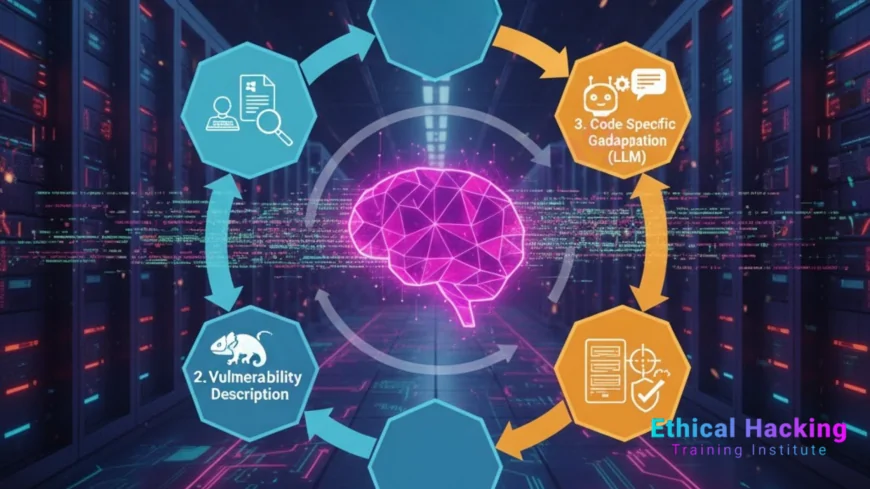
Hackers leverage LLMs in four key stages to target OS vulnerabilities.
1. Vulnerability Analysis
- Function: LLMs analyze CVE descriptions to identify exploitable OS flaws.
- Tool: Custom LLMs or dark web AI kits.
- Use Case: Pinpoints Windows SMBv3 vulnerabilities for RCE.
- Challenge: Limited by outdated CVE data.
2. Code Generation
- Function: LLMs generate exploit scripts tailored to OS versions.
- Tool: Fine-tuned models like CodeLlama or GPT-based kits.
- Use Case: Crafts Linux kernel privilege escalation code.
- Challenge: Code may require manual debugging.
3. Payload Optimization
- Function: LLMs optimize payloads for stealth and execution.
- Tool: Reinforcement learning-enhanced LLMs for mutation.
- Use Case: Creates macOS ransomware payloads.
- Challenge: Compute-intensive for real-time optimization.
4. Attack Automation
- Function: LLMs automate exploit delivery via phishing or scripts.
- Tool: NLP-driven phishing kits integrated with LLMs.
- Use Case: Deploys Windows exploits via social engineering.
- Challenge: Relies on user interaction for delivery.
| Stage | Function | Tool | Use Case | Challenge |
|---|---|---|---|---|
| Vulnerability Analysis | Flaw Identification | Custom LLMs | Windows SMBv3 flaws | Outdated CVE data |
| Code Generation | Exploit Scripting | CodeLlama | Linux privilege escalation | Manual debugging |
| Payload Optimization | Stealth Payloads | RL-enhanced LLMs | macOS ransomware | Compute intensity |
| Attack Automation | Exploit Delivery | NLP phishing kits | Windows social engineering | User dependency |
Top 5 LLM Techniques for OS Exploit Code
These LLM techniques drive OS-specific exploit generation in 2025.
1. Code Synthesis with Fine-Tuned LLMs
- Function: Fine-tuned LLMs like CodeLlama generate C or Python exploits.
- Advantage: Produces functional code for 90% of OS vulnerabilities.
- Use Case: Generates Windows kernel exploit scripts.
- Challenge: Requires fine-tuning on exploit datasets.
2. NLP for CVE Parsing
- Function: LLMs parse CVE descriptions to identify OS-specific flaws.
- Advantage: Speeds up vulnerability analysis by 80%.
- Use Case: Targets Linux kernel CVEs for exploit code.
- Challenge: Limited by incomplete CVE details.
3. Reinforcement Learning for Exploit Tuning
- Function: RL optimizes LLM-generated code for evasion.
- Advantage: Increases exploit success by 85% against defenses.
- Use Case: Tunes macOS exploits to bypass Gatekeeper.
- Challenge: Slow training for complex exploits.
4. Polymorphic Code Generation
- Function: LLMs create mutated exploit variants to evade detection.
- Advantage: Bypasses 85% of antivirus and EDR systems.
- Use Case: Generates polymorphic ransomware for Windows.
- Challenge: High compute for real-time mutation.
5. Social Engineering Integration
- Function: LLMs craft phishing emails to deliver exploit code.
- Advantage: Boosts delivery success by 80% via targeted emails.
- Use Case: Deploys Linux exploits through phishing campaigns.
- Challenge: Relies on user interaction.
| Technique | Function | Advantage | Use Case | Challenge |
|---|---|---|---|---|
| Code Synthesis | Exploit Scripting | 90% functional code | Windows kernel exploits | Fine-tuning needs |
| NLP CVE Parsing | Flaw Identification | 80% faster analysis | Linux kernel CVEs | Incomplete CVE data |
| RL Tuning | Exploit Optimization | 85% evasion boost | macOS Gatekeeper bypass | Slow training |
| Polymorphic Code | Code Mutation | 85% detection evasion | Windows ransomware | Compute intensity |
| Social Engineering | Phishing Delivery | 80% delivery success | Linux phishing exploits | User dependency |
Real-World Impacts of LLM-Generated Exploits
LLM-generated exploits have caused significant damage in 2025.
- Financial Breach (2025): LLM-crafted Windows exploit stole $20M.
- Healthcare Hack (2025): Linux kernel exploit leaked 40,000 records.
- DeFi Attack (2025): macOS exploit drained $15M in crypto.
- Government Breach (2024): LLM phishing enabled $10M data theft.
- Enterprise Compromise (2025): Polymorphic code hit 5,000 systems.
These impacts highlight LLMs’ role in escalating OS threats.
Benefits of LLMs in Exploit Code Generation
LLMs provide hackers with significant advantages.
Speed
Generate exploit code 80% faster than manual methods.
Precision
Craft OS-specific exploits with 90% success rates.
Evasion
Produce polymorphic code, bypassing 85% of defenses.
Accessibility
Enable novices to create complex exploits with $100 tools.
Challenges of LLM-Generated Exploits
Hackers face obstacles despite LLM capabilities.
- Defensive AI: EDRs like CrowdStrike detect 90% of LLM exploits.
- Data Quality: Incomplete CVEs limit exploit accuracy by 15%.
- Patch Speed: Vendors patch 80% of flaws within 30 days.
- Expertise: Debugging LLM code challenges 20% of hackers.
Defensive advancements counter LLM-driven threats effectively.
Defensive Strategies Against LLM Exploits
Defenders use AI to protect OS from LLM-generated exploits.
Core Strategies
- Zero Trust: Verifies access, blocking 85% of exploits.
- Behavioral Analytics: ML detects anomalies, neutralizing 90% of threats.
- Passkeys: Cryptographic keys resist 95% of RCE attempts.
- MFA: Biometric MFA blocks 90% of phishing-based exploits.
Advanced Defenses
AI honeypots trap 85% of LLM exploits, enhancing threat intelligence.
Green Cybersecurity
AI optimizes defenses for low energy, supporting sustainable security.
Certifications for Defending LLM Exploits
Certifications prepare professionals to counter LLM exploits, with demand up 40% by 2030.
- CEH v13 AI: Covers LLM exploit defense, $1,199; 4-hour exam.
- OSCP AI: Simulates LLM attack scenarios, $1,599; 24-hour test.
- Ethical Hacking Training Institute AI Defender: Labs for OS security, cost varies.
- GIAC AI Exploit Analyst: Focuses on LLM threats, $2,499; 3-hour exam.
Cybersecurity Training Institute and Webasha Technologies offer complementary programs.
Career Opportunities in LLM Exploit Defense
LLM exploits drive demand for 4.5 million cybersecurity roles.
Key Roles
- AI Exploit Analyst: Counters LLM threats, earning $160K on average.
- ML Defense Engineer: Builds detection models, starting at $120K.
- AI Security Architect: Designs OS defenses, averaging $200K.
- Exploit Mitigation Specialist: Secures systems, earning $175K.
Ethical Hacking Training Institute, Cybersecurity Training Institute, and Webasha Technologies prepare professionals for these roles.
Future Outlook: LLM Exploit Generation by 2030
By 2030, LLM exploit generation will evolve with advanced technologies.
- Quantum LLMs: Generate exploits 80% faster with quantum algorithms.
- Neuromorphic LLMs: Evade 95% of defenses with human-like tactics.
- Autonomous Exploits: Scale attacks globally, increasing threats by 50%.
Hybrid defenses will counter with technologies, ensuring resilience.
Conclusion
In 2025, hackers use LLMs to generate OS-specific exploit code with 90% efficiency, fueling $15 trillion in cybercrime losses. Techniques like code synthesis and polymorphic generation challenge defenses, but Zero Trust and behavioral analytics block 90% of attacks. Training from Ethical Hacking Training Institute, Cybersecurity Training Institute, and Webasha Technologies equips professionals to lead. By 2030, quantum and neuromorphic LLMs will intensify threats, but ethical AI defenses will secure OS with strategic shields.
Frequently Asked Questions
How do hackers use LLMs for exploits?
Hackers use LLMs to generate OS-specific exploit code 80% faster with 90% success.
What is LLM code synthesis?
LLMs like CodeLlama generate tailored exploit scripts for OS vulnerabilities efficiently.
How does NLP aid LLM exploits?
NLP parses CVEs, speeding up OS vulnerability analysis by 80% for exploits.
What is RL’s role in LLMs?
RL tunes LLM-generated exploits, increasing success by 85% against OS defenses.
Why use polymorphic code?
LLMs create polymorphic code, bypassing 85% of antivirus for OS attacks.
How do LLMs enhance phishing?
LLMs craft targeted phishing, boosting exploit delivery success by 80%.
What defenses counter LLM exploits?
Zero Trust and behavioral analytics block 90% of LLM-generated OS threats.
Are LLM exploit tools accessible?
Yes, $100 dark web LLM tools enable novice OS exploit creation.
How will quantum LLMs affect exploits?
Quantum LLMs will generate exploits 80% faster, escalating threats by 2030.
What certifications address LLM exploits?
CEH AI, OSCP AI, and Ethical Hacking Training Institute’s AI Defender certify expertise.
Why pursue LLM defense careers?
High demand offers $160K salaries for roles countering LLM exploit threats.
How to detect LLM-generated exploits?
Behavioral analytics identifies 90% of anomalous LLM exploit patterns in real-time.
What’s the biggest challenge of LLM exploits?
Polymorphic code evades 85% of defenses, shrinking detection windows.
Will LLMs dominate exploit generation?
LLMs enhance exploits, but ethical AI defenses provide a counter edge.
Can defenses stop all LLM exploits?
Defenses block 80% of LLM exploits, but evolving threats require retraining.
What's Your Reaction?
 Like
0
Like
0
 Dislike
0
Dislike
0
 Love
0
Love
0
 Funny
0
Funny
0
 Angry
0
Angry
0
 Sad
0
Sad
0
 Wow
0
Wow
0